

Three agents give the same homeowner nearly the same price. Only one walks out with the listing. More often than not, it isn't the one with the highest number, but the one who showed the seller what their living room would look like online.
Home staging for real estate agents is no longer reserved for luxury listings: with virtual staging, every listing can get it for a few euros. That leaves the questions this guide answers one by one: which model to offer, who pays for staging, what belongs in the listing agreement, and how to pitch it to the seller so it becomes a reason to sign rather than one more cost.
What you'll learn in this guide:
- The three ways an agent can handle home staging: referrer, provider, or producer
- How to choose between physical staging and virtual staging by home, budget, and timeline
- Who pays for staging (seller, agent, or offered with an exclusive listing), with NAR's 2025 numbers
- How to pitch staging at the listing appointment, objections included
- The disclosure to add to your listings and the workflow to set up on your team
Home staging for real estate agents: three ways to work it
Home staging means getting a home ready for sale: decluttering, depersonalizing, furnishing, or redecorating so buyers can picture themselves living there. An agent can be involved at three levels, and that choice drives everything else: the bill, the liability, and the sales pitch.
The referrer: you recommend a home stager
You point the seller to an independent home stager you trust. The contract is between the seller and the stager, who bills the seller directly. You collect nothing and you are not responsible for the result.
It is the simplest model, and the most fragile: the seller has to pay before the home is even on the market, and many say no. It fits expensive, vacant, or very dated homes, where the difference in presentation justifies the spend.
The provider: staging included in your listing package
You build staging into your listing package: a prep checklist for the seller, a partner stager you pay for, or both. It becomes part of your marketing, like professional photos or syndication to the listing portals, and you fund it from your commission.
The producer: virtual staging done in-house
You photograph the home, then furnish, restyle, or empty the rooms digitally. No furniture moves: only the listing photos change. This is the model AI has made mainstream, because its cost lets you apply it to every listing, occupied homes included. Our complete guide to virtual staging walks through the method step by step.
Physical staging or virtual staging: which one to offer?
They are not rivals: they solve different problems. Physical staging changes the home buyers walk through. Virtual staging changes the photos that get them through the door. An agent wins by knowing both and recommending the right one.
| Criterion | Physical home staging | Virtual staging |
|---|---|---|
| What changes | the home itself | the listing photos |
| Typical cost | $1,500 median for a staging service (NAR) | a few euros per photo |
| Timeline | several days, furniture to deliver | a few minutes |
| Occupied home | possible, with the seller's agreement | possible, with virtual decluttering |
| Showings | buyers see the staged rooms | buyers see the real rooms |
| Best for | vacant upscale homes, very dated homes | every listing, vacant or cluttered first |
The cost figure comes from the 2025 Profile of Home Staging by the National Association of Realtors: a median of $1,500 when the seller uses a staging service, and $500 when the seller's agent handles the staging themselves. Neither amount is something most agents can absorb on every listing.
Virtual staging changes that math. An empty room is furnished in seconds, a cluttered living room is cleared with virtual decluttering, and you can show several styles for the same home. The one honest limit: buyers who tour the home see the real room. Virtual staging earns the showing; it doesn't replace a clean, presentable home on showing day.
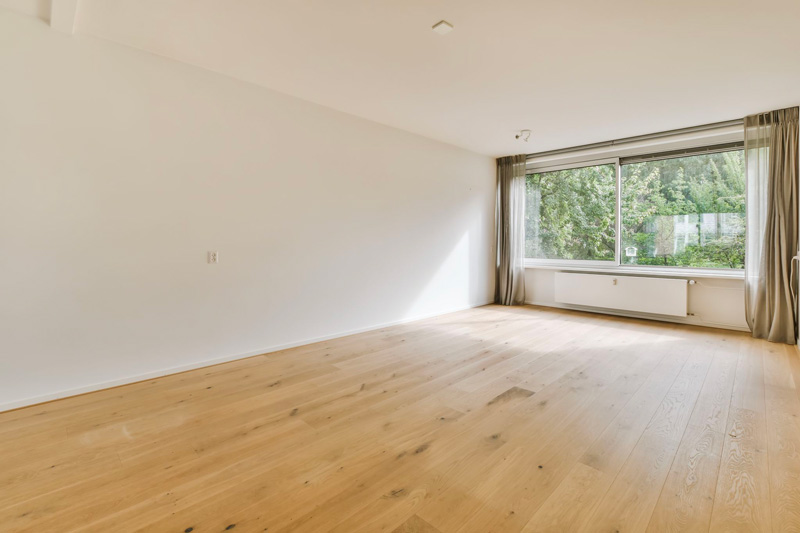
 Before and after: an empty living room furnished with virtual staging. AI-generated staging, to be labeled as such in the listing
Who pays for staging: the seller, the agent, or nobody?
It is the question every seller asks, and no rule settles it. Three arrangements coexist, each with its own consequences.
The seller pays a home stager directly
This is the classic arrangement for physical staging. The seller signs the stager's proposal and pays it whether or not the home sells. You can help choose the stager, but keep the money flowing between them, not through you.
The agent pays, and why it goes in the listing agreement
According to NAR's 2025 report, 23% of sellers' agents personally offer to stage the home, 17% say the seller pays, and 26% say it depends on the situation. There is no standard, so the arrangement has to be explicit. Spell out in the listing agreement who pays for staging, what is included, and whether the seller owes anything back if they cancel the listing early. A surprise invoice at closing is the fastest way to lose a referral.
With physical staging, paying out of pocket is a real bet and only makes sense on a few listings. With virtual staging, the cost is marginal next to a commission: IACrea pricing works on a monthly photo volume, not per job.
Offered with an exclusive listing
This is the most common arrangement among agents who use staging as a selling point: staging is included when the seller signs an exclusive right-to-sell listing agreement. It works for both sides. The seller gets a polished presentation without paying up front; you get the exclusivity period you need to earn your investment back.
Staging as a listing tool: how to pitch it to the seller
Sellers don't want staging. They want to sell fast, at the right price, without wasted showings. So pitch staging by what it produces. NAR's 2025 report gives you the numbers: 49% of sellers' agents said staging reduced time on market, and 29% saw offers 1% to 10% higher than on comparable homes that were not staged. We break these figures down, limits included, in our article on virtual staging ROI.
Show the seller's room, not a portfolio
A deck of examples convinces less than a single photo of the seller's own living room, taken during the walkthrough and staged in front of them. The seller stops comparing agents on price and starts seeing what their home will look like in the listing. We describe the same effect in our guide to the CMA and home valuation report: an image you produce during the appointment outweighs a promise made for after the signature.

 The seller's living room, photographed during the appointment and then cleared virtually: an AI-generated preview, to be presented as such
Three objections and how to answer them
“My house looks great the way it is.” Don't argue about the seller's taste: talk about the buyer. Buyers tour online first, on a thumbnail a couple of inches wide, and need to picture their own life there, not the seller's. Virtual staging doesn't touch the home: it creates neutral photos.
“I don't want to pay before it sells.” Nobody is asking them to. If you include staging in your package, the seller pays nothing up front, and the listing agreement says so in writing.
“Buyers will feel misled.” Not if the listing says so. A label next to each photo and one unaltered photo of the room are enough: buyers arrive knowing what they will see, and the showing is better qualified.
The disclosure: what to write in your listing
Virtual staging is legal. What is regulated is honesty. Article 12 of the NAR Code of Ethics requires REALTORS® to “present a true picture in their advertising.” In California, AB 723 (Business and Professions Code § 10140.8), operative since January 1, 2026, requires agents to disclose digitally altered listing images conspicuously and to give access to the unaltered original. MLS rules vary by MLS, so check yours.
Three habits cover you:
- a label next to each staged image, such as “Virtually staged”;
- at least one unaltered photo of every staged room;
- no edits to anything permanent: defects, views, layout, or the neighbors.
Our article is virtual staging legal, and should you disclose it? covers the wording and the edge cases.
Setting up staging on your team: workflow and responsibilities
Staging offered on one listing in ten is an anecdote. To make it part of your offer, you need a workflow every agent on the team follows the same way:
- During the walkthrough: photograph the two or three main rooms in natural light, with the windows behind you.
- Before you leave: show the seller one room virtually furnished or cleared, and explain your staging model (included with an exclusive listing, for example).
- At signing: have the seller approve the style and the list of rooms to stage.
- At launch: publish the staged photos with their label, plus the original photo of each room.
- After closing: add the before and after to your portfolio.
On responsibilities, name one person who approves every image before it goes live: they check that no defect has disappeared. And keep a consistent style from one listing to the next so your listings are recognizable. Our before and after examples show results room by room.
Measuring what staging brings your business
Judge staging on three numbers you already track, or should:
- your listing appointment conversion rate, and the share of exclusive listings, before and after you introduce the offer;
- the time from going live to the first showing, which measures the photos directly;
- your list-to-sale price ratio, compared with your own median.
Six months is enough to read a trend for a mid-sized team. If your exclusive listings go up, staging has done its sales job, even when its effect on price is hard to isolate. A floor plan produced during the walkthrough plays the same role, as we explain in the floor plan as a tool to win exclusive listings.
FAQ
Do real estate agents offer home staging? More and more do, in one of three ways: some refer sellers to an independent home stager, some include a staging service in their listing package, and some virtually stage the listing photos themselves. Ask the agent which model they use, and who pays for it.
Who pays for staging when you sell with an agent? There is no fixed rule. In NAR's 2025 Profile of Home Staging, 23% of sellers' agents said they personally offer to stage the home, 17% said the seller pays, and 26% said it depends on the situation. Whatever the model, write it into the listing agreement.
How much does home staging cost an agent? NAR's 2025 survey puts the median cost of a staging service at $1,500, against $500 when the seller's agent stages the home themselves. Virtual staging costs a few euros per photo, which lets an agent offer it on every listing instead of only on hard-to-sell homes.
Do you have to disclose virtual staging in a listing? Yes. NAR's Code of Ethics requires REALTORS® to present a true picture in their advertising, and since January 1, 2026, California requires a conspicuous disclosure and access to the original image for digitally altered listing photos. A “Virtually staged” label next to each staged photo, plus one unaltered photo of the room, covers you and your seller.
Does staging help an agent win an exclusive listing? It is one of its best uses: a seller who sees their own living room staged during the listing appointment compares a marketing plan, not just a price. Offering staging with an exclusive right-to-sell agreement also gives the agent the time needed to earn the cost back.
Conclusion
Home staging for real estate agents is no longer a budget question but a choice of model: refer, include, or produce it yourself. Virtual staging makes the third option possible on every listing, as long as you label it and agree in writing on who pays for staging. Shown at the listing appointment, on the seller's own room, it becomes what it should be for an agent: a reason to sign. Try IACrea virtual staging on the photos from your next listing appointment.
About the author

Co-founder & CTO of IACrea
Constance Laborie is co-founder and CTO of IACrea, the AI platform that helps real estate professionals create their visuals — photos, virtual home staging and videos — in seconds. She leads the product and technical development of the platform and writes practical guides on real estate photography, virtual home staging and the use of AI in real estate.
Related articles



Ready to turn your photos into content that sells?
Join thousands of real estate agents using IACrea to create professional content in seconds.
Try for free →