

A seller who meets with three agencies in the same week walks away with three different prices. If the figures are within 5%, it’s not the price that determines who signs the mandate: it’s what the accompanying document reveals about their property and the agent.
The property valuation report is that document. Most agencies treat it as a formality — a range, three comparables, a logo — while it’s the only support the seller keeps after the appointment. This guide outlines what it should include, provides a commented model, and shows how to connect it to what actually helps you win listing mandates: a concrete marketing plan for the property.
What you will learn in this guide:
- The difference between a valuation report, an estimate and a formal appraisal, and the statement the Charter of Expertise requires
- The nine sections of a complete valuation report, in the order the seller reads them
- How to leverage DVF sales data without falling into their blind spots
- Free or paid: what the legal framework states
- The process that turns the valuation report into a mandate proposal
Valuation opinion: definition and legal framework
A valuation opinion is a document in which a real estate professional provides their view on the price at which a property can be sold (market value) or rented (rental value), at a given date. It is provided to the owner, most often after a visit, and serves as the basis for setting the listing price.
This is not a regulated act. Unlike a mandate, it is not covered by the Hoguet law: no regulation defines its form, minimum content, or validity period. It does not bind the seller, who remains free to list their property at any price they wish, and it does not have probative value before a judge or tax authority.
Valuation opinion, estimate, appraisal: three different documents
Sellers use the three terms interchangeably. For the agent, the distinction matters because it determines what they can promise.
| Valuation opinion | Estimate (common usage) | Formal appraisal | |
|---|---|---|---|
| Drafted by | Real estate agent or broker | Agent, notary, online tool | Real estate valuation expert |
| Due diligence | Limited: visit, comparable properties | Variable | Comprehensive: documented analysis, cross methods |
| Demonstrated value | No, the value is asserted | No | Yes, with justified report |
| Typical use | Listing, taking a mandate | Initial pricing idea | Succession, divorce, litigation, taxation |
| Cost | Often free | Free to moderate | Paid, upon quote |
The mention required by the Charte de l'expertise
The Charter of Real Estate Valuation Expertise, whose 6th edition was presented on November 4, 2025, clearly distinguishes between the two exercises. Expertise provides a justified and demonstrated value; the valuation opinion is an estimate with limited diligence, asserting a value without proving it. Therefore, any valuation opinion must include a written statement specifying that it is not a real estate appraisal.
This phrase protects the agent. It does not diminish the document in the eyes of the seller, provided the rest is serious.
What Should a Property Valuation Report Include?
A convincing valuation report answers three questions, in this order: what do you see in my property, what do you base it on, and how much. Most templates start with the price. That's a mistake: putting a figure on the first page triggers comparisons with other agencies before the reasoning has been read.
Here are the nine sections of a comprehensive document.
- Identification: owner, address, visit date, report date.
- Property Description: type, habitable surface area and, in co-ownership, Carrez law surface area, number of rooms, floor, exposure, annexes (cellar, parking, outdoor space).
- Condition and Features: general condition, recent or upcoming work, equipment, energy performance diagnosis if known.
- Environment: neighborhood, transportation, shops, schools, potential nuisances.
- Local Market: recent sales of comparable properties, ongoing competing listings, observed selling timeframe.
- Method: how comparable properties were selected and adjusted.
- Value: a range, followed by a recommended listing price and its justification.
- Limitations: the statement “this is not a real estate appraisal,” unverifiable information, recommended validity date.
- Signature of the agent, with their professional license or authorization number.
Surface areas are the section where errors can be most costly: a discrepancy between the announced surface and the actual surface impacts the price per square meter used in the entire estimate. Our article on habitable surface area and the Carrez law details what the agent must measure and display.
Annotated Valuation Report Template
The table below outlines the structure of a four- to six-page valuation report. The column on the right indicates what the seller actually takes away — it’s what makes the difference between a document that’s read and one that’s simply thumbed through.
| Page | Content | What the seller retains |
|---|---|---|
| 1 | Main photo of the property, address, date | "They took the time to photograph my property" |
| 2 | Description and surface areas, floor plan | "They understood how we live here" |
| 3 | Strengths and areas of caution | "They didn’t flatter me" |
| 4 | Sold comparable properties and current listings, on a map | "The price isn’t just pulled out of a hat" |
| 5 | Price range and suggested asking price | "I understand why this price" |
| 6 | Highlighting and distribution plan, legal notice, signature | "I know what they will do with my property" |
Page 3 is the most often missing. Yet, it’s the one that builds trust: an agent who points out a bathroom needing refreshment or an unfavorable energy report before announcing a price appears more credible than one who only highlights positives. It also prepares for future negotiation, since the flaws are disclosed before the property is listed.
Page 6 is rarely included in most templates, and we’ll come back to it later: it’s what turns the document into a formal mandate proposal.
Calculation methods: comparison first
The Charter of expertise describes several methods: comparison, income (capitalization), replacement cost, and the developer’s residual method. For a home, the valuation report almost always relies on comparison, supplemented by income when the property is rented or intended for investment.
Using DVF sales data without falling into their blind spots
The DVF (Demandes de valeurs foncières) database, published by the tax authorities, records actual sales signed at the notary: price, date, surface area, property type, parcel. It is the best free source of comparable properties, provided you know its limitations, which the application details itself:
- it covers the last five years and is updated only twice a year (end of April and end of October): sales from the recent months are not yet included;
- it contains no data for Bas-Rhin, Haut-Rhin, Moselle, and Mayotte;
- prices are net seller, excluding agency and notary fees;
- it ignores the floor level, condition, view, DPE: two apartments of the same size in the same building can show very different price per square meter, with no explanation given by the database.
A sale may also include multiple lots (an apartment and a cellar, two apartments) at a single price: dividing this price by only the property’s surface area skews the price per square meter. Exclude multi-lot transactions from your comparables, or recalculate them.
Adjust comparables to match the property being estimated
A raw comparable is worthless. Each retained sale needs to be adjusted upward or downward based on criteria DVF does not account for: floor level and elevator, condition and renovations needed, exterior, parking, brightness, energy label. Record these adjustments in your document. A seller who sees “+5% for the balcony, −8% for the kitchen to be renovated” understands the logic; a seller who sees an average price per square meter multiplied by their surface will conclude that anyone could calculate it.
Complement with current listings in the sector. They show the competition the property will face—and help explain to the seller why the asking price of their neighbor hasn't sold.
The trap of flattering estimates
Overestimating to sign a deal is a common temptation, and it has a cost. The agent has an obligation of means (article 1992 of the Civil Code): they must justify their serious estimation work without guaranteeing the price. Several court decisions, listed by the Journal de l'Agence, have held agencies responsible for a clearly overstated price without justification—or, conversely, for not warning a client about a too-low price.
The other cost is commercial: a mandate above market value wears out in a few weeks without visits, and it is the agent whom the seller holds responsible for the subsequent price drop.
Free or Paid Valuation Report?
Since the valuation report is not regulated, its price depends on the agency's commercial policy. Most offer it for free because it initiates the discussion about the listing; some charge for it, especially when it serves purposes other than a sale (donation, sharing, tax declaration).
Two rules apply if you charge for it, as outlined by the Journal de l'Agence:
- its price must be listed in the fee schedule displayed by the agency;
- if it is ancillary to a sales mandate, payment is only due upon signing the authentic deed, in accordance with article 6 of the Hoguet law.
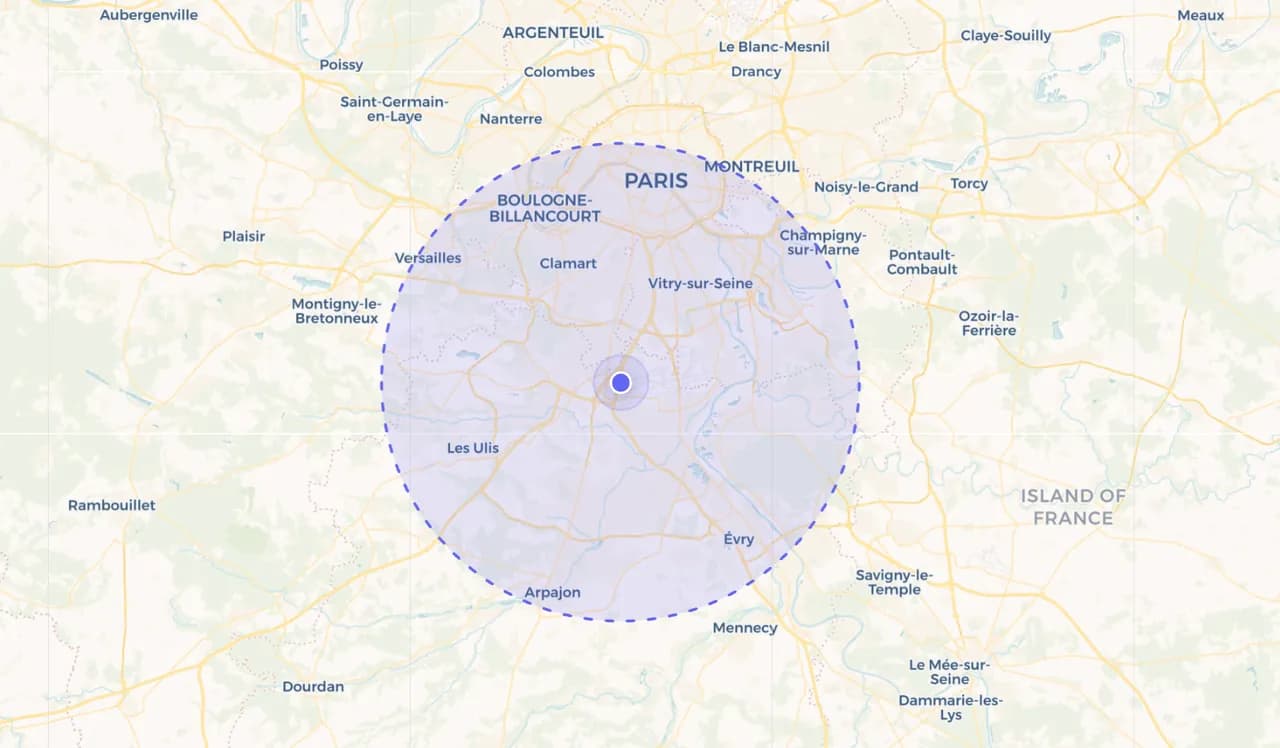
For an agency seeking mandates, the question is mainly strategic. Offering a free valuation report is a way to attract the first appointment; this is precisely the message behind the "free estimate" campaigns that agencies run on social media to attract sellers.
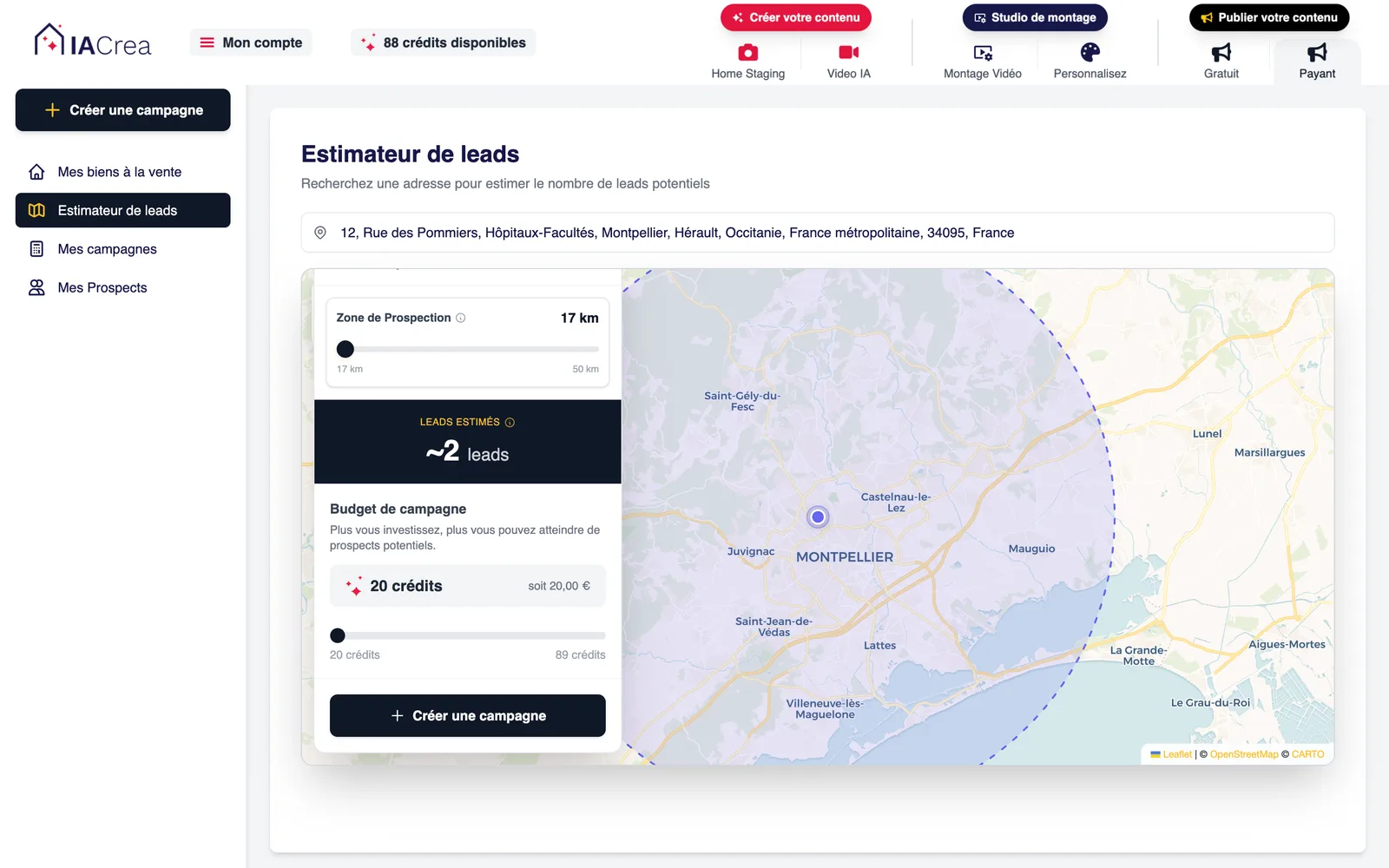 A targeted "free estimate" campaign within a radius of the agency: the first step leading to a valuation appointment
These valuation requests are seller contacts at a specific moment: they are still comparing agencies. IACrea's real estate lead generation is designed for this purpose, and our guide to real estate lead generation using AI explains the complete mechanics.
Rental valuation report: what changes
The rental valuation report estimates the market rent of a property. It is used by the landlord who is renting out the property and by the agency seeking a management mandate. The framework remains the same, with three differences.
- Comparable rents are based on rents recorded for similar leased properties, treated separately for furnished and unfurnished units.
- Charges are listed separately: the proposed rent excludes charges.
- Rent control applies in several municipalities (Paris, Lille, Montpellier, Bordeaux, Grenoble, Basque Country, and the municipalities of Plaine Commune and Est Ensemble notably). The basic rent cannot exceed the increased reference rent set by a prefectural decree, unless justified rent supplement, as recalled by Service-Public.fr. A rental valuation report that ignores this exposes the landlord to disputes from the tenant.
For an investment property, the rental value also helps cross-check the market value via capitalization: annual net rent divided by the expected yield rate observed in the sector.
From valuation opinion to mandate: what makes signing happen
Let's return to the seller who received three agency offers. The three valuation opinions are similar: same sales basis, neighboring price ranges, same legal mention. What sets them apart is no longer the price but the answer to the question the seller doesn't always ask aloud: "And you, what will you do with my property?"
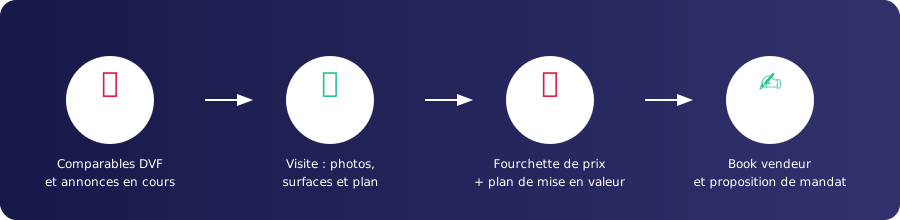
Show the property as it will be presented
The valuation opinion states how much the property is worth. Page 6 of our template explains how it will be sold, and it benefits from being concrete rather than declarative:
- Enhanced photos of the property, with its empty living room in virtual home staging or its dated kitchen in virtual renovation, starting from a photo taken during the visit;
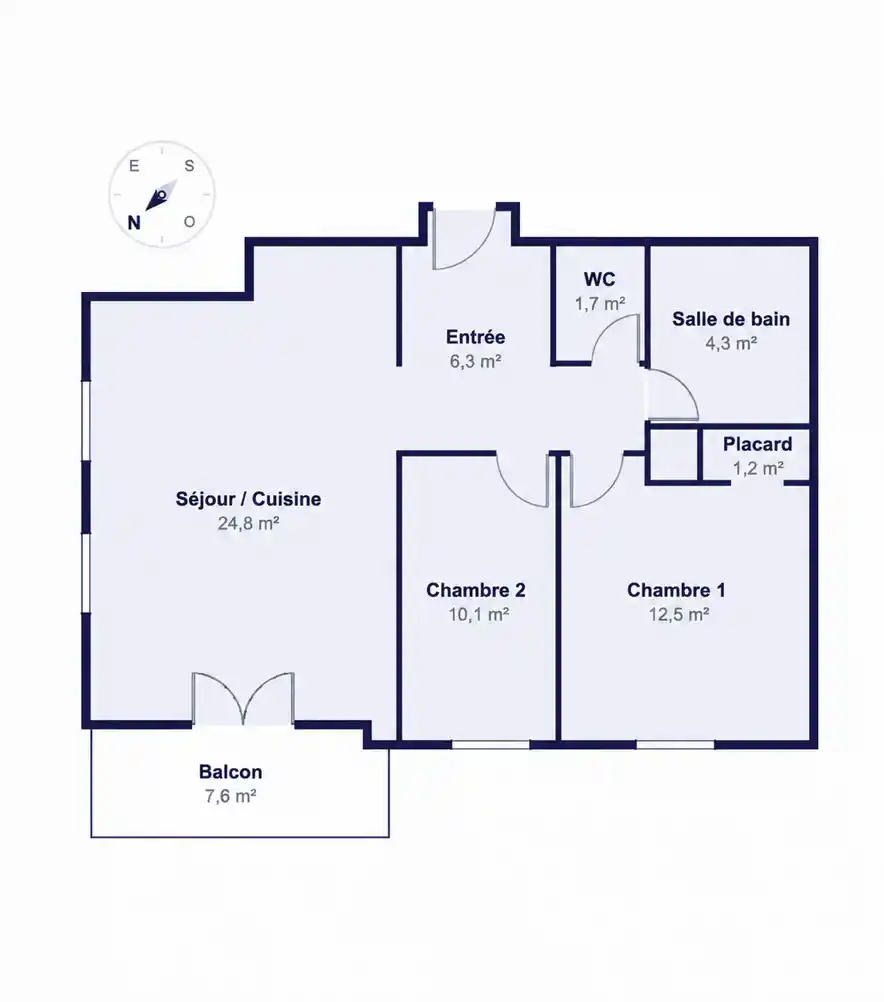
- The property layout, scanned on site, which also helps verify the surfaces mentioned in the valuation;
- A short video generated from the photos, and the dissemination schedule on portals and social networks.
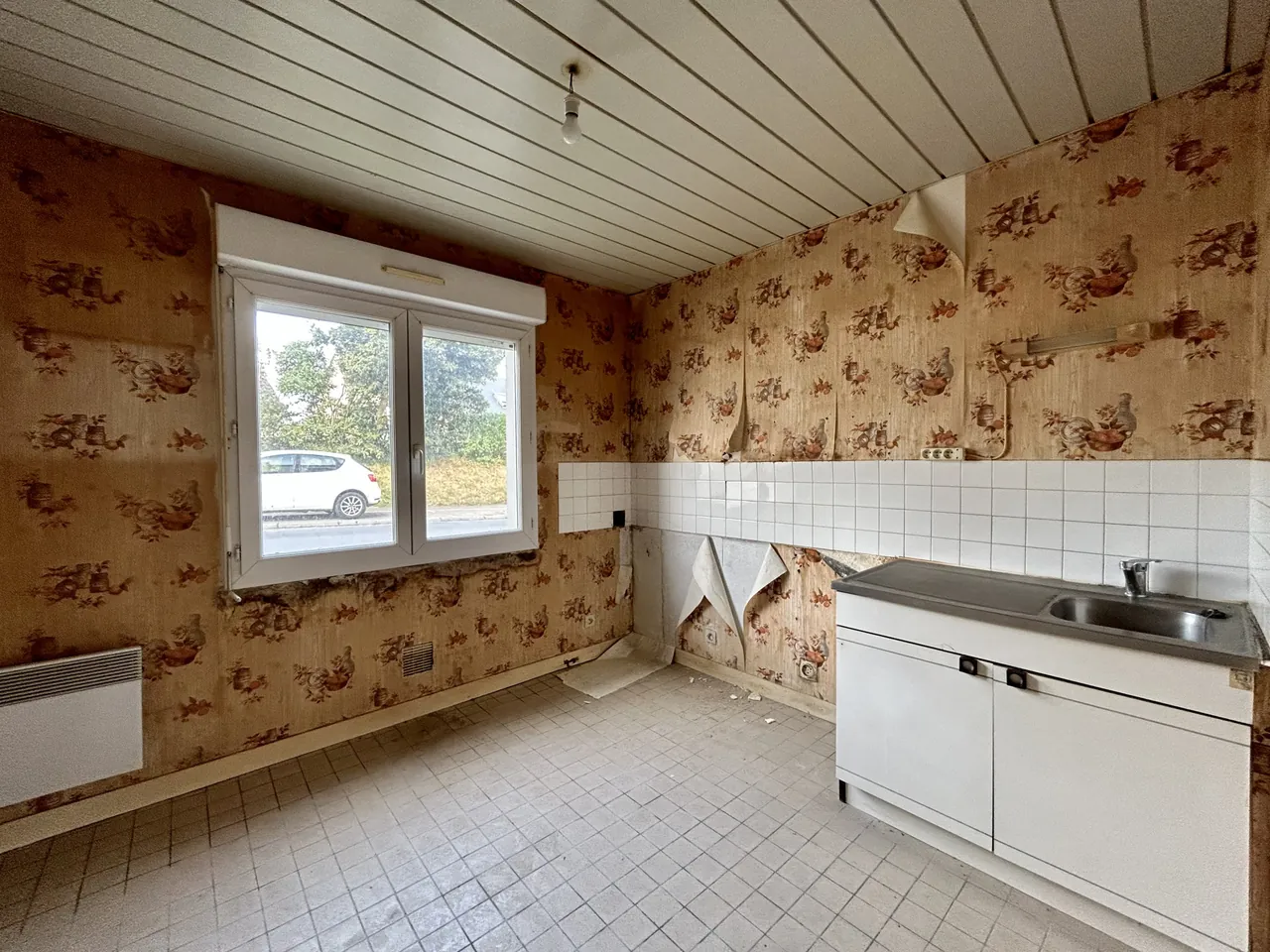
 The seller's kitchen, photographed during the visit and then virtually renovated: an AI-generated projection, to be presented as such to the seller and in the listing
A seller who sees their own kitchen renovated compares more than a price: they compare a project. We detailed this effect for the plan in the property plan as a leverage to secure the exclusive mandate, and it applies to each visual produced during the appointment rather than promised for after signing.
Provide a seller's portfolio instead of a simple PDF
The seller rarely rereads a valuation opinion entirely. Instead, they show it to their partner, their children, sometimes to a friend who is “in the know.” A seller's portfolio in your colors, including the valuation opinion, visuals, and dissemination plan, does this convincing work in your absence. This is what the mandate-taking kit from IACrea gathers.
Photo quality matters just as much as staging: our real estate photography guide explains how to succeed in your shots during the visit, in natural light.
Present the price last
In the appointment flow, keep the price range for the end: first description and points of vigilance, then comparables, recommended listing price, and finally the enhancement plan. The seller arrives at the figure with the reasoning in mind, and leaves already committed to the next steps.
FAQ
Does a valuation opinion have legal value?
No. It is an informational document that provides a price estimate without proof, and it does not bind the seller. The Charter of Real Estate Valuation Expertise even requires it to state in writing that it is not an appraisal. For inheritances, divorces, or disputes, an appraisal report is required.
Is a valuation opinion from an agency free of charge?
Most often, yes: the agency offers it because it initiates the discussion for the mandate. However, there is no obligation. If it is charged, the price must be listed in the displayed fee schedule, and when it accompanies a sales mandate, payment is only due upon the signing of the authentic deed.
What is the difference between a valuation opinion and an estimate?
In common usage, the two words often refer to the same document provided by the agency. The real distinction is between the valuation opinion, a price opinion with limited diligence, and an appraisal, a reasoned report prepared by an expert who assumes responsibility for the demonstrated value.
How long is a valuation opinion valid?
No specific period is set by law. In practice, it reflects the market at its date: beyond three to six months, or after a significant variation in interest rates or prices in the area, it is advisable to update it before setting the mandate price.
What should a rental valuation opinion include?
A description of the property, comparable rent prices, the proposed market rent, charges separate, and, in municipalities subject to rent controls, the applicable reference rent cap. The proposed rent excluding charges cannot be higher than the reference rent plus any justified additional rent.
Conclusion
A serious property valuation — verified surface areas, adjusted comparables, identified points of caution, legal mentions — builds trust. It’s not enough to get the client to sign, because other agencies also provide one. What sets you apart is the page others don’t have: the seller’s property already photographed, staged, with its floor plan, with its dissemination schedule.
IACrea brings these visuals together in a single tool, ready before the appointment ends. Create a free account or view our plans to prepare your next valuation report.
About the author

Co-founder & CTO of IACrea
Constance Laborie is co-founder and CTO of IACrea, the AI platform that helps real estate professionals create their visuals — photos, virtual home staging and videos — in seconds. She leads the product and technical development of the platform and writes practical guides on real estate photography, virtual home staging and the use of AI in real estate.
Related articles

Ready to turn your photos into content that sells?
Join thousands of real estate agents using IACrea to create professional content in seconds.
Try for free →