
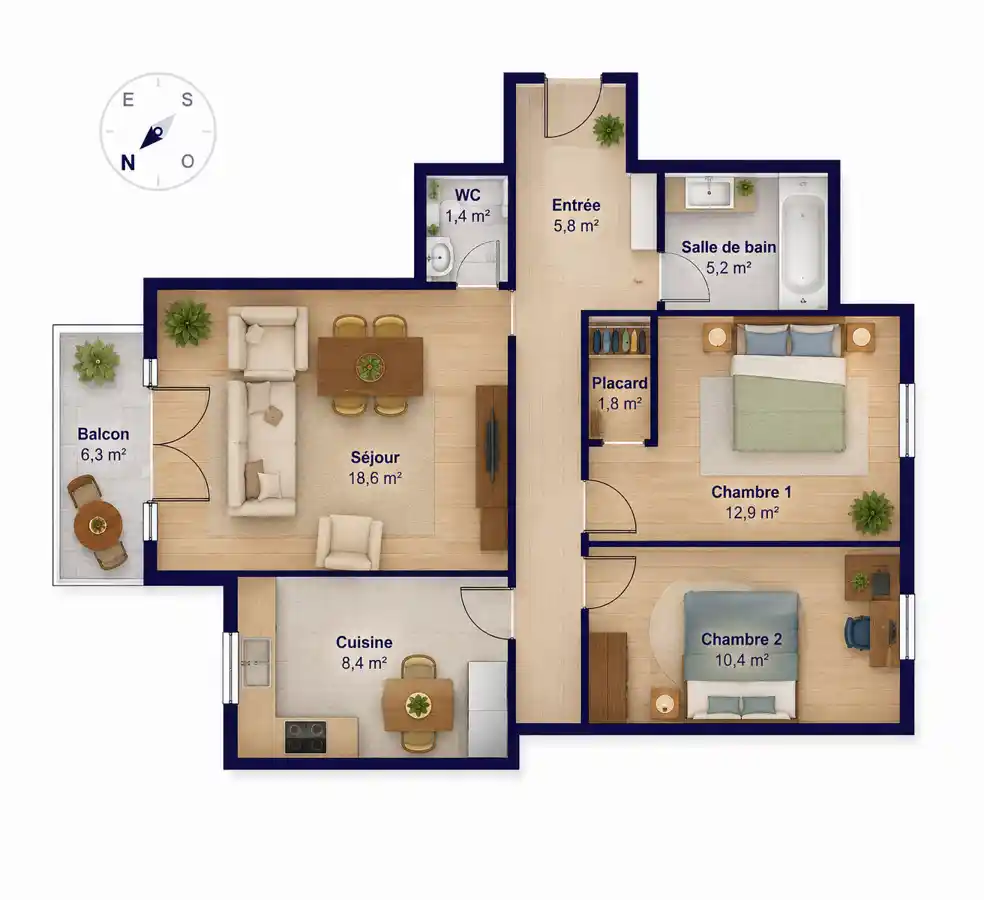
Three figures can describe the same apartment — and none of them can replace the other two. Confusing habitable area with Carrez surface in a listing is not a harmless approximation: it is the most common reason for DGCCRF inspections of real estate professionals.
The 2D floor plan now accompanying most listings adds a third, purely indicative surface to an already confusing set. This guide clarifies the definitions, the applicable texts for each, what the listing must obligatorily display, and what risks an agent faces if they’re mistaken.
What you'll learn in this guide:
- The exact difference between habitable surface, Carrez surface, and plan surface
- Why these three figures almost never match on the same property
- What must legally be displayed in listings, for sales and rentals
- The real penalties for errors or omissions
- Where a scanned plan ends and professional measurement begins
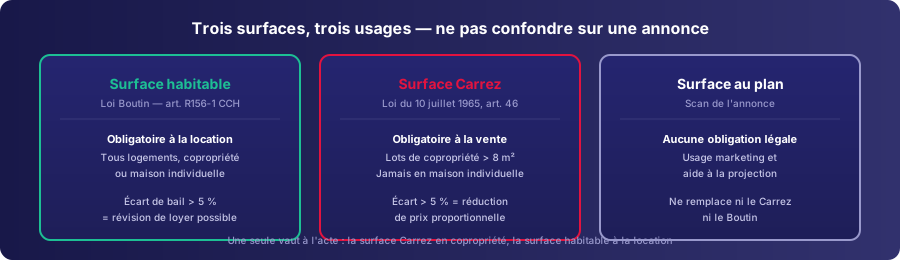
Three surfaces, three uses that never substitute for each other
A single apartment can show a habitable area of 62 m², a Carrez surface of 64 m², and a plan surface of 63 m² — three correct figures, each in its own category. The confusion comes from a natural reflex: people assume a dwelling has only one size. In reality, it has as many as there are texts that require them.
Habitable surface (Boutin law): the rental measurement
Habitable surface is defined by article R156-1 of the French Building and Housing Code (former article R111-2, renumbered by the decree of June 30, 2021): it’s the built floor area, excluding walls, partitions, stairs, shafts, door and window embrasures. Areas under 1.80 m ceiling height, cellars, garages, unconverted attics, terraces, and balconies are excluded.
Originating from the 2009 Boutin law, it is mandatory in all unfurnished residential leases, regardless of property type — co-ownership or individual house. It serves as the reference for setting the rent, not the sale price.
Carrez surface: the measurement for sale in co-ownership
Carrez surface stems from article 46 of the law of July 10, 1965 and the decree of May 23, 1997. It is calculated almost like habitable surface — same deductions for walls and embrasures, same 1.80 m threshold — but with a different purpose: to secure the price in a sale of co-owned property.
Its scope is strictly narrower than habitable surface: it applies only to co-ownership units over 8 m², and never to a single-family house outside co-ownership. A typical house therefore has no obligation of Carrez measurement, even if it has a habitable surface if rented out.
Plan surface: the marketing indicator on the listing
The third surface is the newest and least regulated: the one appearing on the 2D plan generated from a scan or quick survey, displayed alongside photos in the listing. It has no legal standing — no text requires or defines it — and its sole purpose is to help the buyer visualize the layout of the property, as detailed in our guide to residential 2D plans.
Why these three figures almost never match
| Surface | Reference text | Scope of application | What it excludes |
|---|---|---|---|
| Habitable | Boutin law, art. R156-1 CCH | Rental, all housing | Walls, height < 1.80 m, cellars, garages, terraces, unconverted attics |
| Carrez | Law of 07/10/1965, art. 46 | Sale, co-ownership only (>8 m²) | Same as habitable, plus strictly on annexes |
| Plan surface | None — marketing use | Any listing, for guidance | Nothing standardized: depends on scan method |
The difference between habitable and Carrez on a single property rarely stems from an error: both calculations are based on similar deduction logic but are applied to different types of transactions (lease vs. sale), and measurement professionals do not always perform them simultaneously. The gap with the plan surface, however, is explained differently: a scan captures the walls as they appear, without distinguishing a doorway from a regular irregularity, resulting in surfaces generally close within one or two square meters, but never exactly matching the legal figures.
What must be displayed in a listing, obligatorily
The arrêté of January 10, 2017, as amended on January 26, 2022, sets out the mandatory information for professional real estate ads: property type, price (including sharing of fees and who pays them for sales), surface, number of main rooms, and, for co-ownership, existence of a syndic and the average charges.
Regarding surface, the rules vary depending on the transaction:
- Sale of a co-ownership lot: Carrez surface is mandatory in the listing, the preliminary contract, and the deed.
- Sale of a single-family house: No legal surface is required by this regulation; habitable or plan surface can be provided as information.
- Rent: habitable surface is mandatory, both in the listing and in the lease.
Additionally, mentions of energy performance diagnostics are required: energy class, climate class, estimated annual expenditure, and the mention “housing with excessive energy consumption” for properties rated F or G. These pieces of information are independent of the displayed surface but are often evaluated together: a control of a listing typically checks both — the obligatory details are listed on the service-public.gouv.fr practical sheet.
Mistaking surface measurement: what it really costs
Sanctions are not symbolic; they target not just the seller but directly expose the agent who drafts the listing.
- Sale of a co-ownership lot without Carrez measurement: the buyer can request nullity of the deed. This is the heaviest penalty and applies to missing mention, not only calculation errors.
- Sale of a co-ownership lot with Carrez discrepancy over 5%: the buyer has up to one year from the deed to request a price reduction proportional to the shortfall. An excess measurement, conversely, does not entitle the seller to any additional compensation.
- Rental with habitable surface discrepancy over 5%: the tenant can ask for rent reduction proportional to the difference.
- Missing or misleading mandatory mention (surface, DPE, fees): the DGCCRF can impose an administrative fine up to €3,000 for individuals and €15,000 for legal entities — practically, for agencies as well.
The common point in these four sanctions: none distinguish good faith errors from negligence. The regulation protects the buyer or tenant based on the displayed figure, not the intent of the drafter.
Where a scanned plan ends and professional measurement begins
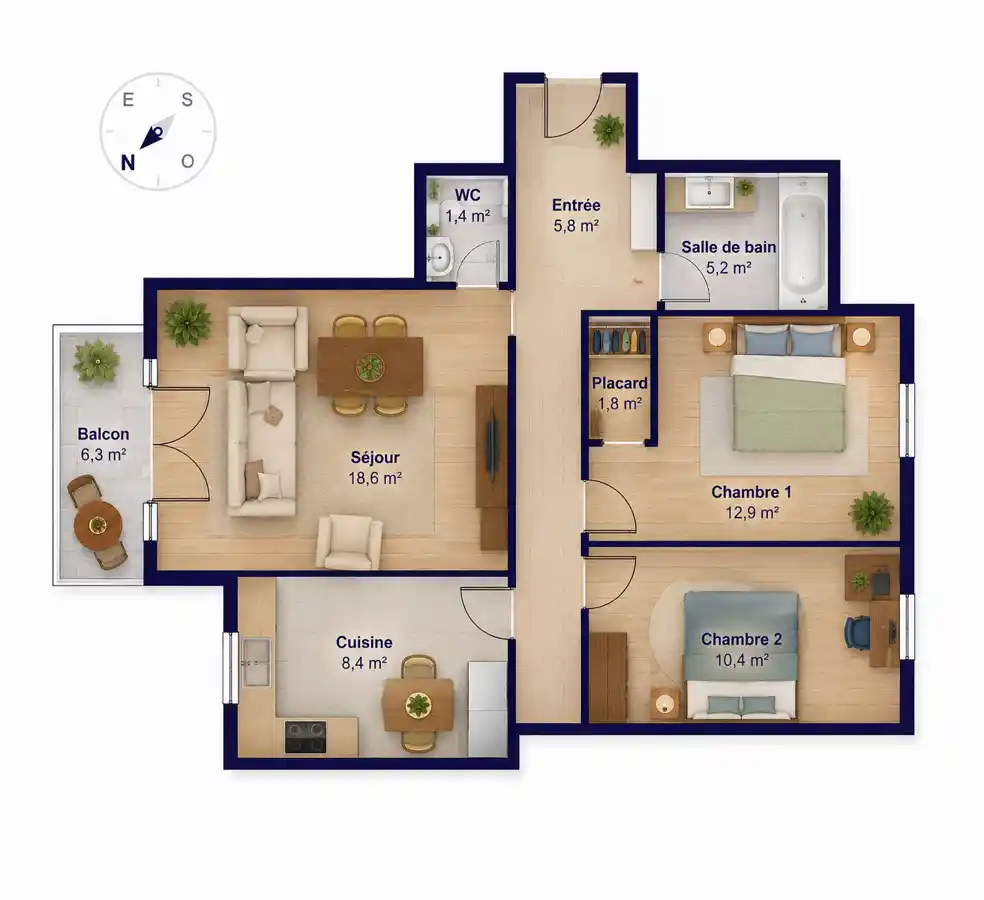 The listing’s plan shows a surface per room, useful for reading — never an official Carrez or habitable surface
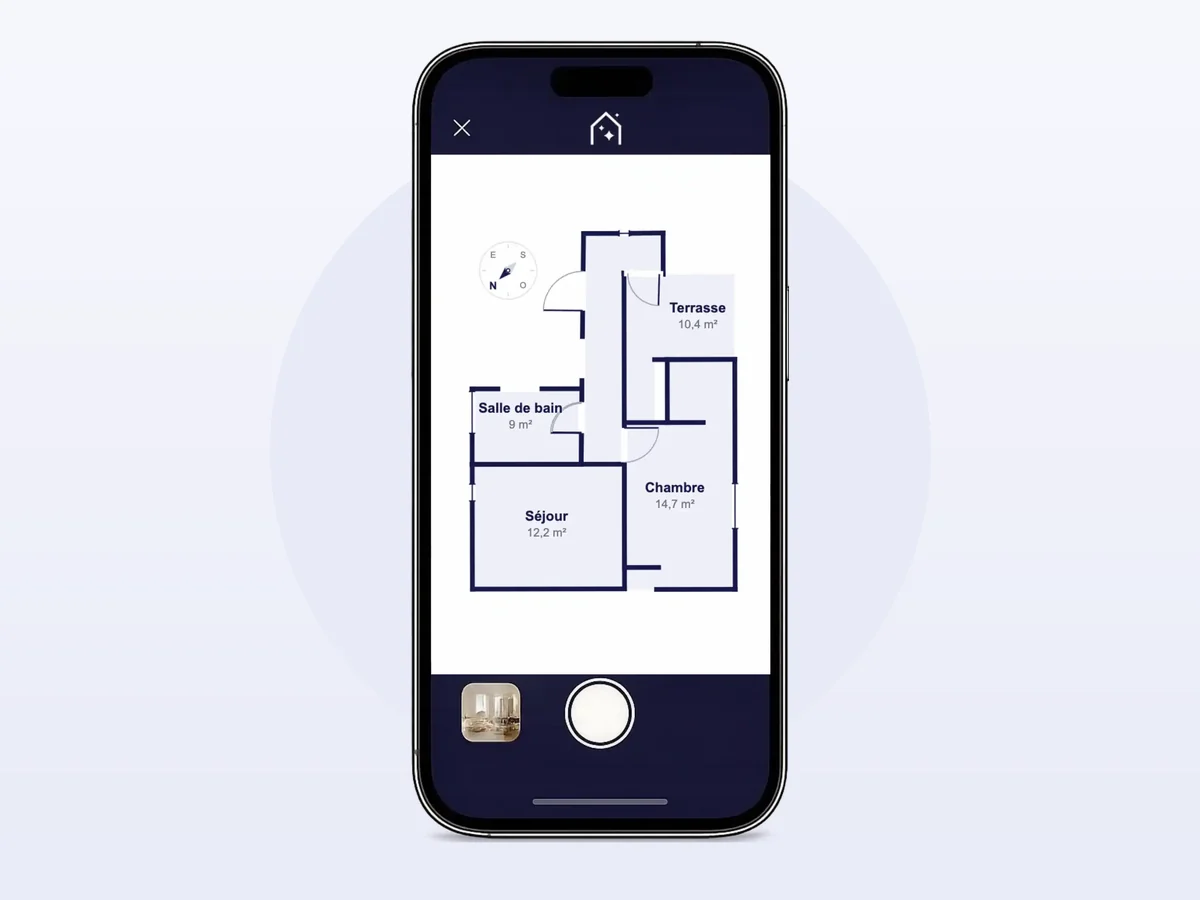
A plan produced in minutes from the IACrea real estate photo app, as detailed in our iPhone scanning tutorial, provides a reliable surface per room within a few percent — enough for a buyer to compare two properties or visualize the layout. But it is not sufficient to commit to a sale or rental: a 3% difference on a scanned plan remains within marketing margins, but would already constitute non-compliance if presented as official Carrez surface.
The straightforward, non-negotiable rule is this: the plan displays its surfaces with the note that they are indicative; the figure that officially engages the transaction is the measurement made by a professional, as recorded in the preliminary contract and deed. The same caution applies to displayed prices for generating a 2D plan: a quick tool and a legal measurement serve different purposes, and confusing the two results in higher costs than the gains.
Which surface to show, and where in the file
The most common mistake is not miscalculating, but displaying the correct surface in the wrong place:
- In a co-ownership sale listing: only the Carrez surface, with nothing that could cause confusion.
- In a single-family house sale listing: either habitable surface or plan surface, with neither being legally required but one being expected by the buyer.
- In a rental listing: the habitable surface, the only legally recognized measurement for a lease.
- On the attached plan, created and adjusted with IACrea: surfaces by room, with the note that they are indicative.
- In the vendor’s brochure and the mandate argumentation: all three can coexist, as long as each is named for what it is. This is also a sign of professionalism to be highlighted during a mandate appointment — just as displaying professional real estate photos reassures clients: showing that you can distinguish marketing figures from legal figures builds confidence, especially after a previous bad experience.
This rigor does not slow anything down: it fits into a single line of text under each displayed surface, and it avoids the only costly mistake on this topic.
FAQ
What is the difference between habitable surface and Carrez surface?
Habitable surface (Boutin law) applies to all rentals and is used to set the rent; Carrez surface applies only to the sale of a co-ownership lot and is used to determine the price. Both exclude spaces under 1.80 m, cellars, garages, terraces, and balconies but are based on two different texts and are never interchangeable.
Does the Carrez law apply to a single-family house?
No. The Carrez law only concerns co-ownership lots over 8 m². A house outside coproduction has no obligation to be measured according to Carrez when sold — only the habitable surface, as an indication, can be mentioned.
What are the risks for an agent who displays an incorrect surface in a listing?
For co-ownership sales, failure to mention Carrez can lead to the nullity of the deed, and a discrepancy over 5% can trigger a reduction request for the price. For rentals, a difference over 5% can lead to rent reductions. On the listing itself, missing or misleading mentions of surface, DPE, or fees can lead to an administrative fine by the DGCCRF — up to €3,000 for individuals and €15,000 for companies, including agencies.
Can a scanned plan from an app replace a Carrez or Boutin measurement?
No, and it should never be presented as such. A scan provides indicative surfaces, useful for listing and preparing the measurement. The official surface that matters for sale or rent must be established according to the legal method, typically by a measurement professional.
Should I display the Carrez surface or habitable surface in a co-ownership sale?
Carrez surface is the only mandatory figure for a co-ownership lot being sold: it appears in the preliminary agreement and deed. It’s permissible to display habitable or plan surface as additional info, but never as the official Carrez surface.
Conclusion
Three surfaces, three texts, three uses: confusion costs more than it saves — risking contract nullification, price reductions, and DGCCRF penalties. The rule protecting agents is simple: label each surface for what it is, and never present an indicative number as a legal measurement.
The listing plan is no exception: it remains the fastest way to give a buyer a reliable first impression of the property. Scan your next mandate with the IACrea app and complement it with the pricing options suitable for your volume of mandates — but the legal surface will always be the responsibility of a measurement professional.
About the author

Co-founder & CEO of IACrea
Pauline Clavelloux is co-founder and CEO of IACrea. In daily contact with real estate agencies and agents, she understands their challenges around visibility, marketing and lead generation. On the blog, she shares actionable strategies on real estate marketing, social media and prospecting in the age of AI.
Related articles

Ready to turn your photos into content that sells?
Join thousands of real estate agents using IACrea to create professional content in seconds.
Try for free →