
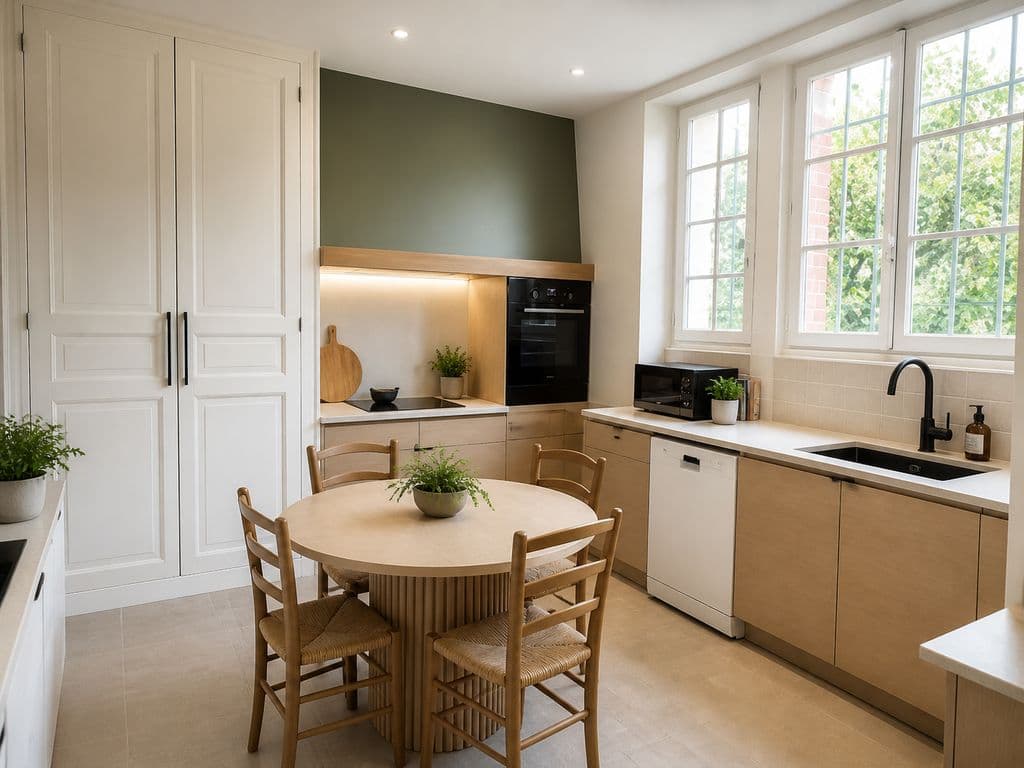
A raw real estate photo and the same retouched image can produce two completely different results on a listing portal — yet nothing has changed on the ground, only the image processing. Between the moment of capture and publication, retouching has become as crucial as the shooting itself.
This guide details the real estate photo editing techniques that truly matter, the legal boundaries you must respect, and how to automate this work without spending your evenings on it.
What you'll learn in this guide:
- The 5 retouches that truly transform a real estate photo
- The difference between manual retouching and AI-powered automatic editing
- What the law permits — and what it sanctions
- How to integrate retouching into your workflow, from smartphone capture to published listing
What is real estate photo retouching?
Real estate photo retouching encompasses all adjustments made after a photo is taken to improve clarity and appeal without altering the reality of the scene. It involves five main areas: exposure (dark areas and blowouts), geometry (tilted walls due to wide-angle lenses), visible sky through windows, foreground clutter, and overall colorimetry.
Contrary to common belief, retouching a real estate photo isn't cheating: it's correcting the device’s technical limitations to accurately represent the property as perceived by the eye on site. A dark room during shooting, once properly exposed, does not become a lie — it becomes a faithful image.
Why retouching impacts listing performance
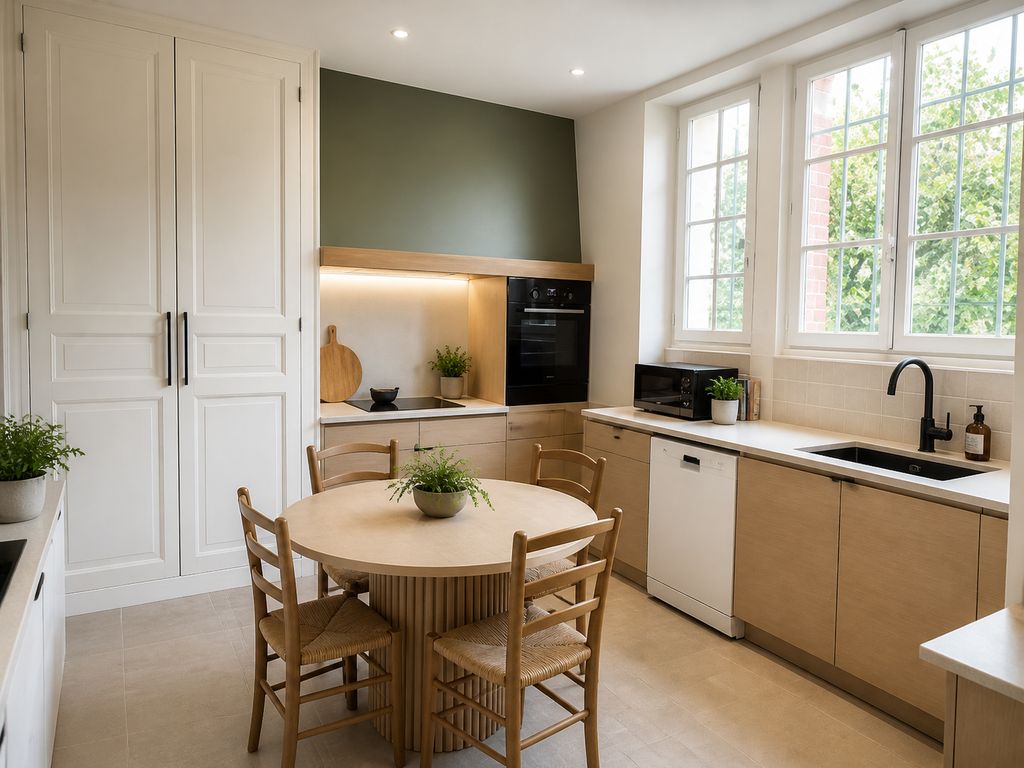
The performance gap between a raw photo and a retouched one is far from marginal. Listings with polished visuals generate up to 7 times more visits than those with amateur photos (SeLoger). Field observations confirm: for two comparable properties, the only difference being photo quality, the number of requests remains unequal.
The reason is simple. A buyer scrolling through a portal decides within seconds whether to click or move on. A blown-out window, a leaning wall, a dull, gray sky — each of these technical flaws falsely signals neglect or poor presentation. Retouching corrects this impression without touching the true property's features.
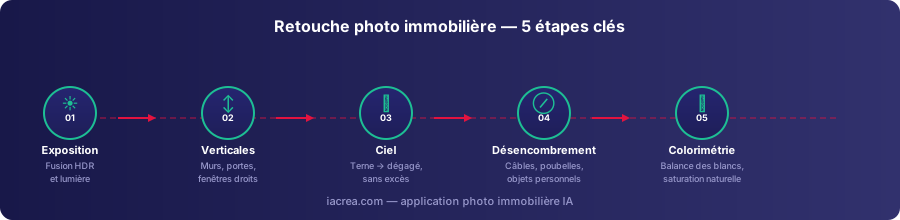
The 5 essential photo retouches in real estate
Not all edits are equally impactful. Five interventions cover most of the work on a real estate photograph.
1. Correct exposure
The most common and visible flaw: a window washed out by light or a poorly lit room. The solution is to merge multiple exposures of the same scene — HDR technique — so that interior and exterior views are sharp simultaneously. We detail this technique extensively in our guide to HDR real estate photography.
2. Straighten verticals
Wide-angle lenses, essential for capturing entire rooms, distort straight lines: walls seem to converge, doors appear tilted. This geometric correction straightens verticals in seconds, preventing the instantly recognizable “amateur photo” look on a listing.
3. Replace a dull sky
A gray, low-hanging sky visually flattens a facade or a view through a window. Replacing it with a clear sky, without oversaturation, revives the photo’s brightness without modifying the property's structure.
4. Virtually declutter
Trash bins, visible cables, personal objects in the foreground — these elements divert attention from the essentials. Removing objects via AI allows retouching of visual distractions without redoing the entire shot, unlike virtual decluttering, which empties a room of furniture.
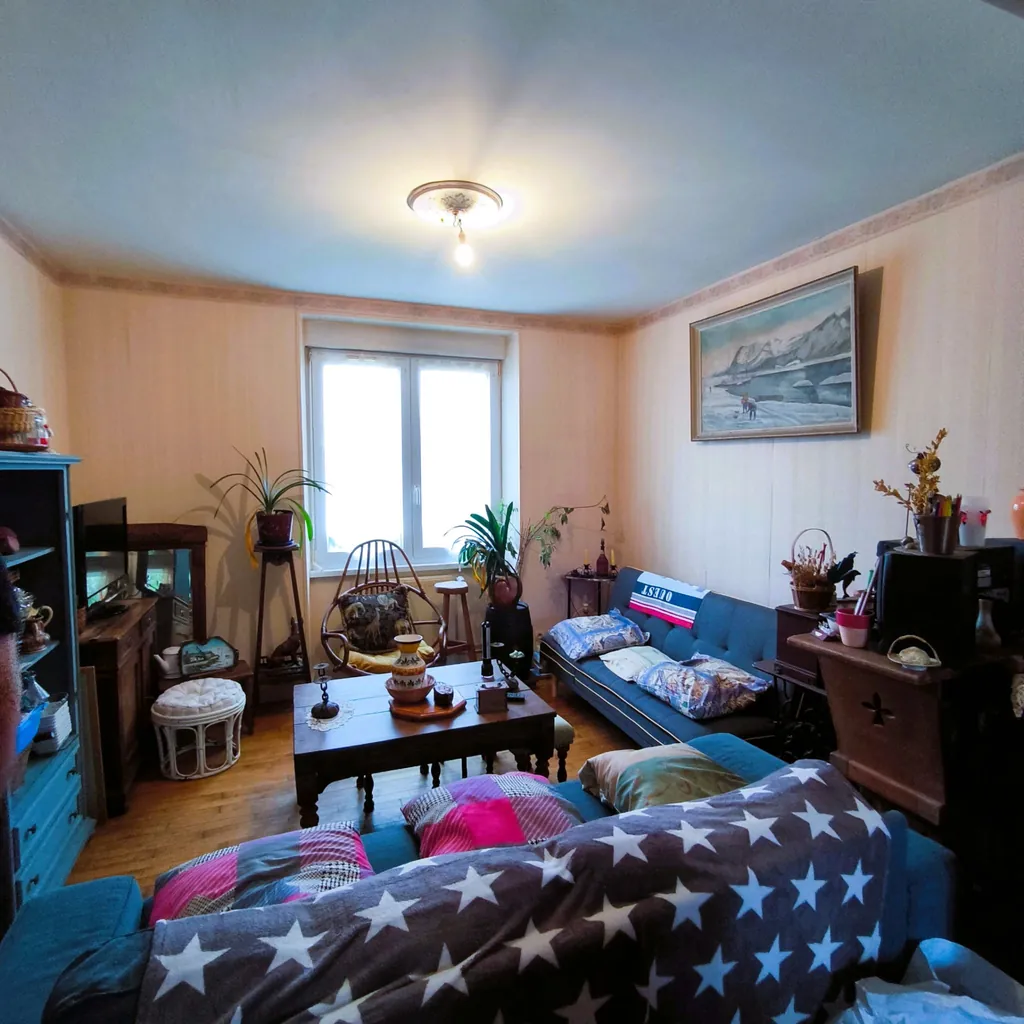 Before: cluttered living room
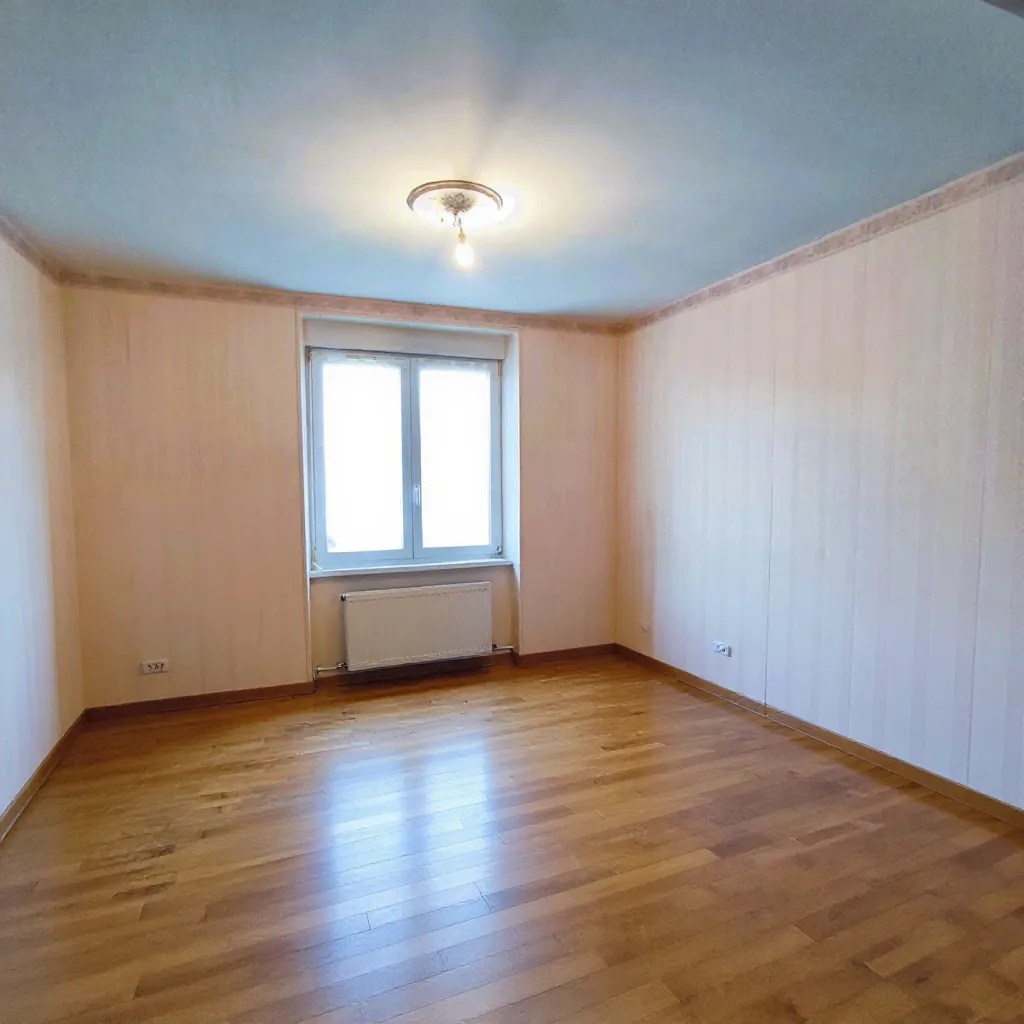 After: AI retouched — image generated for illustration
5. Adjust colorimetry
White balance and saturation finish the job: overly yellow interiors under artificial lighting, or too blue on an overcast day, distort perceived real colors (paint, flooring, materials). A subtle adjustment restores a faithful, engaging rendering — provided you mastered lighting at shoot time; retouching can’t fully compensate for poorly lit scenes.
Manual vs AI automatic retouching
The choice depends mainly on the volume of photos to process and available time per property.
| Criterion | Manual retouching (Lightroom, Photoshop) | AI automatic retouching |
|---|---|---|
| Time per photo | 3 to 8 minutes | A few seconds |
| Skills required | Proficiency with editing software | None — integrated in shooting app |
| Consistency across photos | Variable depending on operator | Homogeneous across series |
| Cost | Software license or external service | Included in subscription |
| Creative control | Full, fine-tuned adjustments | Limited, natural-looking results |
For an agent publishing 3 to 5 properties weekly with 15–25 photos each, manual retouching takes several hours, difficult to optimize. AI automation is designed to eliminate this bottleneck — not to replace human judgment on the final look but to instantly apply repetitive corrections.
Legal framework: how far can you go with real estate photo retouching?
Photo retouching isn’t a rule-free zone. The article L121-2 of the Consumer Code classifies any presentation — including visual — that falsely implies “substantial qualities” of a property as misleading commercial practice (Légifrance). In plain terms: surface area, structural condition, actual lighting, or environment cannot be artificially altered via retouching. The DGCCRF can penalize violations with a civil fine up to €37,500.
The key distinction lies between technical correction and alteration of reality. Adjusting exposure, straightening verticals, balancing white — these are fidelity edits reflecting what the eye perceives. Conversely, artificially enlarging a room, hiding structural flaws, or furnishing an empty space without disclosure crosses the line (legal analysis, Village de la Justice).
In practice, a simple disclaimer like “optimized photo” for light retouches, or “perspective projection” for virtual decluttering or staging, suffices to ensure compliance while maintaining persuasive power. This approach is detailed in our article on legal mentions for virtual home staging.
Incorporating AI retouching into your workflow
In the field, effective retouching isn’t a post-process step added later in a third-party software — it’s integrated at capture time. This is the core technical choice behind IACrea’s photo app: automatic HDR, vertical correction, sky replacement all apply directly from the smartphone, before export.
Practically, an agent visiting a 6-room property can come away with a set of 20 already retouched images, consistent among themselves, without exporting to Lightroom. Time saved directly boosts the number of listings they can handle weekly — a quality and productivity advantage. For photos needing portal upload, our free compression tools prevent rejection due to file size limits, a common frustration after retouching.
This automation doesn’t replace virtual decluttering or staging, which remain separate staging steps. Check out our before/after examples to see the difference between simple retouching and fully staged virtual impressions, and explore our packages and pricing to adopt this workflow in your practice.
FAQ
Is real estate photo retouching legal?
Yes, as long as it remains a technical enhancement — exposure, verticals, colorimetry — and doesn’t modify the true features of the property. The article L121-2 of the Consumer Code classifies any visual presentation giving a false impression of surface, condition, or environment as misleading, with civil sanctions up to €37,500 (Légifrance).
Should I disclose AI retouching for real estate photos?
Yes, for transparency and honesty with buyers. A discreet mention like “optimized photo” or “illustrative rendering” suffices for minor edits (HDR, colorimetry). It becomes necessary if the retouching results in perceptible changes, such as replacing the sky or virtual decluttering.
What’s the difference between retouching and virtual staging?
Retouching corrects an existing photo — exposure, verticals, sky, parasites — without changing the property's layout. Virtual staging goes further: it adds or removes furniture to reproject a furnished or empty space. Both are complementary and often performed sequentially in the same workflow.
Which software should I use for real estate photo editing?
Two main approaches: generalist software (Lightroom, Photoshop) offering full control but requiring skills and time, and specialized real estate tools automating HDR, verticals, and sky directly from a smartphone, like the IACrea app.
How long does real estate photo retouching take?
Manual editing with Lightroom or Photoshop takes about 3 to 8 minutes per photo for full correction (exposure, verticals, sky, color). Automated AI retouching reduces this to a few seconds per shot, applied directly during capture.
Conclusion
Real estate photo retouching isn't a gimmick or trick — it’s the step that turns a decent shot into visuals that truly generate visits, as long as it respects consumer law boundaries. Exposure, vertical correction, sky replacement, and colorimetry cover most of the essentials — virtual decluttering and staging add value for certain properties. Automating these corrections at the moment of capture, as enabled by the IACrea app, frees up the agent’s most limited resource: time, to focus on mandates rather than retouching software.
About the author

Co-founder & CTO of IACrea
Constance Laborie is co-founder and CTO of IACrea, the AI platform that helps real estate professionals create their visuals — photos, virtual home staging and videos — in seconds. She leads the product and technical development of the platform and writes practical guides on real estate photography, virtual home staging and the use of AI in real estate.
Related articles

Ready to turn your photos into content that sells?
Join thousands of real estate agents using IACrea to create professional content in seconds.
Try for free →