
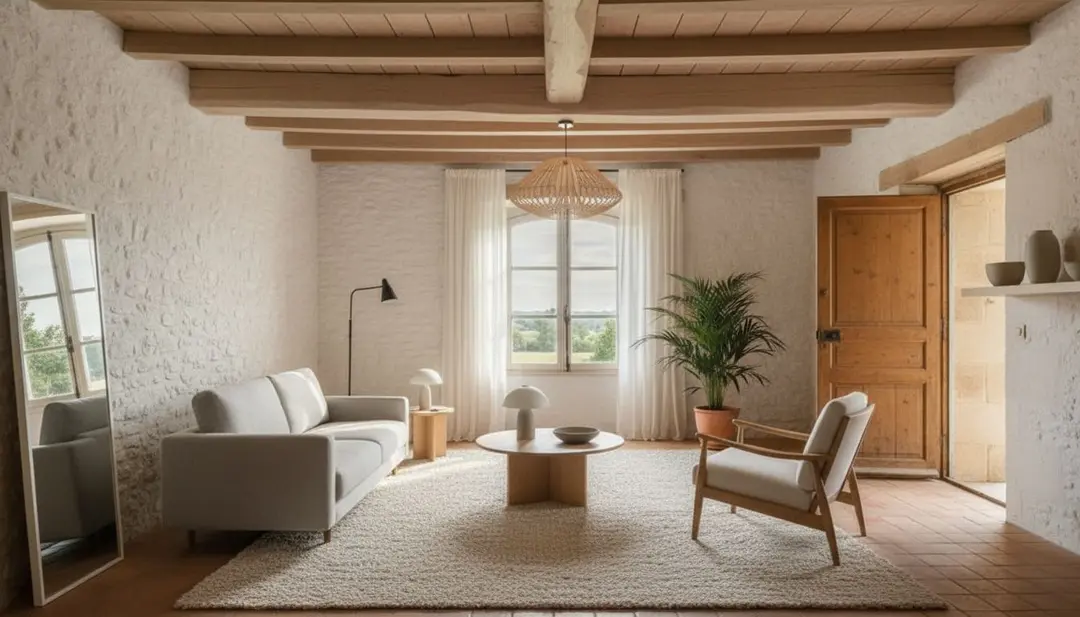
Two figures sum up the topic: 64 days versus 78, and -2% versus -7%. These figures represent the difference in sales turnaround time and negotiation margin measured between a well-valued property and a rawly presented property, according to the FNAIM/OpinionWay study. In other words, two fewer weeks on the market and five points preserved in the price—a €15,000 difference on a €300,000 property.
The real question remains: what does it cost, what does it bring in, and on which mandates? This guide examines the ROI of virtual home staging in detail: available studies, actual costs in 2026, a 4-step calculation method, and three detailed scenarios by property type.
What you'll learn in this guide:
- The FNAIM and NAR figures on sales time and negotiation, and what they really mean
- The full cost of physical versus virtual home staging in 2026
- The four-step method to calculate ROI on a given mandate
- Three detailed scenarios: empty property, cluttered property, property to renovate
- The hidden benefits not shown by the calculation—and cases where staging alone isn't enough
What the ROI of home staging truly covers
The return on investment for a valuation operation is calculated like any other: the net gain generated divided by the invested cost. The difficulty isn’t the formula—it’s knowing what to include.
Cost-wise, everything is visible: the staging service (physical or virtual), the time spent, possibly photography. On the gain side, three components accumulate—and the second is often underestimated:
- The asking price: a well-presented property negotiates more easily and is less likely to be overbid.
- Avoided carrying costs: each week on the market costs the seller (charges, bridging loans, depreciation of “stale” property) and the agent (follow-ups, price reductions, commercial effort).
- Portfolio effects: mandates gained through demonstration, visuals reused in prospecting—real benefits but harder to quantify.
Virtual home staging radically changes the first factor: the cost. When the expense drops from several thousand euros to just a few euros per photo, the breakeven point collapses—and mandates that previously didn’t justify physical staging become eligible. For the technical fundamentals, our comprehensive guide to virtual home staging walks through the method step by step.
Sales delays and negotiation: what studies reveal
The FNAIM/OpinionWay study: 18% faster, 5 points preserved
The benchmark data on the French market comes from the FNAIM: properties staged with home staging sell in median 64 days versus 78 days for unstaged properties—an 18% reduction. And the gap between listing price and final signed price narrows significantly: -2% versus -7%.
This second figure is especially relevant for agents. On a €300,000 property, five points of negotiation equal €15,000—more than most agency fees on the same property. Staging doesn’t “inflate” the price; it prevents the well-known cycle of the property languishing online, leading to price drops and eventual discounting.
NAR data: buyer projection as a mechanism
In the U.S., where the practice is older, the 2025 report from the National Association of Realtors documents this: 83% of buyer’s agents say staged properties help their clients envision themselves, 49% of seller’s agents report a shorter market time, and 29% see offers 1–10% higher compared to unstaged similar properties.
The causal chain is simple: sales start online—80% of French people browse real estate websites before buying (SeLoger)—and a photo that resonates with the buyer triggers a visit. More qualified visits in the initial weeks maintain a stronger negotiation position at the time of offer.
What these figures don’t say
Honest note: none of these studies isolate virtual staging from physical staging, and staged properties are not a random sample—they often belong to sellers who invest more in presentation, including price and listing quality. Estimates are consistent across studies, but the key is scenario modeling rather than promising a guaranteed outcome.
How much will virtual home staging cost in 2026?
Physical home staging: 0.5 to 4% of property price
In France, a full physical staging service (diagnostics, decluttering, furniture rental, styling) generally costs between 0.5% and 4% of the sale price, i.e., €1,500–€5,000 for a standard property—more in Île-de-France or on the Côte d'Azur. At these prices, staging makes sense mainly for high-value or particularly difficult-to-sell properties.
Virtual home staging: a few euros per photo
| Item | Physical staging | Virtual staging |
|---|---|---|
| Cost for a T3 | €1,500 – €5,000 | less than €50 (6–8 photos) |
| Implementation time | 3–10 days | a few minutes |
| Changes | new service billed | unlimited variants |
| Properties eligible | accessible, empty or nearly empty | any photo, including occupied |
| Breakeven point | high-value or stuck properties | from the first mandate |
Using AI tools like IACrea, staging a full property costs less than a client meal—pricing plans are based on monthly photo volume, not per-job billing. What changes the ROI logic is this: at this cost level, the question is no longer “does this mandate justify staging?” but “why not stage all properties?”
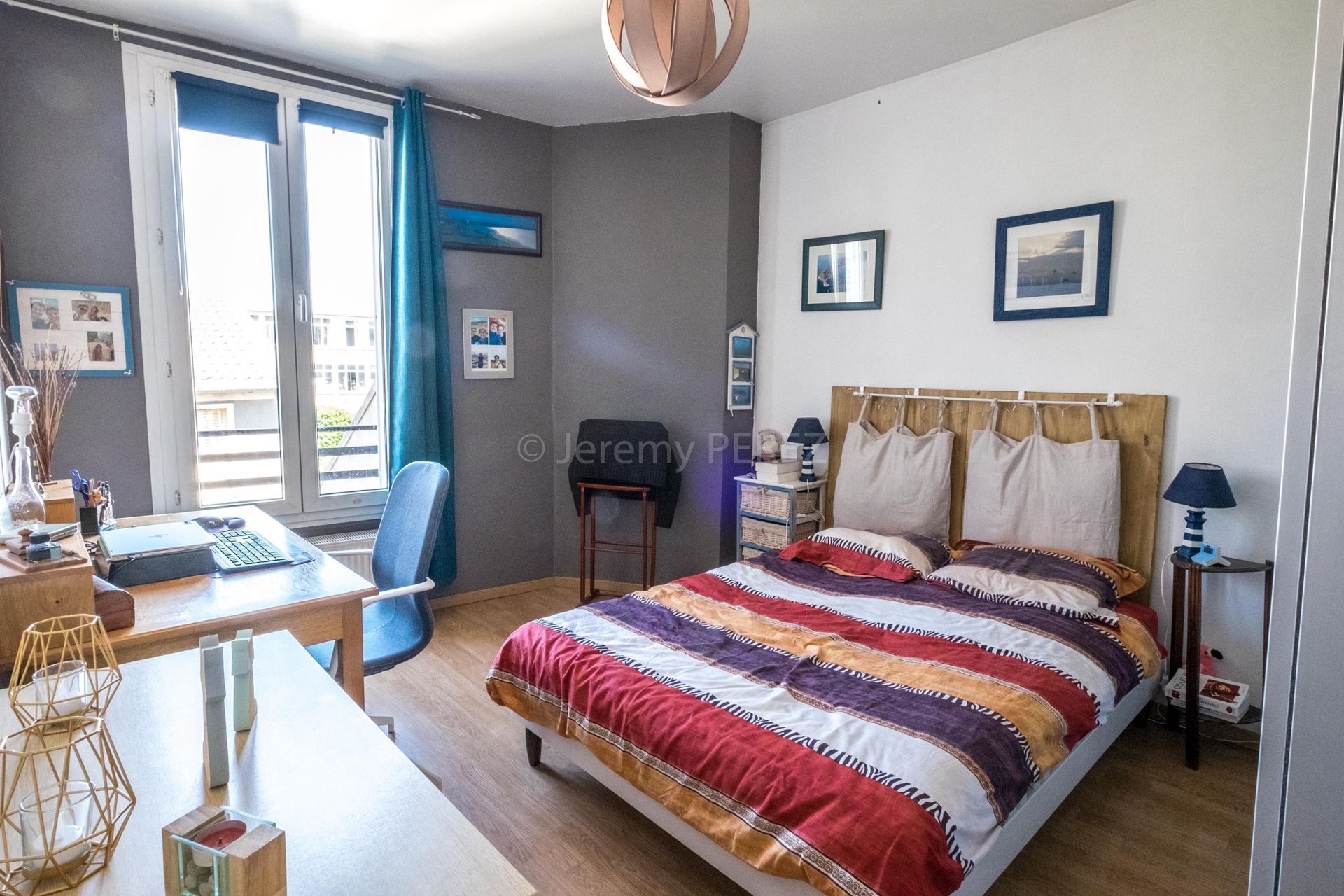 Before: an occupied bedroom cluttered with personal items—visitors see the seller’s life, not the property
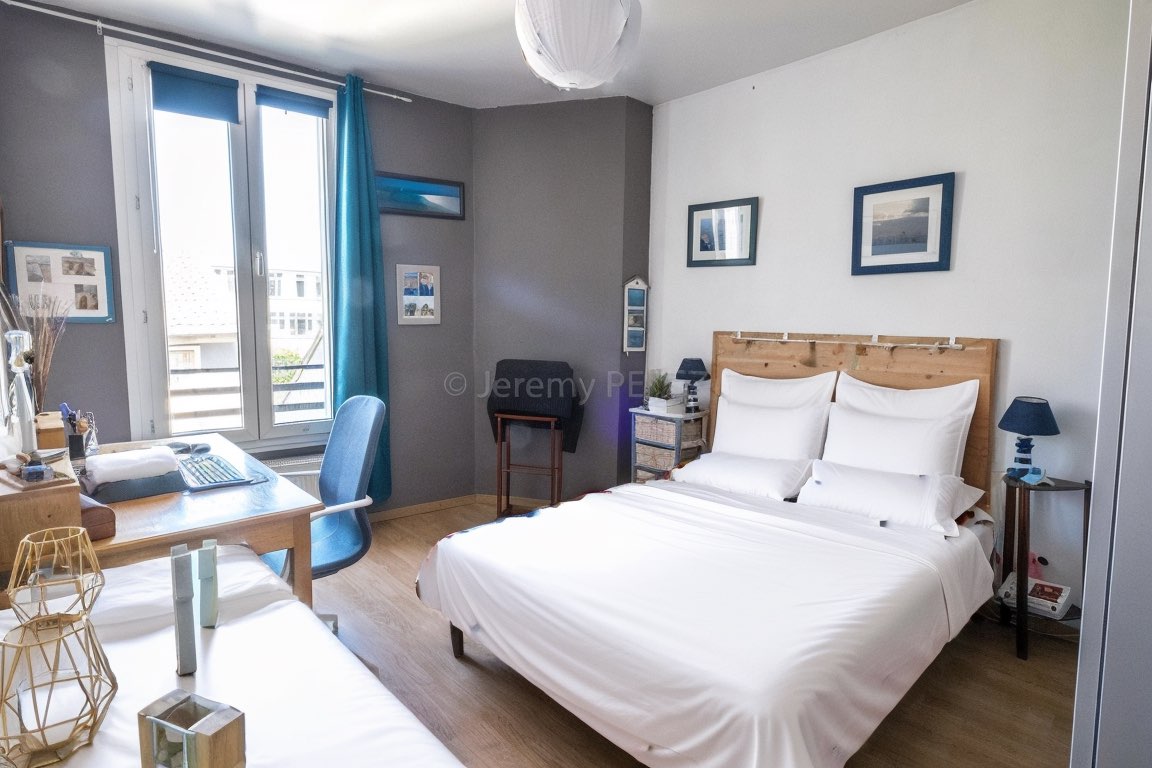 After: same room depersonalized and simplified—a generated staging, mention it explicitly in the listing
How to calculate the ROI of virtual staging on a mandate
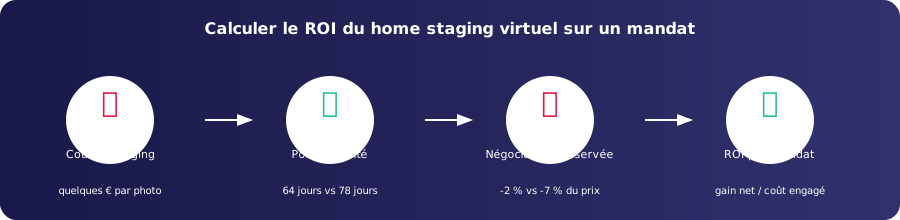
Step 1 — Quantify total costs
Add up AI generation costs for the 6–8 main photos of the property, plus your time: selecting views, choosing style, validating with the seller. With a streamlined process, count 20–30 minutes per mandate. Realistic total cost: less than €50 all-in.
Step 2 — Estimate avoided carrying costs
Use your average sales delay in the sector and apply the approximate two-week gain indicated by studies. Convert this into euros on the seller’s side (charges, insurance, bridging loan costs if any) and on the agency’s side (follow-ups, price drops). A property exceeding its market time almost always triggers price discussions.
Step 3 — Quantify preserved negotiation
This is the main component. Apply the FNAIM’s measured difference—negotiation kept within -2% instead of -7%—to the listing price. On €250,000, that’s €12,500 preserved; on €400,000, €20,000. Even conservatively halving that effect, the gain amounts to thousands of euros.
Step 4 — Compare gain to cost
Divide the estimated net gain by the total staging cost from Step 1. With a cost under €50 and a potential gain in the thousands, the ratio speaks for itself—this is precisely why calculations should be done per mandate and presented to the seller as a convincing argument.
Three detailed scenarios by property type
Vacant apartment after move-out—an illustrative case
A €250,000 T3, empty, cold photos. Virtual staging of the 6 main views: about 30 minutes of work. If this causes negotiation to go from -7% to -4%, the seller preserves €7,500; plus two weeks of costs and avoided carrying. The total invested remains below €50: the ROI is hundreds of times the cost—even at the low end.
Occupied and cluttered home—the most common case
A €320,000 family house, lived-in, full of furniture and personal effects. The main lever here isn’t furnishing but decluttering: virtual decluttering visually removes surplus and reveals volume without forcing owners to live in boxes. The dominant effect is an increase in qualified visits early on—the window where the bargaining power is strongest.
Property to renovate—highlight potential rather than condition
An €180,000 apartment needing refreshment, where each visit gets stuck on wallpaper. A virtual visualization of a renovated version, clearly labeled as such, helps buyers see the potential rather than just the current state. This is where negotiation gaps are generally largest—and a few visual projections can change the nature of the conversation. Our before/after examples illustrate what these projections look like.
Hidden benefits of the calculation
Three effects are not captured in the formula but influence an agent’s annual results.
Getting the mandate. Showing during estimation visits what the living room could become—tailored to the prospect—differentiates instantly from an agency that only presents raw photos. On IACrea, it’s the most cited use after closing a deal: staging helps secure the mandate first, sales follow.
Brand image. A consistent, well-presented portfolio builds a reputation of professionalism, attracting sellers and referrals—added value mandate after mandate.
Reuse of visuals. Before/after images feed social media, shop windows, prospects’ presentations. The same content is reused multiple times—and this approach aligns with the 2027 trends in virtual home staging, where personalized visuals per buyer segment become standard.
When virtual staging isn’t enough
An average high ROI can’t prevent three pitfalls that negate its benefits.
Poor pricing. No staging can sell an overpriced property by 15%. Staging optimizes presentation but doesn’t fix overestimation—using it to delay a necessary price discussion devalues the property instead of adding value.
Weak initial photos. AI enhances decent photos but won’t rescue dark or distorted images. Careful shooting—ideally HDR, directly from the IACrea photo app—remains fundamental.
Lack of transparency. An unstated staged photo causes disappointment and legal risks. Explicit mention is required, and properly introduced, it becomes a selling point (“here is the property’s potential”) rather than an admission. Exact guidelines are detailed in our article on the legality of virtual home staging in listings.
FAQ
Is virtual home staging really profitable for a real estate agent?
Yes, it’s one of the most asymmetric marketing investments: a few euros per photo versus an 18% median sales delay reduction (64 days instead of 78, FNAIM/OpinionWay) and negotiation margin constrained to -2% instead of -7%. Even if staging only benefits a portion of mandates, the cost is marginal compared to the potential gain.
What’s the cost difference between physical and virtual staging?
In France, physical staging runs €1,500–€5,000 for a complete service, or about 0.5%–4% of the property price. Virtual staging costs only a few euros per photo. For 6–8 photos, the total remains under €50, with unlimited variations included.
How much time does staging save on average?
The FNAIM/OpinionWay study finds properties are sold 18% faster—64 days instead of 78. US surveys show that 49% of seller’s agents see a reduction in market time thanks to staging. The actual gain is roughly two weeks—consistent across studies.
Does virtual staging increase the sale price?
It mainly protects the listing price: staged properties sell with negotiation margins around -2%, versus -7% for unstaged ones (FNAIM/OpinionWay). In the U.S., 29% of agents report offers 1–10% higher compared to comparable unstaged properties (NAR). Staging doesn’t boost a poorly priced property—it prevents undervaluing.
How to calculate the ROI of virtual staging on a mandate?
Four steps: sum staging costs (a few euros per photo), estimate avoided market time and related costs (follow-ups, price reductions, seller costs), quantify preserved negotiation margin (difference between -2% and -7%), and relate net gain to the cost. On a €300,000 property, saving 5 points amounts to €15,000—staging less than €50 makes this clearly worthwhile.
Conclusion: ROI calculated mandate by mandate
Overall, studies agree: a well-staged property sells faster and negotiates less. What’s changed in 2026 is the denominator—at just a few euros per photo, the ROI of virtual staging can no longer be averaged—it must be demonstrated on each mandate, with concrete figures from the property, starting at the estimation appointment.
The best way to use this guide? Recompute the 4-step calculation on your last closed mandate—and do it on the next, before listing. With IACrea’s virtual staging, the process takes less time than reading this article.
About the author

Co-founder & CTO of IACrea
Constance Laborie is co-founder and CTO of IACrea, the AI platform that helps real estate professionals create their visuals — photos, virtual home staging and videos — in seconds. She leads the product and technical development of the platform and writes practical guides on real estate photography, virtual home staging and the use of AI in real estate.
Related articles
Ready to turn your photos into content that sells?
Join thousands of real estate agents using IACrea to create professional content in seconds.
Try for free →