

Property listings with video receive 403% more calls than those without, according to Homes.com. Yet fewer than 15% of real estate agents in France publish a video alongside their listings — not for lack of desire, but because producing a professional video used to cost between €300 and €800 and take several days.
AI has changed everything. In 2026, any agent can turn a single property photo into a professional animated video in under 2 minutes — no camera, no editor, no video budget. That's exactly what AI real estate video makes possible, and this guide explains how to make the most of it.
What you'll learn in this guide:
- Why video has become the dominant format for real estate listings in 2026
- How AI video generation (photo-to-video) actually works
- The 4 most effective types of AI video for selling a property
- Where and how to distribute your videos for maximum reach
- The complete workflow for integrating AI video into your daily work as an agent
- The real ROI and costs compared to traditional solutions
Why video has become essential in real estate
The numbers don't lie
The French real estate market has shifted entirely to digital since 2023. Today, 92% of property searches start online (FNAIM, 2025), and buyers spend an average of 6 minutes on a listing with video versus 90 seconds on a photo-only listing.
Here's what consolidated market data shows:
| Metric | Photo-only listing | Listing with video |
|---|---|---|
| Average number of views | 100 | 280–400 |
| Contact rate (leads) | 2.1% | 8.5% |
| Average time to sell | 78 days | 49 days |
| Average sale price vs. estimate | -3% | +1.2% |
Sources: Homes.com, NAR Real Estate in a Digital Age 2025, French industry estimates.
Video is no longer a marketing "nice-to-have" — it's the format buyers expect. A property presented with only static photos in 2026 inadvertently creates the impression that it's hard to sell, or that the agent is unprofessional.
What buyers expect today
The 30–45 age group, currently the core target of the residential real estate market, grew up with YouTube and Instagram. For them, the virtual viewing starts long before any physical visit: they want to feel the space, the light, the atmosphere — something a static photo simply cannot convey.
Video addresses three fundamental psychological needs:
- Projection: camera movements allow the viewer to "move through" the property
- Trust: a video gives a more honest perception of space than a retouched wide-angle photo
- Emotion: music, fluid movement, and animated light create an emotional connection
AI video vs. traditional video: the quiet revolution
The real cost of a traditional real estate video
Before AI, producing a professional video required a complex production chain:
- Videographer: travel + shooting (2 to 4 h) + editing (3 to 6 h) → €250 to €600
- Drone (for exteriors): C1/C2 certification required, specialist contractor → €150 to €300
- Turnaround time: 3 to 7 days between the shoot and final delivery
- Revisions: every correction meant more delays and extra cost
The result: only prestige properties or new-build developments could economically justify a video. Apartments at €200,000 stayed on static photos.
What AI changes in 2026
The latest-generation video models (such as those built into IACrea) use an approach called photo-to-video: from a single still image, the AI generates an animated video clip of 5 to 15 seconds, with smooth camera movements, natural lighting effects, and quality sufficient for property portals and social media.
| Criterion | Traditional video | AI video (IACrea) |
|---|---|---|
| Cost per property | €400 – €900 | €2 – €8 per video |
| Production turnaround | 3 – 7 days | < 2 minutes |
| Equipment required | Camera, drone, editing software | Smartphone + web access |
| Revisions | Paid and slow | Unlimited, instant |
| Perceived quality | Professional (cinematic) | Professional (social, portals) |
| Properties processed/day | 1 to 2 | 20 to 50 |
For 90% of real estate transactions — standard residential properties between €150,000 and €800,000 — AI video offers an unmatched quality/cost/turnaround ratio.
How AI real estate video creation works
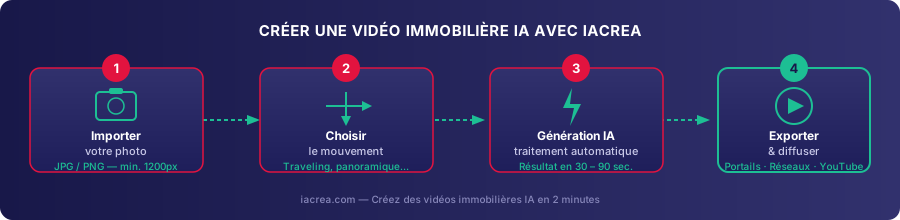
Animation from a photo (photo-to-video)
The core technology is based on Video Diffusion Models trained on millions of cinematic and real estate sequences. The model "understands" the spatial depth of a still image — the perspective, background planes, light sources — and generates movement that is consistent with that geometry.
This is not a simple zoom or parallax effect. The model generates frame by frame a smooth camera movement (forward dolly, pan, gentle rotation) that respects the optical laws of the photographed room.
The result: a 5 to 15-second video that gives the impression of a genuine cinematic shot — without ever moving a tripod.
Available movement styles
IACrea offers several types of movement tailored to different property spaces:
- Forward dolly: ideal for entrances and hallways — the "entering the property" effect is very impactful
- Horizontal pan: perfect for large living rooms and reception rooms with views
- Gentle elevation: highlights double-height ceilings and vertical volumes
- Exterior dolly: for facades, gardens and terraces with blue sky
Each style can be adjusted for intensity (slow and contemplative vs. dynamic and modern) to match the target buyers and the property's positioning.
Step by step with IACrea
Step 1 — Import the photo Upload your raw or staged photo. The quality of the input photo directly affects the quality of the video. Refer to our professional real estate photography guide to optimise your shots beforehand.
Step 2 — Select the movement style Choose the type of dolly move and the intensity. IACrea offers a real-time preview before generation.
Step 3 — AI generation (30 to 90 seconds) The model generates the video. No technical input is required during this time.
Step 4 — Export and distribution Download the video in MP4 format optimised for portals (SeLoger, Leboncoin) or for social media (Instagram Reels, Facebook, YouTube Shorts).
Total time: under 3 minutes. A 5-room apartment with 8 key photos can be fully video-toured in under 25 minutes of actual work.
The 4 most effective types of AI video for selling
1. The property presentation video (listing video)
This is the main video for the listing. It chains together 5 to 8 clips of 5–8 seconds covering the key rooms of the property: entrance, living room, kitchen, master bedroom, bathroom, and exterior. All set to a light background music track.
This video effectively replaces the basic photo slideshow on portals that support video (SeLoger Premium, PAP, Bienici).
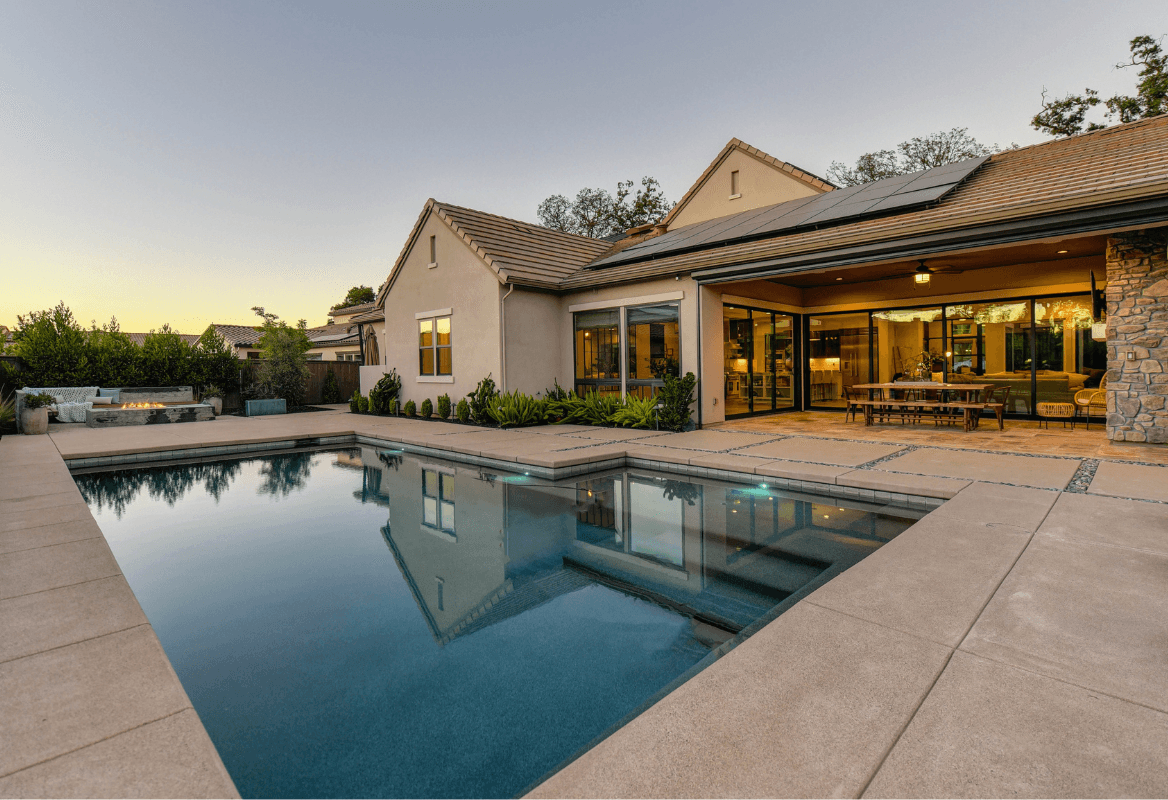
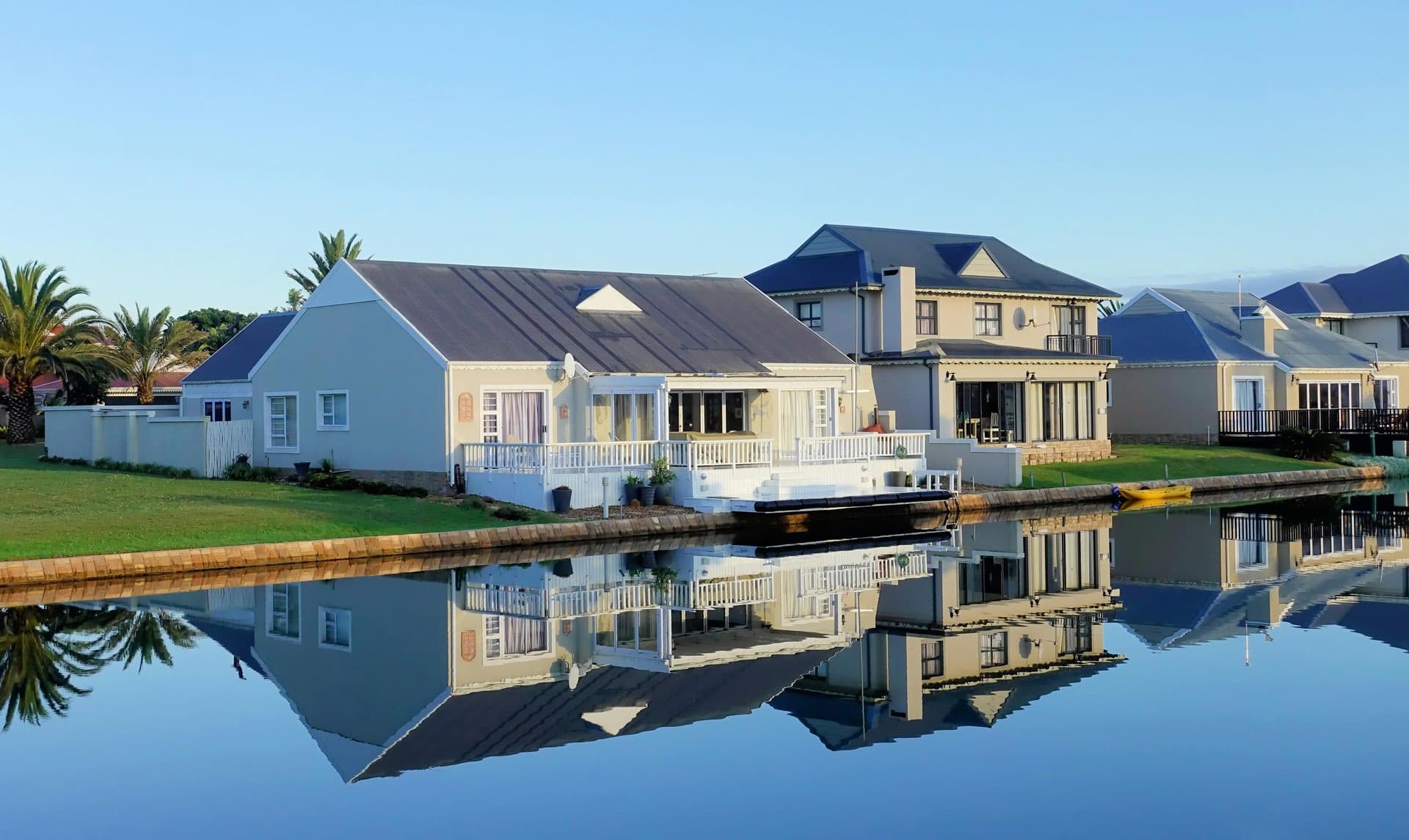
Example: AI-generated exterior dolly shot of a house with garden — result obtained from a single photo
2. The seasonal or lighting effect video
Did you photograph a property in winter, on an overcast day? AI can transform that shot into a bright summer scene — blue sky, warm light, soft shadows. The property regains its full visual potential, regardless of the weather on the day of the shoot.
This feature is particularly effective for:
- Properties with a garden or terrace photographed out of season
- Exteriors under grey skies (very common in the Île-de-France region or northern France)
- Under-exposed interiors where you want to showcase the natural light
3. The short social media video (Reel / Short)
Format: 9:16 (vertical), 15 to 30 seconds, with captions and trending music.
This format is optimised for Instagram Reels, TikTok, and YouTube Shorts. It doesn't try to show everything about the property — its goal is to generate clicks and engagement: a spectacular view, a before/after effect, a room transformed by virtual home staging.
Used in combination with virtual home staging, the real estate Reel becomes a formidable organic prospecting tool: algorithms naturally favour this format.
Example: AI animation of a kitchen — video generates on average 3x more engagement than an equivalent static photo
4. The before/after video (staging in motion)
One of the most striking uses: visually comparing a property before and after virtual home staging within the same video shot. The progressive reveal effect (the empty property that fills with furniture in a cross-fade) generates engagement rates far above standard formats.
This format works particularly well for vacant or renovation properties, where the goal is to show the potential rather than the current state.
Example of an interior before/after effect: the transition from the empty property to the furnished property is generated automatically by IACrea
Where and how to distribute your AI real estate videos
Property portals
SeLoger: accepts MP4 videos up to 500 MB. Listings with video benefit from better placement in sorting algorithms.
Leboncoin Immobilier: video format available on Pro listings. Limit: 2 minutes, MP4/MOV format.
PAP.fr: videos accepted on all listings, at no extra cost.
Logic-Immo / Bienici: native videos integrated directly into the property page.
Recommendation: export your videos in two formats simultaneously — 1920×1080 (16:9) for horizontal portals and 1080×1920 (9:16) for social media.
Need to fix a video before publishing — convert an iPhone MOV file to MP4, shrink a file that's too heavy for a portal or email, or trim off a few seconds? Our free video tools handle it in seconds, directly in your browser, with no sign-up required.
Instagram Reels and Facebook
Instagram algorithmically favours Reels above all other formats. A well-crafted real estate Reel can organically reach 10 to 50 times your follower base — a free prospecting opportunity.
Best practices:
- Duration: 15 to 30 seconds (beyond that, completion rates drop)
- Hook in the first 3 seconds (spectacular zoom, statistic, question)
- Captions are essential (70% of Reels are watched without sound)
- CTA at the end of the video: "Link in bio to view the listing"
Check out our guide on how to use your real estate photos on social media to go further with your social media strategy.
YouTube and Google
YouTube is the world's 2nd largest search engine, and real estate videos have untapped SEO potential there. A well-optimised local agent YouTube channel (title with city + property type + price, description with approximate address) can appear in Google results for highly targeted searches.
Recommended format for YouTube: full property presentation video (2 to 4 minutes), with an SEO description and a link to the listing in the first pinned comment.
Integrating AI video into your real estate workflow
The recommended process
An efficient workflow is organised in 4 stages, systematised for each new mandate:
-
Photography (Day 0) — Photos of the property following our photography guide. Select the 8 to 12 best photos for video processing.
-
AI processing (Day 0, within the hour) — Upload to IACrea, generate video clips room by room + optionally virtual home staging on the key views.
-
Editing and export (Day 0–1) — Assemble the clips via the IACrea editor or a tool like CapCut for social media. Export in portal format + vertical format.
-
Synchronised publication (Day 1) — Portals + Instagram + Facebook + YouTube simultaneously. Schedule your social media posts from IACrea using the scheduling feature.
Mistakes to avoid
Mistake #1: Using photos that are too dark or blurry AI amplifies the flaws of an under-exposed photo. A blurry photo will produce a blurry video. Invest in good photography — it's an essential prerequisite. Our real estate photo app automatically corrects exposure and applies HDR to optimise every shot.
Mistake #2: Using the same movement style for every room A forward dolly works well on an entrance or hallway, but becomes monotonous across 8 consecutive clips. Vary the movements to maintain attention.
Mistake #3: Forgetting the legal disclaimers on staged videos If the video shows a virtually staged property, the mention "illustration with virtual home staging" is required in the listing description (the same requirement as for staged photos).
Mistake #4: Publishing videos without audio optimisation A video with no music, or with unsuitable music (too fast-paced for a quiet apartment, too slow for a dynamic property), undermines perception. IACrea offers a library of royalty-free music tracks suited to real estate.
How much does it cost? The real ROI of AI real estate video
Market solution comparison
| Solution | Cost per property | Turnaround | Perceived quality |
|---|---|---|---|
| Professional videographer | €400 – €900 | 3 – 7 days | ★★★★★ |
| Drone + editing | €200 – €400 | 2 – 5 days | ★★★★☆ |
| Basic SaaS video app | €50 – €100/month flat rate | 1 – 2 days | ★★★☆☆ |
| IACrea AI video | €2 – €8 per video | < 2 minutes | ★★★★☆ |
The ROI calculation for an active agent
Take an agent managing 40 mandates per year with an average fee of €4,500.
- Before AI video: 40 photo-only listings → average time to sell: 75 days
- With AI video (conservative assumption: 20-day reduction in time to sell) → 55 days
- Impact: each mandate closed 20 days earlier frees up time and capacity for a new mandate
- AI video cost: 40 properties × 5 videos × €4 = €800/year
For €800 invested in IACrea, this agent reduces their average time to sell by 27% — which translates concretely into a more fluid portfolio, more satisfied vendor clients, and a stronger reputation. Check out our pricing plans to find the plan suited to your volume.
FAQ: your questions about AI real estate video
Is AI video accepted on SeLoger and Leboncoin? Yes. AI-generated videos are standard MP4 files — portals make no distinction between filmed and AI-generated video. The only requirement is to mention "illustration with virtual home staging" if the property is virtually staged in the video.
Do you need training to use IACrea video? No. The interface is designed for non-technical users. The learning curve is 10 to 20 minutes, after which generating a video becomes as quick as uploading a photo to a portal.
What input photo quality is required? Minimum recommended: 1,200 × 900 px, good exposure, no motion blur. Photos from most modern smartphones (iPhone 13+, Samsung Galaxy S21+) are sufficient. For optimal results, use the IACrea photo app, which automatically optimises every shot.
Does AI video completely replace the professional videographer? For prestige properties (> €1M), developer new-builds, and agency brand videos, the professional videographer remains superior. For the entire standard residential market, AI video offers an unbeatable quality/cost ratio.
Can AI video be combined with virtual home staging? Yes — and it's actually the most effective combination. You virtually stage your photos with IACrea, then generate the videos from those staged photos. The final result presents a furnished, animated, well-lit property — with no physical intervention in the property whatsoever.
Are the videos royalty-free? Videos generated via IACrea from your photos belong entirely to you. You can publish, share, and use them for commercial purposes without restriction.
Conclusion: AI video, the new standard for real estate listings
Video was until now reserved for agents who could afford to include it in their marketing budget. AI has removed that barrier. In 2026, producing a professional property video takes just 2 minutes and costs less than a cup of coffee.
Agents who adopt AI video now are gaining a decisive competitive advantage: their listings stand out, their properties sell faster, their vendor clients recommend them.
Try AI real estate video with IACrea — the first 5 videos are free, with no commitment.
About the author

Co-founder & CEO of IACrea
Pauline Clavelloux is co-founder and CEO of IACrea. In daily contact with real estate agencies and agents, she understands their challenges around visibility, marketing and lead generation. On the blog, she shares actionable strategies on real estate marketing, social media and prospecting in the age of AI.
Related articles
Ready to turn your photos into content that sells?
Join thousands of real estate agents using IACrea to create professional content in seconds.
Try for free →