
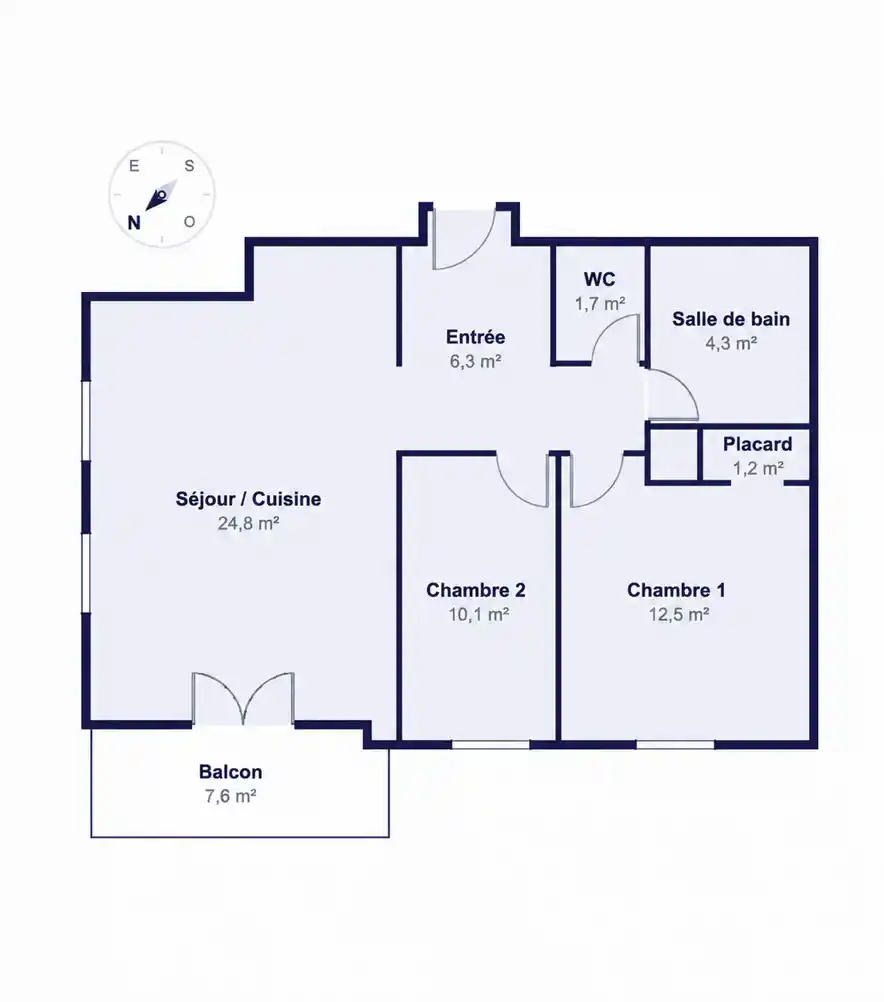
Three agents received in the same week, three nearly identical property brochures, but only one exclusive mandate signed. Sellers don’t always choose the cheapest or most experienced agent — they often pick the one who left something tangible on the table while the others were just promising.
Having a floor plan of the property is one of those tangible elements. Generated in just a few minutes during the valuation appointment instead of being postponed “for later,” it becomes a concrete argument at the crucial moment when the decision between exclusive sale mandate, simple mandate, or switching agencies is made.
What you will learn in this guide:
- Why the valuation appointment is usually wrapped up in a single visit, rarely two
- What sets apart a floor plan presented directly to the seller from a generic brochure
- The key data that reinforce the value of exclusivity during the discussion
- How to incorporate plan scanning into the appointment flow
- What the plan does not replace in your argumentation
Why the valuation appointment is typically completed in a single visit
A seller preparing to list their property rarely invites only one agent. They compare, often within the same week, two or three professionals doing the same thing: visiting rooms, estimating a price, explaining why they should be granted exclusivity instead of multiple agencies under simple mandates.
In this tightly scheduled process, the verbal pitch tends to be quite similar: knowledge of the neighborhood, network of buyers, support until signing. What truly differentiates one visit from another is what remains after the agent has left — a brochure that can be flipped through once, or a tangible support that can be shown to the spouse absent during the appointment.
The decision is made quickly, often on the same day
A seller who receives three agents in one week doesn’t read three complete dossiers before making a choice. They compare impressions still fresh in their mind, and they tend to remember what they saw and handled better than what was just described. A floor plan displayed on a screen, with rooms labeled and areas calculated, remains identifiable even after the agent who created it has left.
What sets apart a floor plan produced in front of the seller from a generic brochure
The traditional estimation brochure — agent’s biography, pricing method, included services — remains useful to build confidence, but it tells the same story across all competitors who are at least somewhat organized. The real-time plan changes the game: it doesn’t just describe a service, it demonstrates it.
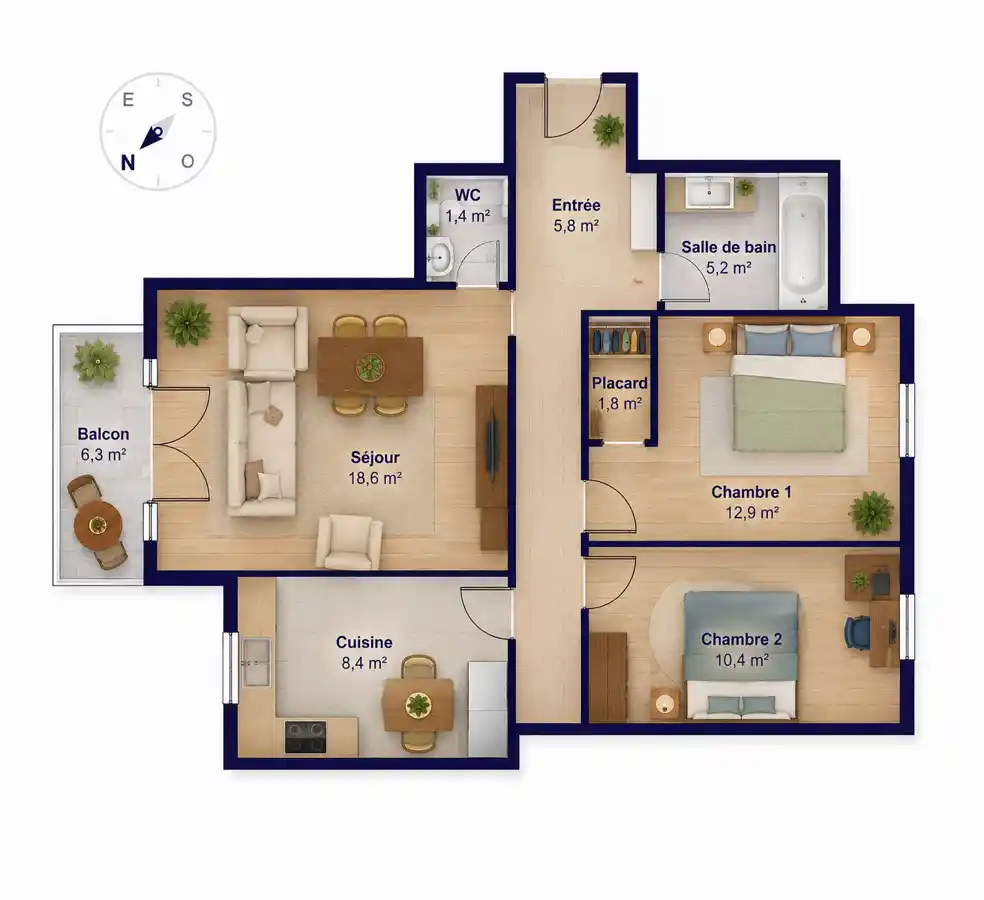 A labeled, room-sized plan generated during the appointment, not just announced for later
The contrast with agents who don’t produce such plans
Many agencies promise a plan “within days after signing.” The seller who already has theirs before choosing an agent perceives the difference immediately and without explanation: the one who shows it has already started working, while the one promising still requires a sign of trust. In a meeting where every minute counts, this demonstration replaces several lines of argument.
The data supporting the exclusivity argument
A plan produced on the spot opens the door, but it’s the concrete data that seals the decision in favor of exclusivity rather than a dispersed simple mandate with multiple agencies.
Properties under exclusive mandate sell on average in 91 days, compared to 142 days for a simple mandate — a difference of 51 days, nearly two months, confirmed by a study relayed by the Capifrance network (Journal de l'Agence). Out of one hundred successful sales, forty come from an exclusive mandate, and negotiation gaps are also narrower: -2% on the initial price in exclusivity, versus -5% on average for a simple mandate (MeilleursAgents).
| Indicator | Exclusive Mandate | Simple Mandate |
|---|---|---|
| Average selling time | 91 days | 142 days |
| Share of successful sales | 40% | 60% split among multiple agencies |
| Negotiation margin on price | -2% | -5% |
These figures do not replace a conversation but structure it: instead of claiming that exclusivity “better protects the property,” the agent can show, with the plan as support, what this protection concretely produces in terms of time and final price.
A plan that also counts once the listing goes online
The effect doesn’t stop at the appointment. Portals that rate the quality of an ad take into account the presence of a plan among their visibility criteria — to the point that a well-constructed listing (photos, video, plan) can be up to sixteen times more visible on the front page than an incomplete listing (Immobilier 2.0). The argument made during the appointment therefore extends into the actual performance of the ad once the mandate is signed.
How to incorporate plan scanning into the valuation appointment
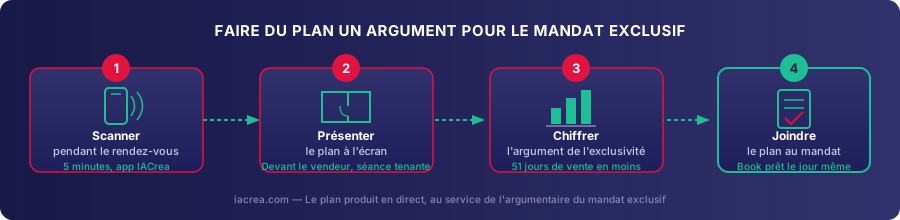 The plan produced during the visit, from measuring to signing
Before the appointment
No heavy preparation needed: a smartphone equipped with an appropriate sensor and familiarity with the scanning gesture are enough to produce the 2D plan of the property. It’s not an ancillary service to be scheduled separately; rather, it’s a step that fits into the visit already planned for the valuation itself.
During the appointment
Scan room by room, with furniture in place, in a few minutes per room. Once the walkthrough is complete, the plan is immediately available: this is the moment to show it on screen, in front of the seller, even before discussing the price or the type of mandate. The order matters — demonstrating before arguing instills a credibility that the latter cannot.
After signing
The plan is directly added to the listing brochure, with no new order or waiting time. Our scan and editing tutorial details how to take measurements room by room, and the comprehensive guide to 2D plans for listings explains what the plan should include once published.
The plan compared to the competition and the simple mandate reflex
A hesitant seller considering both exclusivity and simple mandate often thinks prudently: spreading the mandate across multiple agencies seems to reduce the risk of failure. The real-time plan subtly counters this logic by showing that a single, well-equipped agent will go faster than a collection of agencies neutralizing each other due to lack of individual engagement on a property placed in competition.
In the face of a competitor promising the same service “after signing,” the pre-produced plan removes the most common argument for a simple mandate — waiting to see what each agency offers before committing. Nothing to wait for: the work is already visible, on screen, before the appointment ends.
What the plan does not replace in your argumentation
The plan convinces through demonstration, not legal accuracy. The surfaces displayed are indicative, useful for visualization and preparing the listing, but not a substitute for a regulatory measurement where necessary — especially the Carrez law surface for a condominium unit, which legally binds the transaction. Our article on living space and the Carrez law details this distinction and what risks an agent runs if they confuse them in an advertisement.
The plan also does not replace the price estimation itself, nor the knowledge of the local market which remains the core of the exclusive mandate’s argumentation: it’s a tool to support a broader lead generation strategy, not a standalone element.
FAQ
Is a 2D plan enough to get an exclusive mandate signed?
No. The plan is one of several proof elements — knowledge of the sector, justified pricing, included services — not a standalone argument. Its role is to quickly concretize what other agents only promise: it’s this contrast that influences the decision, not the plan alone.
Should the plan be charged during the valuation appointment?
No, it’s included in the service already offered to the seller, just like photos or a valuation opinion. With a subscription that includes the plan, its marginal cost is zero: charging it separately would turn a sales argument into an additional cost line, weakening the intended effect.
Should the plan be attached to the signed sales mandate?
It’s not legally required, but it’s good commercial practice: attaching the plan as an appendix shows the seller that the promised work during the appointment has already been delivered, even before marketing begins. The plan remains distinct from the mandatory listing mentions mandated by law.
What’s the difference between showing the plan during the appointment and sending it later?
A seller considering multiple agents often makes their decision on the same day or within 48 hours, while visits are still fresh. A plan sent three days later arrives after the decision is made; a plan shown on-screen during the appointment weighs heavily at the very moment when the comparison takes place.
How long does it take to produce the plan during the valuation visit?
Around 5 minutes for a full apartment, by scanning each room with an iPhone Pro. The plan is available immediately after the scan. This time fits within the normal duration of an estimation appointment, without extending it or requiring a second visit.
Conclusion
Landing an exclusive mandate rarely depends on a single argument, but producing a plan in front of the seller during the valuation appointment changes the nature of the exchange: it turns a promise of service into immediate proof, right at the moment when the agent comparison is made. On the IACrea platform, agencies adopting this approach confirm that the plan often becomes the support they present at the end of the appointment to close the discussion — even before talking about the price again.
Compare our pricing and try scanning during your next valuation appointment: five minutes are enough to turn an ordinary visit into a decisive argument.
About the author

Co-founder & CTO of IACrea
Constance Laborie is co-founder and CTO of IACrea, the AI platform that helps real estate professionals create their visuals — photos, virtual home staging and videos — in seconds. She leads the product and technical development of the platform and writes practical guides on real estate photography, virtual home staging and the use of AI in real estate.
Related articles


Ready to turn your photos into content that sells?
Join thousands of real estate agents using IACrea to create professional content in seconds.
Try for free →