

A prospecting flyer has only two seconds to survive: the time it takes for the owner to pick it up from their mailbox, turn it over, and decide whether to keep it or toss it onto the pile of ads. In those two seconds, it's not your logo that speaks, but the image and the first line.
Real estate flyers remain one of the few local prospecting tools that directly reach property owners in a neighborhood, without an algorithm between them and you. But they only prompt a call if they promise one specific thing, showcase an appealing property, and comply with a legal framework that many agents discover too late. This guide details the three flyers to produce, 12 catchphrases categorized by purpose, the required mentions to include, the Stop Public rule, and the only honest method to find out if your mailing yields mandates.
What you will learn in this guide:
- The three types of real estate prospecting flyers and which one to choose based on your goal
- 12 ready-to-adapt catchy phrases, sorted by purpose (free estimate, “sold,” new mandate, neighborhood)
- How to create the visual that prompts calls: enhanced photo, before/after comparison, 2D plan, QR code linking to the video
- The mandatory mentions for an estate agent flyer and the Stop Public rule (fifth-class fine)
- How to measure the effectiveness of your mailing without market statistics
Real Estate Flyer: What Is It Really For
A real estate flyer is a short document, printed on one or both sides, distributed in a specific area to prompt a contact: a phone call, a QR code scan, or a request for an appraisal. Its purpose is not to showcase your agency. It should move the owner from “I haven’t thought about it” to “I’m asking questions.”
This is what sets it apart from a brochure or a business card, which are meant to reassure someone already familiar with you. The prospecting flyer targets strangers. It has only one mission, one promise, and one call to action.
What a flyer doesn’t do
It doesn’t sell your expertise in four lines, it doesn’t replace an appraisal appointment, and it doesn’t generate mandates on its own. A flyer promising everything (“appraisal, sale, support, advice”) without specifying anything offers few reasons to call. The one that makes a single promise is read in two seconds.
The three prospecting flyers to produce
There's no need to create ten templates. Three are enough, one for each sales situation.
The "Free valuation" flyer
This is the most common, because it directly targets homeowners who are hesitant. The promise: a valuation without any commitment. The visual features a well-kept interior, with the message overlaid on the image, as in the example below.
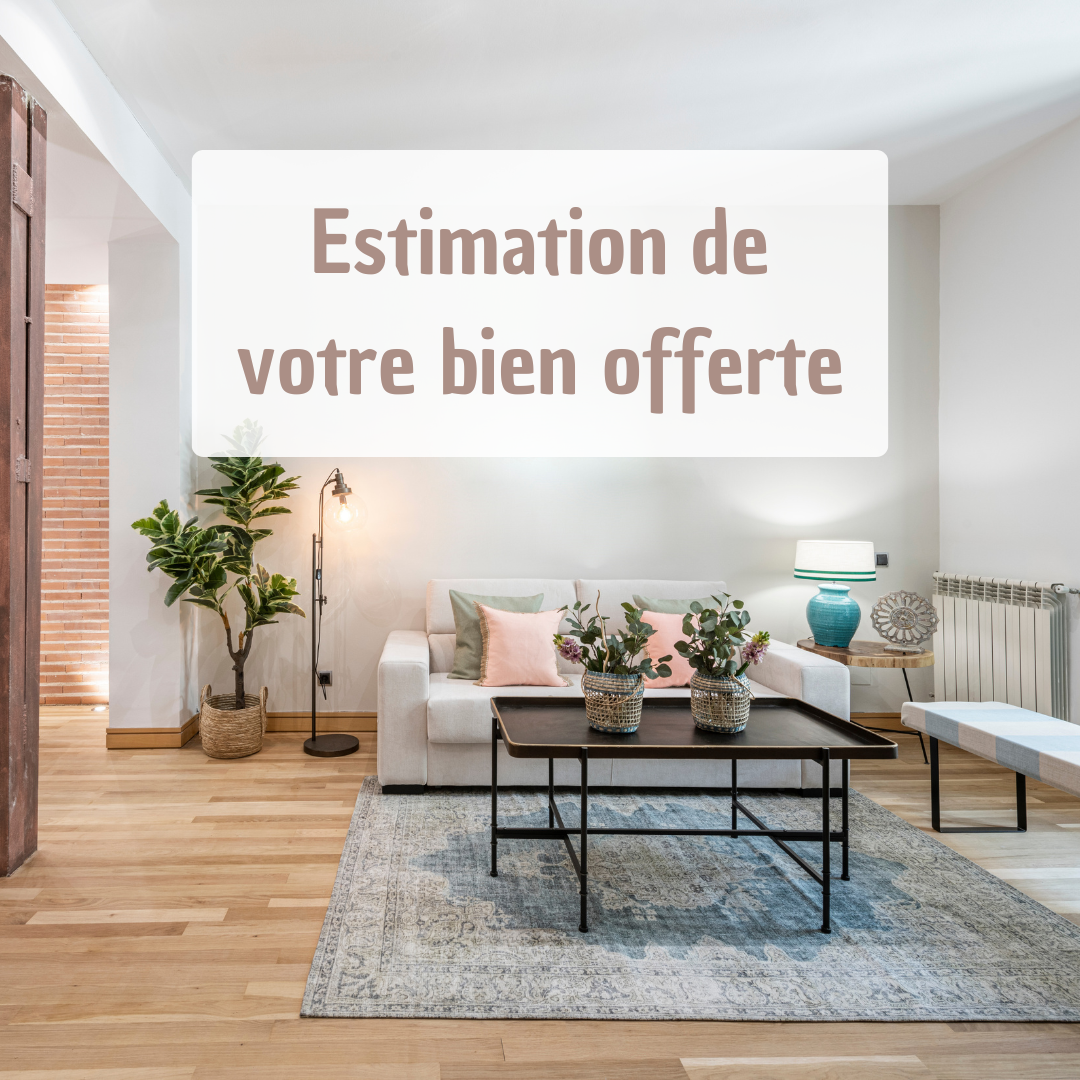
Example of a real estate flyer visual for a "free valuation" prospecting.
Its drawback: all your competitors distribute the same one. To stand out, the photo must be impeccable, and the text should mention the neighborhood ("Free valuation in Saint-Cyr"), not "your property."
The "Sold" or "New Mandate" flyer
It relies on local proof: a property in the neighborhood that you have just sold or listed. A nearby owner immediately understands that you work in their street and that there are buyers. This flyer converts best with sellers because it replaces an argument with a fact.
Two precautions: obtain the seller’s written consent before showing their property, and never print the sale price or exact address without their approval. A street and the number of rooms are enough.
The "Neighborhood" or "Project" flyer
Less direct, it informs: price trends in the neighborhood, average sale time, roadworks, new transport lines. It targets owners who are not selling yet and positions you as the local expert. It’s used for follow-up, not as the initial approach.
12 Real Estate Flyer Catchphrases by Usage
A good tagline fits in one line, includes a tangible benefit, and avoids promising results you can't deliver. These formulas should be adapted to your specific sector.
| Usage | Catchphrase |
|---|---|
| Free valuation | “Does your apartment on [street name] match what you believe it’s worth? Free valuation within 48 hours.” |
| Free valuation | “What’s the price for your house in [neighborhood]? A reasoned answer, with no obligation.” |
| Free valuation | “Just 20 minutes at your home to find out your property’s value.” |
| Sold | “Sold in [neighborhood]: your neighbor found a buyer in [x] weeks.” |
| Sold | “A property like yours just sold in your street. Want to know for how much?” |
| New mandate | “New in [neighborhood]: our latest mandate—see how we present it.” |
| New mandate | “Buyers are looking in your area. What if they visited your property?” |
| Neighborhood | “[Neighborhood]: what sales over the past six months say about your property.” |
| Neighborhood | “The tram is coming to [neighborhood]: what this means for your home's value.” |
| Highlighting | “Before/after: see your furnished living room even before the first visit.” |
| Highlighting | “Photos sell the visit. Ours begin with virtual staging.” |
| Follow-up | “We wrote to you last month. Just one question: do you have a selling project?” |
A real estate flyer catchphrase doesn’t have to be original; it needs to be precise. “Free valuation” alone says nothing; “Free valuation in [neighborhood] within 48 hours” specifies where, for whom, and in how much time.
The visual that prompts a call: photo, before/after, floor plan, video
A homeowner doesn’t read a flyer — they look at it. Visuals make the first impression, and that’s where most agency flyers look alike: three houses in perspective, a logo, a phone number. To stand out, use the media you’re already producing for your listings.
The enhanced photo of the property
A photo of the latest sold or listed property, corrected for exposure and colors, immediately looks more professional than a generic illustration. The IACrea photo app takes a photo of the property and applies an HDR effect: balanced dark areas, less burned-out windows, corrected colors. A sharp, well-exposed photo is also better suited for large-format printing. The professional real estate photography guide details the settings.
The virtual home staging before/after
This is the most effective visual hook for a seller’s flyer: an empty or cluttered living room on the left, the same room furnished on the right. The homeowner immediately sees how full staging enhances the space, without reading your pitch. The virtual staging can produce this before/after in just a few minutes.
A rule to follow: any modified visual must be clearly indicated as such. A mention like “Example of virtual staging” at the bottom of the image is enough for a flyer, and the applicable rules for listings are detailed in the article on the legal notice for virtual staging. If the example isn’t a client’s property, specify that.
The 2D floor plan, rare and immediately understandable
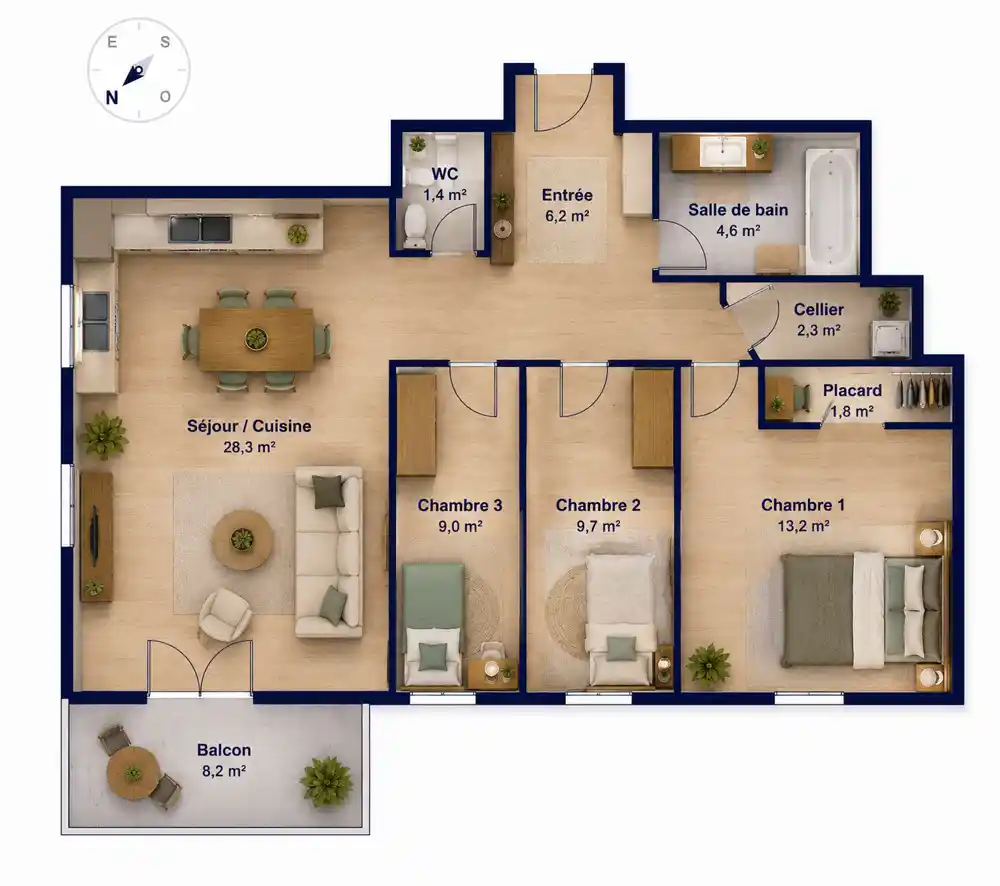
Few flyers feature a floor plan. Yet it’s the illustration that instantly shows that you provide a professional presentation. A 2D floor plan of a sold property, in small format on the back, reinforces credibility without taking up space. See also the property plan as an exclusive mandate argument.
The QR code linking to the property video
Paper can’t showcase a property tour. A QR code placed under the photo redirects the owner to the real estate video of the sold or listed property: they see how you present a property, which answers the question “and for my place, what would you do?” better than any phrase. Print the QR code at a minimum of 2 cm on each side, with a white margin, and test it on two different phones before printing.
Layout of a Real Estate Agent Flyer
A simple structure that appears on the flyers that generate calls:
- Front: an image, a hook. Full-page photo, a 6 to 10-word slogan, neighborhood name. Nothing else.
- Back, top: proof. A line about the sold property or the result, possibly a plan or a video via QR code.
- Back, middle: the unique action. A direct phone number or a QR code, never both competing with a website, three social media platforms, and an email.
- Back, bottom: the legal section. The mandatory notices, in small but readable print.
Format A5 or A6, paper weight of at least 135 g to prevent tearing upon touch. Aim for easily readable fonts at arm’s length: at least 14 points for the slogan, 8 points for the legal block.
Mandatory mentions on a real estate agent flyer
A flyer is a professional-use document: it must display the information applicable to your activity. The decree of July 20, 1972 (article 92), which specifies the Hoguet law, requires professional documents to include the number and place of issuance of the professional license, the company’s trade name and address, the activity carried out, and, if applicable, the guarantor’s name and address.
In practice, the legal section of an agency flyer includes:
- the trade name and company name, along with the agency’s address;
- the number and place of issue of the professional card (transaction), with the Chamber of Commerce and Industry (CCI) that issued it;
- the RCS (Trade and Companies Register) mention, followed by the registration office;
- the financial guarantee: name, address of the guarantor, and amount;
- professional liability insurance, according to your practices;
- for an independent representative, their status as a commercial agent, their registration number, and the mention of the principal.
The practical sheet from the DGCCRF on real estate agents outlines these obligations. If the flyer features a specific property with a price, the rules for displaying fees and the energy performance diagnosis (DPE) also apply. Have your legal section reviewed by your network, franchisor, or Chamber of Commerce before printing: an error can appear on 5,000 copies.
Flier Distribution and Stop Pub: What the Law Says
Distributing flyers in mailboxes is legal, with one costly exception: the Stop Pub sticker. Since January 1st, 2021, leaving an unaddressed printed material in a mailbox bearing the "Stop Pub" label is punishable by fines of the 5th class, up to €1,500, under Article L541-15-15 of the Environmental Code. The measure is detailed on the Ministry of Ecological Transition’s website.
Specifically:
- Check each mailbox. A distributor who blindly hands out flyers risks exposing your agency; your name appears on the flyer.
- Brief your distributor in writing: they must skip any mailbox with the sticker, as also reiterated by SeLoger.
- In buildings with a keypad entry system, never force access: a walk-in visit does not grant permission to enter without an invitation.
- Opt for addressed mailing for high-value targets (such as homeowners in a specific neighborhood): it is not affected by Stop Pub, but always respect the recipients’ right to oppose.
Measuring the return of a flyer: the only reliable method
No serious public statistics provide an "average return rate" for real estate door-to-door flyers: it varies depending on the sector, the quality of the visuals, the season, and homeowner density. Instead of trusting a number found online, track your own.
- A number or code per distribution. A dedicated line number or a code to mention ("say FLYER-NORD") indicates where each call comes from.
- A QR code for each flyer version. Add a campaign parameter to the URL: you'll distinguish the "estimate" flyer from the "sold" flyer.
- A question during the call. "How did you get my number?" — the answer feeds your prospecting tracking tool.
- A threshold before judging. One initial distribution says almost nothing. Compare at least two waves, two weeks apart, in the same sector, before changing your message.
Measuring at this level only takes a few minutes and helps you avoid re-issuing a flyer that doesn't yield results or abandoning a channel that works.
Combine flyer, estimation, and follow-up
The flyer opens the door; the subsequent appointment determines the mandate. So, prepare the next steps before printing: schedule the appointment, provide the valuer's opinion, and present the enhancement plan. A flyer promising a free estimate and an agent arriving with a makeshift document is a lost contact. To structure everything, the guide on real estate lead generation shows how to coordinate the channels.
FAQ
What are the mandatory mentions on a real estate agent's flyer?
A flyer is a professional document: it must include the company name and address, the number and place of issuance of the professional license, the RCS mention, and, if applicable, the name and address of the guarantor. An independent representative should also specify their status as a sales agent and their registration number. Have your legal block approved before printing.
Can I put a flyer in a mailbox with a "Stop Pub" sticker?
No. Since January 1, 2021, leaving an unsolicited printed material in a box marked "Stop Pub" is punishable by a fifth-class fine, up to €1,500. Mailed correspondence is not covered by this regulation, but the recipient retains the right to oppose.
What catchy phrase should I choose for a real estate prospecting flyer?
Pick a clear headline that names the neighborhood and offers a concrete benefit: "Free valuation in [neighborhood] within 48 hours" works better than "Sell at the best price." Avoid promising outcomes you cannot guarantee, like a specific sale price or deadline.
Should I include a photo of the property on a prospecting flyer?
Yes, visuals catch attention: a photo of the last sold property, enhanced for exposure and color, or a before/after virtual home staging transformation. Obtain the seller’s permission before displaying their property, and clearly indicate any retouched or virtually staged images.
How can I tell if my real estate flyer was effective?
Assign a unique phone number, code, or QR code to each distribution, then ask every caller how they found your contact information. Compare at least two campaign waves within the same area before making changes: a single distribution isn't enough to draw conclusions.
Conclusion
Real estate flyers work when they deliver a single promise, feature an eye-catching visual, and adhere to the legal framework for flyers. There's no need to search for the perfect phrase: try two different hooks, track the responses, and reinvest in the visuals that generated the most reactions.
To create these visuals without using a service provider, try the virtual home staging, the 2D floor plan, and the IACrea photo app, then check out the pricing to choose the package that suits your property volume.
About the author

Co-founder & CEO of IACrea
Pauline Clavelloux is co-founder and CEO of IACrea. In daily contact with real estate agencies and agents, she understands their challenges around visibility, marketing and lead generation. On the blog, she shares actionable strategies on real estate marketing, social media and prospecting in the age of AI.
Related articles
Ready to turn your photos into content that sells?
Join thousands of real estate agents using IACrea to create professional content in seconds.
Try for free →