
On a listing portal, your home takes up a thumbnail a couple of inches wide. In a social feed, your profile picture shrinks to a circle the size of a fingernail. That's where your real estate logo does most of its work, not on the sign above your office door.
This guide is for agents and brokerages launching a brand or redesigning one. It covers the rules for a real estate logo that stays readable at small sizes, the disclosures it doesn't replace, and how to put it to work on the media that sell homes: watermarked listing photos with our real estate photo editing software, video end cards, social media posts, and floor plans.
What you'll learn in this guide:
- 7 rules for a real estate logo that works from yard sign to favicon
- The advertising disclosures no logo replaces, and how to protect yours
- The file kit to get from your designer before you pay the final invoice
- How to watermark listing photos without hurting the listing
- How to carry your logo into video, social media, and floor plans
What a real estate logo needs to do
A logo isn't there to tell your brokerage's story. Its job is to be recognized in a split second and to tie everything you publish to your name: a listing, a video, a yard sign, a business card. The rest is up to your photos and your copy.
List every place it will appear before you sketch anything. For a real estate business, that list is long: office sign, yard signs, business cards, flyers, your website and its favicon, social media profile pictures, listing photo watermarks, video intros and end cards, the floor plan you hand the seller, your email signature. Two thirds of those show your logo very small, often on top of a photo.
At IACrea, we see it every day: brokerages that upload their logo once to their brand kit get it automatically on their photos, videos, and floor plans. Those whose logo only exists as a large, full-color file on a white background have to rework it before they can use it. The problem is never taste. It's technical.
7 rules for a great real estate logo
1. Readable at 48 pixels
Google recommends a square favicon larger than 48 × 48 pixels so it displays cleanly in search results. That's a good test for everything else: shrink your logo to that size. If the name turns illegible or the symbol becomes a smudge, it won't work as a watermark or a profile picture either.
2. A horizontal version and a square version
The horizontal version (symbol on the left, name on the right) goes on your website, flyers, and signs. The square version, cut down to the symbol or your initials, goes wherever space is tight: favicon, profile picture, the corner of a photo. A logo designed in one version always ends up squeezed into a circle.
3. Two colors at most, plus a one-color version
Two colors are enough to be recognized. Above all, plan an all-white version for dark photos and video, and an all-black version for documents printed in black and white. Navy and green are everywhere in real estate: a less expected color helps you stand out.
4. A typeface you can read from the street
A yard sign gets read from a moving car in a few seconds. Skip script fonts and very thin letters: they vanish at a distance and at small sizes alike. A sans-serif typeface in a medium weight is the safest choice.
5. A simple symbol, or no symbol at all
Rooftops, keys, doors, and stylized houses are everywhere. They say nothing more than the words “real estate,” and they all look alike when small. If you keep a symbol, strip it down to a few lines. A short, well-drawn name is often more recognizable than one more icon.
6. A file with a transparent background
A logo on a white background stamps a white box on every photo. Ask for a PNG with a transparent background and a vector file (SVG or PDF): the first one for screens, the second for print at any size.
7. Built to last, not to trend
Your logo will be printed on signs, windows, and cards you won't redo every year. A gradient or a trendy font looks dated in two or three years; a simple shape lasts a decade.
The disclosures a logo doesn't replace
Your logo identifies your brand, not your license. Advertising rules are set by each state, so check your real estate commission's rules before printing anything. California, for example, requires your eight-digit license number and your responsible broker's name on first point of contact materials such as business cards (10 CCR § 2773).
If you're an NAR member, keep the REALTOR® marks separate from your own logo. NAR states that the block “R” logo and the REALTOR® term may be used by members only to identify themselves as members, and non-members can't use them at all. They identify your membership, not your brand.
So plan a compliance block from day one: same typeface, smaller size, placed under or next to the logo on cards, flyers, and signs. A logo designed without that space forces you to cram the disclosures in at the last minute.
Protecting your real estate logo
A federal trademark registration protects your name and logo nationwide. With the USPTO, the base application fee is $350 per class. Search existing marks before you file, and ideally before you approve the logo: a brokerage that finds out after printing its signs that a similar mark already exists has to start over.
If you hang your license with a franchise or a national brokerage, the brand comes with its own guidelines: you don't create a logo, you learn to apply it. The rules for using it in this guide still apply.
The file kit to get from your designer
A logo delivered as a single JPG will hold you back from your very first video. Before you pay the final invoice, make sure you've received the full kit.
| File | Format | Use |
|---|---|---|
| Horizontal logo, full color | SVG + transparent PNG | website, flyers, signs, email signature |
| Horizontal logo, white | transparent PNG | watermark on dark photos, video |
| Horizontal logo, black | SVG + transparent PNG | black-and-white printing, documents |
| Square version (symbol or initials) | transparent PNG, at least 512 × 512 px | favicon, profile picture, photo corner |
| Color codes | HEX (screen) and CMYK (print) | consistency between your website and your printer |
| Typefaces | names and licenses | text on social posts, videos, signs |
Also ask for a one-page usage guide: clear space around the logo, minimum size, backgrounds to avoid. It keeps every vendor from reinventing your brand.
Using your logo as a watermark on listing photos
A watermark has two jobs: signing your photos, so buyers who see them shared elsewhere know where they came from, and discouraging people from reusing them without permission. It should never come between the buyer and the home.
 Avoid this: a logo repeated across the photo hides the room and makes buyers distrust the listing.
Settings that work:
- One logo, in one corner, the same one across the whole photo set.
- Small: it signs the photo, it doesn't cover it.
- Semi-transparent, so the room stays visible underneath.
- The white version on dark photos, the color or black version on bright ones.
For a one-off batch, our free real estate photo watermark tool applies your logo to a whole set of photos right in your browser and remembers your settings. For everyday use, the IACrea brand kit automatically adds your logo and your disclosure line to every downloaded photo: the edited photo, with its HDR effect, blue sky, or virtual staging, comes out already signed. You set the logo's position, size, opacity, and corner rounding once.
Your logo in real estate videos
In a video, your logo has three spots: a subtle reminder in one corner for the whole video, a branded intro, and an end card that repeats the logo with your contact details. The end card matters most: it's where an interested viewer looks for who to call.
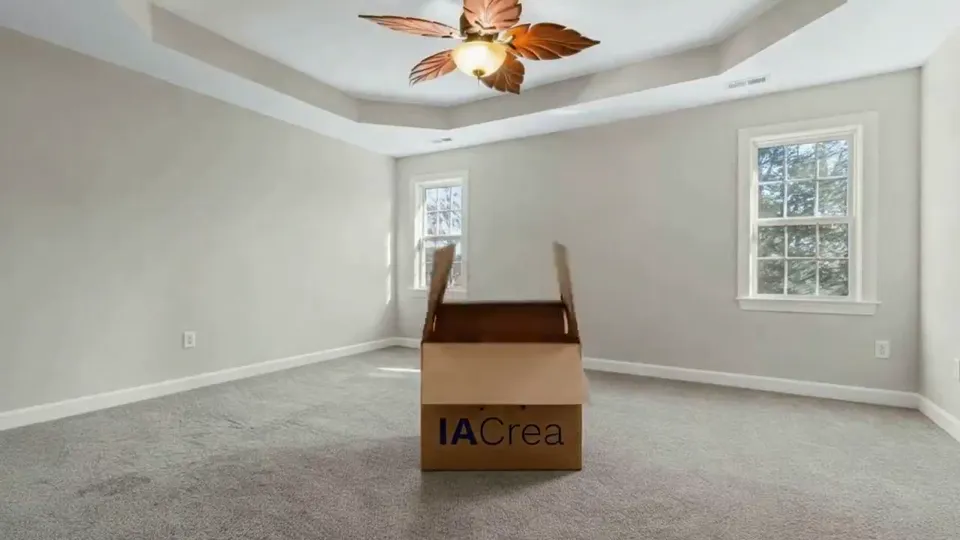
Branded effect: a moving box with the brokerage logo opens and the room furnishes itself.
Branded effects go further: in IACrea, a moving box, a suitcase, or a gift box carrying your logo opens the video before the room gets furnished. In the real estate video editing studio, you can show the logo across the whole video or on selected scenes only. For ideas on what to film with it, our guide to real estate agent video ideas covers seven formats, from your agent intro to the “just sold” video.
Social media, floor plans, and print
Your profile picture
Instagram and Facebook display your profile picture in a circle. That's the place for your square version, centered, with enough margin so nothing gets cropped. Use the same image on every network: consistency is what builds recognition.
Your social media posts
A “just listed” or “just sold” post should be recognizable before anyone reads your name. Keep the logo in the same position every time and use a color palette taken from it. IACrea's real estate post templates pull in the logo and colors from your brand kit automatically, and the app can even suggest a palette based on your logo.
Your floor plans
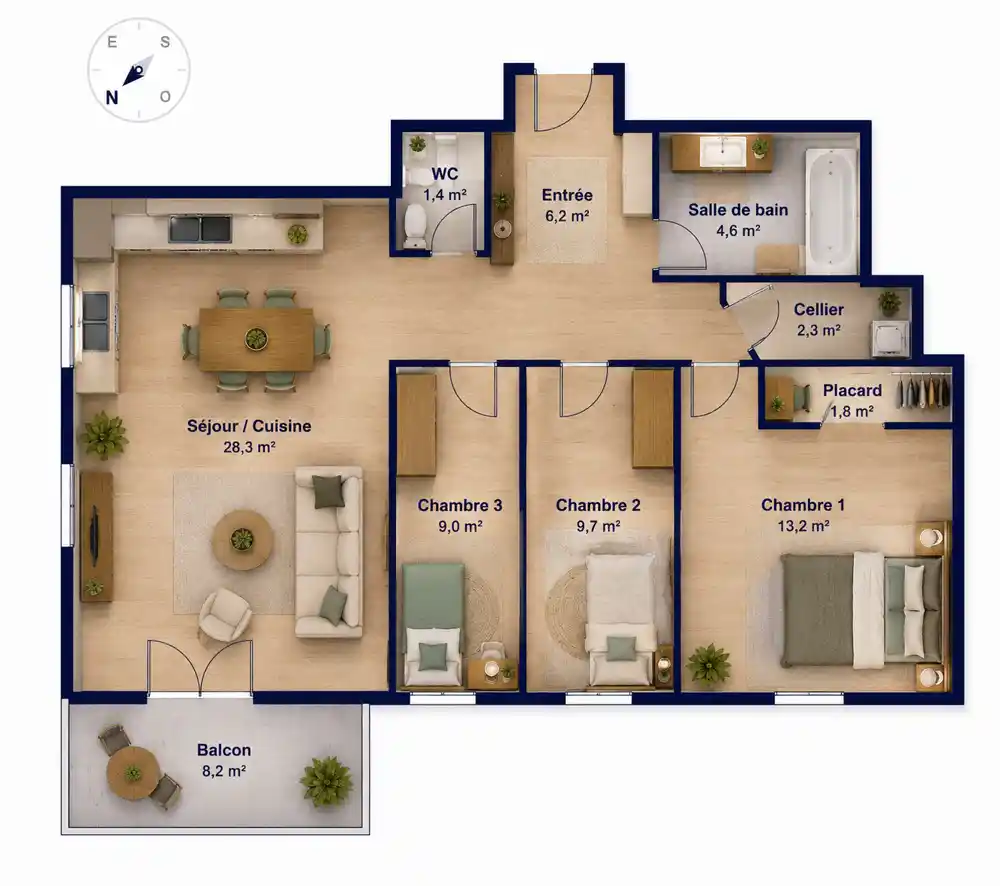
The floor plan you hand the seller or add to the listing keeps circulating long after closing. IACrea's 2D floor plans carry your brokerage logo, so every shared plan reminds people who made it. Our guide to 2D floor plans in listings shows how they drive clicks.
Print materials
Yard signs, business cards, and real estate flyers use the vector version and the CMYK colors. Approve a printer's proof before every run: a screen blue is never exactly the paper blue.
Creating or redesigning your real estate logo in 5 steps
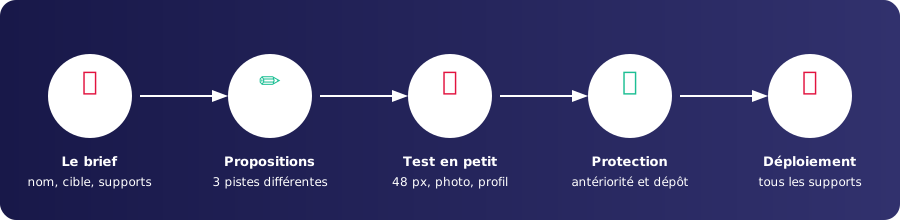
- The brief. One page is enough: name, target clients, three adjectives, the list of places the logo will appear. Add two or three logos you like and explain why.
- The concepts. Freelance designer, agency, or online generator: ask for at least three different directions, not three variations of the same idea.
- The small-size test. Put each concept on a listing photo, as a favicon, in a profile circle, and on a yard sign photographed from the street. The one that survives all four tests wins.
- Protection. Search existing marks, then file before anything goes to print.
- The rollout. Replace the old logo everywhere in the same month: office, website, social profiles, templates, the brand kit in your tools. Two logos in circulation blur the recognition you're trying to build.
FAQ
How do I create a real estate logo? Start with a one-page brief: your brokerage name, the clients you serve, three words that describe you, and every place the logo will appear. Hire a designer or try a logo generator, then test each option at small sizes (favicon, photo watermark, profile picture) before you choose. Finally, search the USPTO database to make sure no similar mark is already registered.
What colors work best for a real estate logo? Two colors at most, plus an all-black and an all-white version. Navy blue and green are everywhere in real estate, so a less expected color helps you stand out, as long as it stays readable on both bright and dark photos.
Should a real estate logo include a house? It doesn't have to, and it can work against you: rooftops, keys, and stylized houses are everywhere and turn into a blur at small sizes. If you keep a symbol, simplify it until it still reads at 48 pixels, or build the logo around a short name and a distinctive typeface.
Should I trademark my real estate logo? It's worth it once you invest in your brand. A federal registration with the USPTO starts at $350 per class for the base application. Search existing marks first, so you don't build your brand on a name or logo someone else already owns.
Where should my logo go on listing photos? In one corner, small and semi-transparent, in the same spot across the whole photo set. The logo signs the photo without hiding the room: a repeated or centered watermark distracts buyers and makes the listing look worse.
Conclusion
A good real estate logo is judged at small sizes: on a photo, in a profile circle, in the corner of a video. Get the full file kit, plan the compliance block that goes with it, protect the mark, then apply it with the same discipline everywhere.
Upload your logo to IACrea once and find it on your photos, videos, posts, and floor plans, with no manual editing. Check our pricing to pick the plan that fits your business.
About the author

Co-founder & CTO of IACrea
Constance Laborie is co-founder and CTO of IACrea, the AI platform that helps real estate professionals create their visuals — photos, virtual home staging and videos — in seconds. She leads the product and technical development of the platform and writes practical guides on real estate photography, virtual home staging and the use of AI in real estate.
Related articles


Ready to turn your photos into content that sells?
Join thousands of real estate agents using IACrea to create professional content in seconds.
Try for free →