
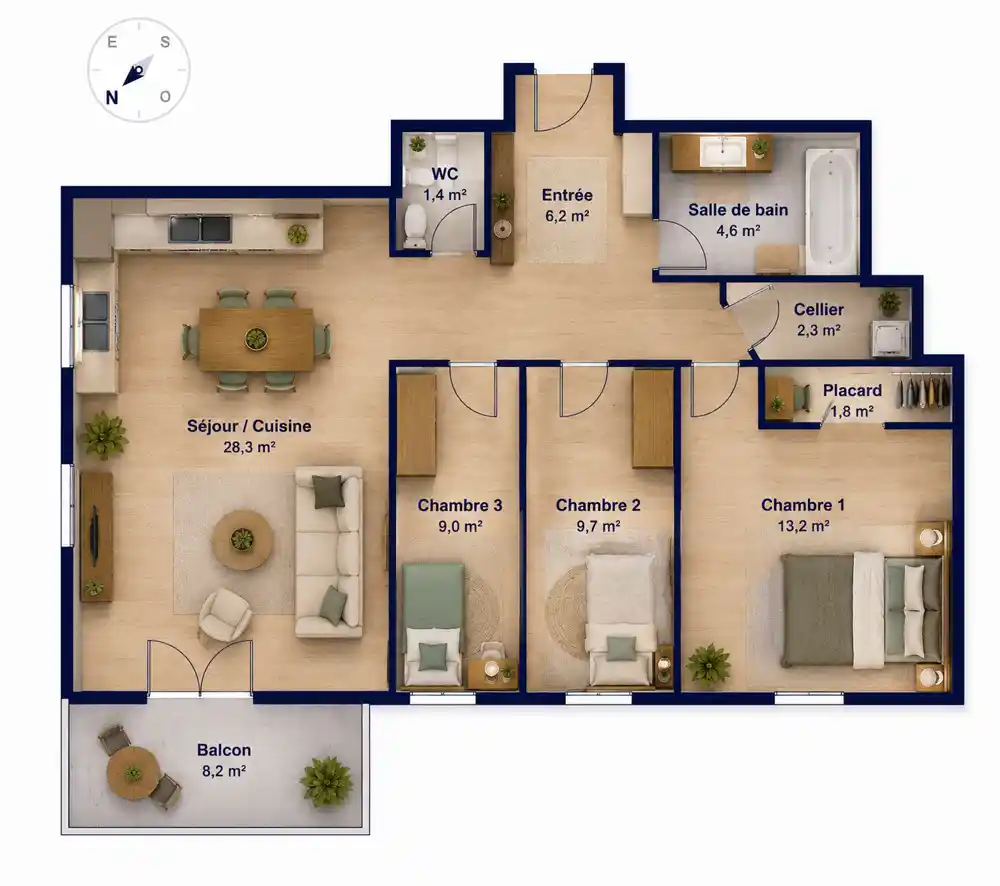
The same 2D floor plan can cost you nothing, a few hundred dollars or close to two thousand, depending on who draws it and how. That's not a negotiation problem. These are three different markets, with three levels of accuracy and three cost structures, each built for a different need.
Before you request a quote or download software, figure out which of these three models fits your listing volume. Few agents ever run that math, and it explains why some pay for a floor plan on every home while others don't even think about it anymore.
What you'll learn in this guide:
- What actually makes floor plan cost vary from one quote to the next
- What an on-site provider really charges, from a listing floor plan to measured drawings
- The hidden cost of free software: the time nobody bills
- How unlimited floor plans at a flat rate change the math after just a few listings
- The volume at which each method becomes the cheapest
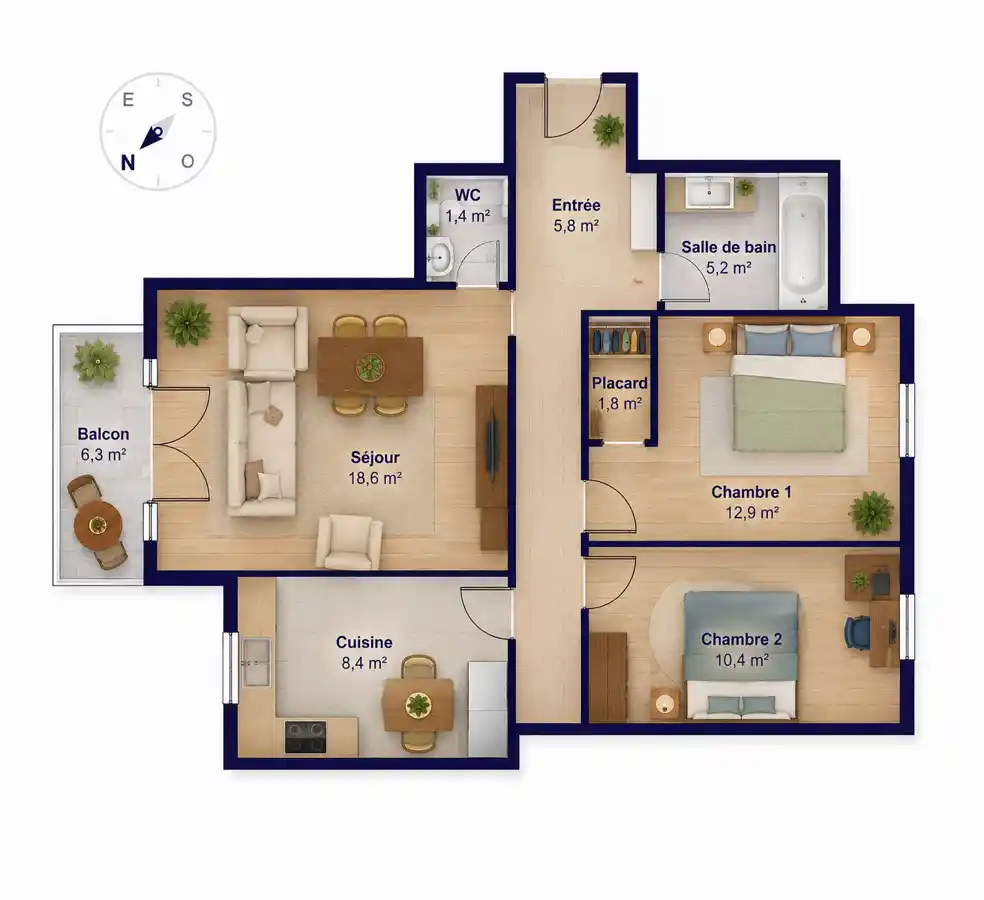 The detail you see on the floor plan (named rooms, square footage, doors and windows) drives its price, whatever the method used to produce it
What drives the cost of a real estate floor plan
A floor plan quote is never a single number. It adds up several variables, and two homes of the same size can get very different prices depending on what you actually order.
Square footage and number of rooms
With an outside provider, time on site grows with the size of the home and the number of floors. A studio takes a few minutes to measure; a two-story house with a detached garage and outbuildings takes hours, often billed as a surcharge above a certain square footage. It's the most intuitive variable, and the only one that has no effect on a floor plan produced by a phone scan, where the marginal cost stays the same whatever the size of the home.
Format and level of detail
A listing floor plan doesn't need the same deliverables as a set of technical drawings. A simple 2D layout with room dimensions costs far less than full measured drawings with sections, elevations and a CAD file an architect can work from. Ordering architect-grade drawings for a marketing job is what quietly inflates the budget of many agents and teams.
On-site providers: the price of custom work
Bringing in a professional is still the standard for a luxury home or a project that needs technical drawings. In the US, two very different services go by the name "floor plan," and mixing them up skews any comparison.
| Service | What you get | Typical US price | Turnaround |
|---|---|---|---|
| Floor plan added to your listing photo shoot | 2D only, measured during the shoot, flat fee by square footage band | A few hundred dollars, more for large homes | A few days |
| Measured drawings (draftsperson or architect) | Floor plans, sections, elevations, CAD file | $500 to $2,000 for most homeowners, $1,300 on average | One to two weeks |
| 3D floor plan as an add-on | 3D model of the home | Extra, quoted separately | Depends on the detail |
The first option fits a standard listing: you get a clean floor plan without asking the seller to block out another appointment. The second makes sense when the deliverable serves more than marketing, such as an estate settlement, a renovation project or a lot split, because you're paying for a precision that selling an ordinary home doesn't require. Hourly rates show the gap: a certified draftsperson typically bills $35 to $150 an hour and an architect $100 to $350 (Angi).
The hidden cost: the second visit
A provider's real extra cost often isn't on the quote. It's the appointment you have to fit between the seller's calendar, yours and the provider's, usually about a week after you sign the listing agreement, right when the listing should already be live and complete. When 57% of recent buyers say floor plans are very useful in their online search (NAR, 2025 Profile of Home Buyers and Sellers), every day without one has a cost no invoice shows.
Free drawing software: $0, but not zero cost
Plenty of 2D floor plan programs, from basic vector drawing tools to interior layout editors, are free or come with a generous trial. On paper, it's the cheapest option on the market.
In practice, the cost moves elsewhere: measuring every wall with a laser measure, entering each room by hand, then going back to fix the dimension you missed. Plan on one to three hours per home for an agent who already knows the tool, more the first time. Across 20 listings a year, that's 20 to 60 hours of work you never bill to anyone, and hours you can't spend prospecting or showing homes.
When this option still makes sense
The math depends on your pace. An agent who draws two or three floor plans a year easily absorbs that time: the learning curve pays for itself on the first plan you don't order from a provider. An agent who lists a home every week, on the other hand, turns that same time into whole weeks over a year. That's the tipping point that pushes most active agents toward an automated method.
Flat-rate floor plans in a brokerage tool
A third option grew with all-in-one tools for real estate agents and brokerages: the 2D floor plan is no longer a service you order home by home, but a module in a monthly tool that also covers photos or video. Depending on the offer, it's part of a monthly package priced for the whole suite, a fixed-price add-on to the subscription, or billed per use, with credits spent on each floor plan, often delivered within 24 to 48 hours.
This changes the nature of the cost: it becomes predictable and independent of how many homes you list, as long as you stay within the flat rate. It's the exact opposite of a one-off provider, whose bill rises in lockstep with your volume.
The true cost: what the sticker price doesn't show
Comparing per-plan prices hides what matters. For your business, the real number isn't the cost of one floor plan, it's the cost of a year of listings.
| Yearly volume | Provider at $250 per plan (example rate) | Free software (your time) | Flat rate, unlimited floor plans |
|---|---|---|---|
| 5 homes a year | $1,250 | ~10 hours of agent time | Flat-rate cost, unlimited floor plans |
| 20 homes a year | $5,000 | ~40 hours of agent time | Flat-rate cost, unchanged |
| 50 homes a year | $12,500 | ~100 hours of agent time | Flat-rate cost, unchanged |
The $250 rate is only there for the math: plug in your own provider's quote. At low volume, a one-off provider or free software still holds up: the total stays manageable and you absorb the time without trouble. As volume grows, the provider's curve rises in a straight line with every home, since each floor plan adds its full cost, while the flat rate stays flat. That crossover point, usually between five and eight homes a month for an active agent, decides the cheapest method far more than the price on any single quote.
How much a 2D floor plan costs with IACrea
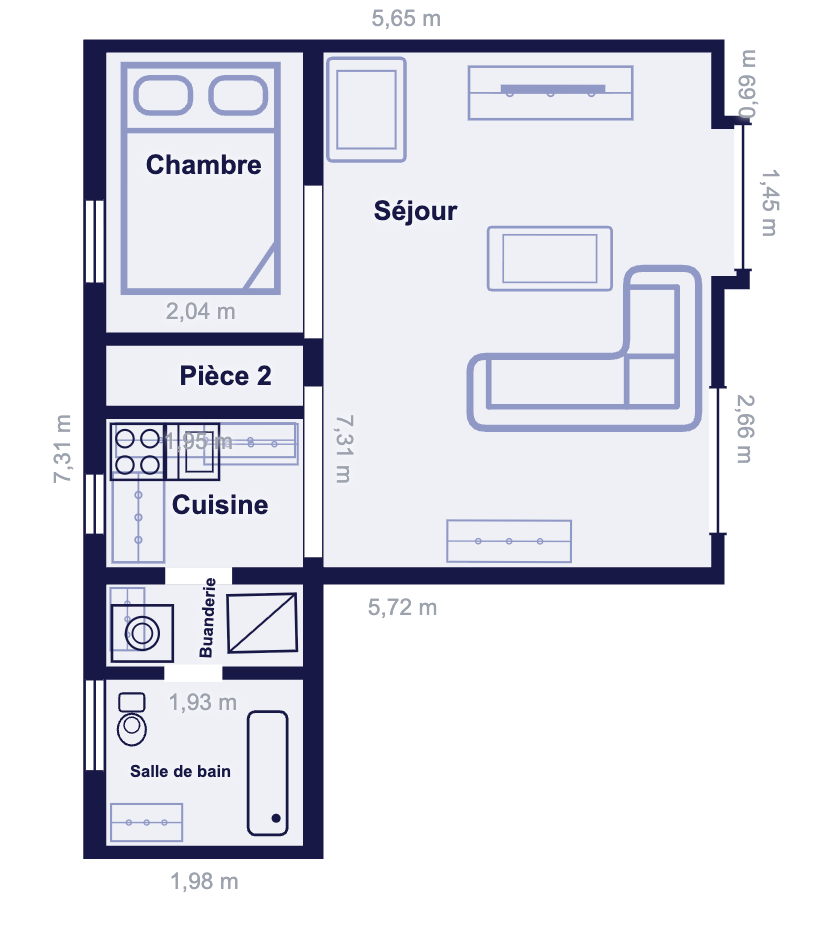 The floor plan you get after the scan: the same level of detail as the examples above, with no quote to negotiate home by home
On IACrea, the 2D floor plan isn't included in the subscription: it's a paid add-on, a flat monthly fee per enabled iPhone (shown in your currency on the pricing page), with unlimited floor plans. You scan the home in about five minutes during your visit with the IACrea real estate photo app (scanning works on iPhone Pro models, iPhone 12 Pro and later), then fine-tune the result in the web editor. No separate order, no invoice per home. Once the add-on is on, an extra floor plan costs you nothing, which is exactly the mechanism that tips the math in favor of volume described above. Our pricing page details the plans and the add-on.
A low price doesn't change what the deliverable is: like any scanned floor plan, its square footage is indicative. The number that counts for the loan comes from the appraiser: for appraisals with interior and exterior inspections, Fannie Mae requires appraisers to measure living area under the ANSI Z765-2021 standard, whatever tool you used for the listing floor plan (Appraisal Institute).
Our complete guide to floor plans for listings covers what a listing floor plan should include and where its accuracy stops counting; the scan and editing tutorial walks through the steps, room by room. The same floor plan can then be shared with buyers as a 3D floor plan, with no new measurement and no vendor to call back.
How to choose based on your listing volume
There's no universal answer: it depends on how many homes you actually list, not how many you hope to.
- Fewer than 5 floor plans a year: a one-off provider or free software is still the simplest option, with no commitment and no new tool to learn.
- Between 5 and 20 floor plans a year: the math gets tight. Time spent in free software starts to add up, without yet justifying a dedicated subscription. This is where comparing your own numbers (real time spent, implied hourly rate) makes the difference.
- More than 20 floor plans a year: a flat-rate floor plan add-on to the tool you already use for photos is almost always the cheapest option, in dollars and in hours.
Your most reliable benchmark is your own listing history over the last twelve months, not a national average: a rural agent with 15 listings a year and a city team with 100 aren't asking the same question.
Here's what we see with brokerages using IACrea: the switch to an all-in-one tool is rarely decided by comparing quotes in the abstract. It happens after missing a floor plan on a rushed listing, the one where the provider couldn't come out for ten days, and working out, just once, what that delay cost in lost showings.
FAQ
How much does a real estate floor plan cost from a provider? It depends on which provider. A 2D floor plan added to your listing photo shoot is usually a flat fee of a few hundred dollars, priced by square footage band. Measured drawings from a draftsperson or an architect cost more: most homeowners pay between $500 and $2,000, about $1,300 on average according to Angi, because you pay for travel, drafting hours and a level of technical detail a listing doesn't need.
Is free floor plan software really free? Free to buy, not free in time. Plan on one to three hours per home to take measurements on site and enter them into the software, plus a laser measure if you don't already own one. Over 20 listings a year, those hours weigh heavily on an agent's schedule, even though no invoice ever shows them.
How many listings a year does it take for unlimited floor plans at a flat monthly rate to pay off? As soon as a flat monthly rate for unlimited floor plans costs less than a per-plan fee multiplied by your number of listings, which usually happens around five to eight homes a month for an active agent. Below that, a one-off provider or free software still makes sense; above it, the zero marginal cost of the flat rate almost always wins.
Does floor plan cost depend on the size of the home? Yes, with an outside provider: more square footage and more rooms mean more time measuring on site and a higher quote, often with a surcharge above a certain square footage or number of floors. Not with unlimited floor plans at a flat rate, where the marginal cost stays the same whatever the size of the home.
Does a floor plan from a phone app cost the same as one from a draftsperson? No, and it doesn't serve the same purpose either. A scanned floor plan costs far less, a flat monthly fee however many plans you make, but its square footage is indicative: fine for a listing, not a substitute for the measurement an appraiser reports for the loan. The price reflects the goal: convincing a buyer doesn't take the same precision as supporting a mortgage appraisal.
Conclusion
There's no single floor plan cost, but three cost models, each suited to a different volume: a provider for the occasional listing, free software if you have the time, and a flat rate for a steady pace. The right choice shows up in your own listing history, not in a single quote.
If you already list more than a few homes a month, the math almost always favors unlimited floor plans at a flat rate, with no bill per home. Compare your numbers with our pricing and try the scan on your next listing: five minutes is enough to see whether the math works for your business.
About the author

Co-founder & CTO of IACrea
Constance Laborie is co-founder and CTO of IACrea, the AI platform that helps real estate professionals create their visuals — photos, virtual home staging and videos — in seconds. She leads the product and technical development of the platform and writes practical guides on real estate photography, virtual home staging and the use of AI in real estate.
Related articles



Ready to turn your photos into content that sells?
Join thousands of real estate agents using IACrea to create professional content in seconds.
Try for free →