
80% of French people browse the Internet before buying a property (SeLoger) — and yet most agencies still publish sporadically, based on incoming mandates. Without a content strategy, each post starts from scratch: no guiding thread, no rhythm, no measurement of what works.
A structured content strategy for real estate agencies changes this dynamic: it turns scattered production into a repeatable system, capable of lasting over time without requiring a full-time position. This guide details how to build it step by step, from content pillars to measuring return on investment.
What you will learn in this guide:
- How to define content pillars that go beyond simple property listings
- The right mix of formats depending on your channels (blog, social networks, email)
- A manageable editorial calendar for the year
- How to distribute production according to your team size
- Key indicators to track for measuring true ROI
Why a content strategy changes everything for a real estate agency
A content strategy is the difference between posting a property photo because a mandate just signed, and posting content that serves a specific goal — attracting sellers, reassuring buyers, building a local reputation. Without this intention, an agency’s feed looks like a catalog: useful, but rarely engaging.
The current context makes this structuring more urgent than it was five years ago. 79% of buyers want video content before visiting, but only 18% of agents produce it (Immo Matin) — a huge gap between market expectations and what most agencies deliver. Agencies that fill this gap with consistent, varied content attract disproportionate attention relative to their size.
Thus, a content strategy isn’t limited to marketing active listings. It serves three distinct objectives: generating seller leads (social proof and local expertise content), reassuring buyers on active properties (immersive content), and building longstanding brand recognition beyond individual transactions (brand content).
The content pillars to define before publishing anything
A content pillar is a recurring topic category that serves a specific objective. Without defined pillars, an agency consistently falls back on the only content available: current listings.
| Pillar | Goal | Example formats |
|---|---|---|
| Portfolio properties | Generate buyer contacts | Photo carousel, property video, virtual tour |
| Social proof | Reassure future sellers | "Sold in X days," client reviews, before/after |
| Local expertise | Build brand authority | Neighborhood market, price per m², sector news |
| Behind the scenes & team | Humanize the agency | Agent portraits, typical day, values |
| Educational | Capture an audience before their project | Buying/selling guides, energy diagnostics, financing |
The trap of 100% listing content
Posting only properties for sale creates a feed that only interests active buyers for that specific property — a narrow and short-term audience. Agencies that alternate listings with social proof and local expertise build an engaged audience that remains interested between mandates, ready to recommend or contact the agency when needed.
Which mix of formats depending on your channels
Each channel has its own purpose and expected format. Using the same content everywhere — a common mistake when time is limited — dilutes impact on each.
| Channel | Priority formats | Recommended frequency |
|---|---|---|
| Instagram / Facebook | Photo carousel, short Reel/video, story | 3 to 5 posts/week |
| SEO blog | Long guides, comparisons, tutorials | 1 to 2 articles/month |
| Property newsletter + local news | 1 send/month | |
| Listing portals | Optimized listing page, local SEO description | Every listing upload |
| Market expertise, agency news | 1 to 2 posts/week |
A single photo or video shoot can feed multiple channels without re-shoots: an Instagram carousel, a portal banner, and a LinkedIn visual all derived from one export, significantly reducing production time per property.
Building an editorial calendar that lasts
The editorial calendar turns intent into habit. Without it, production becomes reactive as soon as commercial activity ramps up — which happens systematically during busy periods.
How many posts per week?
3 to 5 posts per week on social media is the most cited rhythm among sector professionals, with the key principle: consistency beats volume. Posting 3 times weekly all year yields better results than 8 posts per week for a month then silence—algorithms penalize irregular activity, and audience learns not to follow inconsistent accounts.
How to structure an average month
A balanced editorial calendar blends the five pillars discussed above, without dedicating more than 50% of posts to portfolio properties. This distribution works well for an independent agency: 40% active listings, 20% social proof, 20% local expertise, 10% behind the scenes, 10% educational — adjustable based on mandate volume and local market seasonality.
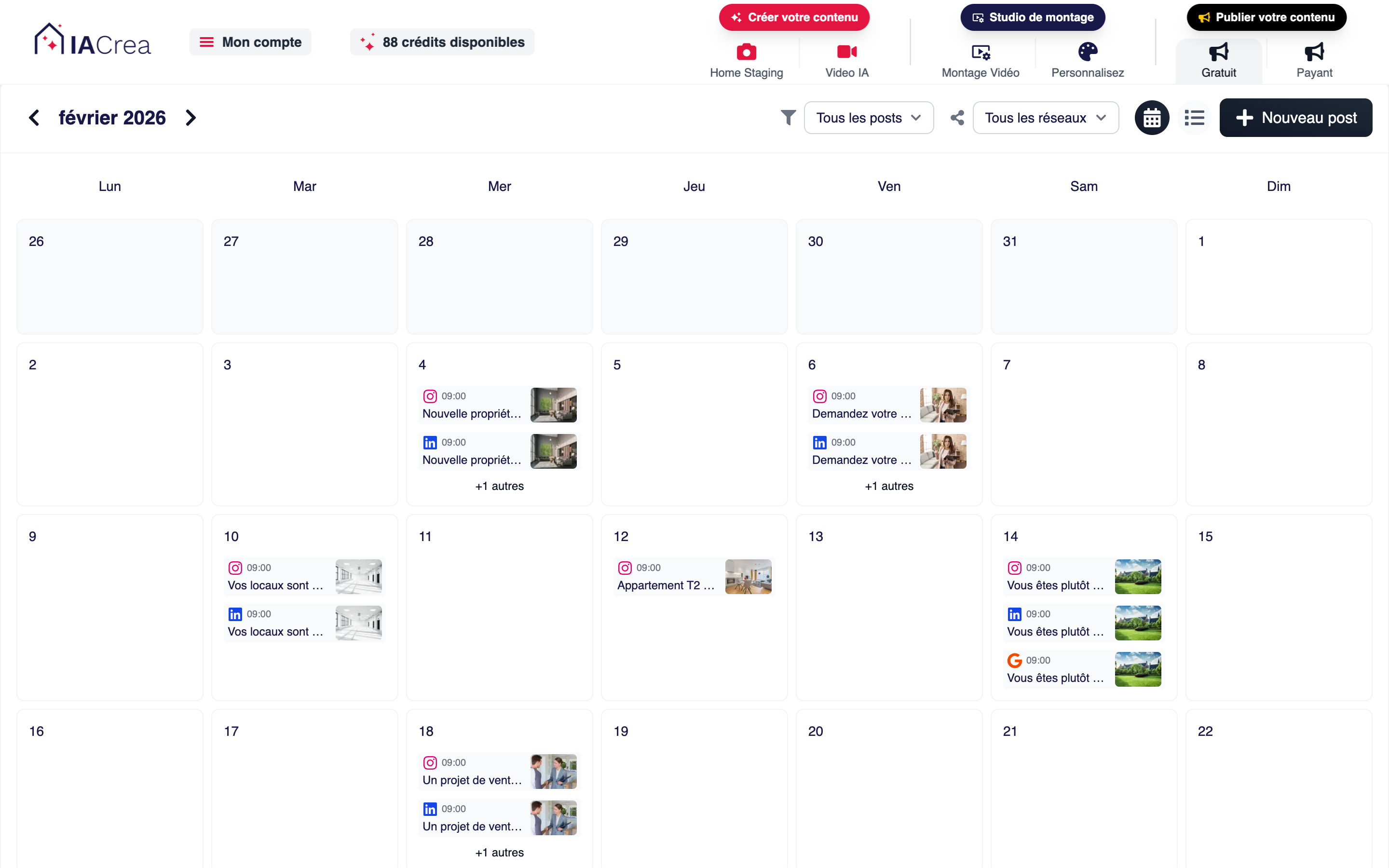 Prepare a week of posts in one go, rather than publishing bit by bit
Producing quickly without sacrificing quality: the role of AI
Maintaining a schedule of 3 to 5 posts per week requires a volume of visuals that traditional production — photographer, graphic designer, community manager — cannot sustain at a reasonable cost for an independent agency.
Virtual home staging transforms a vacant or poorly furnished property into a stylish interior in seconds, without engaging an external service provider at each mandate — staged properties sell on average 18% faster (FNAIM), making it a strong argument for making it a systematic part of property content. The AI real estate video animates a simple photo to produce the most sought-after format by buyers, without filming or additional equipment. And content planning tools (content planning) let you prepare and publish a week’s worth of posts in one session, at times your audience is most active.
For the actual shooting, the IACrea real estate photo app manages exposure and HDR directly on your smartphone — a starting point that speeds up the entire content production chain.
Who does what: organizing production according to team size
Production structure depends directly on team size. An independent agent doesn’t operate like a firm of 8 agents.
Agent or agency with 1 to 3 people. The agent takes photos, creates staging and videos, then plans the week’s posts in a 30 to 45-minute session. AI tools do the heavy lifting previously handled by external providers.
Agency with 4 to 10 agents. A dedicated content manager (often the agency manager or a marketing assistant) oversees the editorial line and calendar, but each agent supplies photos and info from their mandates. A shared content pillars charter prevents incoherent feeds from different agents.
Network of agents or franchise. The brand’s editorial line (pillars, tone, visual identity) is set at the network level, while each agent localizes with their own properties and sector updates — brand consistency then depends on templates and shared calendars rather than centralized control of each post.
Measuring ROI of your content strategy
A content strategy without measurement remains an intention. Three indicators are enough for an independent agency without complex analytics tools.
| Indicator | What it measures | Tracking frequency |
|---|---|---|
| Engagement rate (messages, saves) | Genuine interest, not just exposure | Weekly |
| Traffic to property listings | Content effectiveness in generating clicks | Monthly |
| Leads / Mandate requests | Final business impact | Monthly |
Raw views and likes are vanity metrics: they don’t reliably correlate with signed mandates. Direct messages, visit requests, and contact from sellers are real signals — and should be tracked in a simple monthly dashboard, even a shared spreadsheet among team members.
See concrete examples of staging and video transformations on our examples page, and to deepen your daily social media content production, our AI content for real estate social networks workflow guide details the full process. Compare formulas suited to your agency's mandate volume on our pricing page.
FAQ
What is a content strategy for a real estate agency?
It’s a structured plan that defines which topics to publish (content pillars), on which channels, how often, and for what goal — rather than posting randomly based on available listings. It covers the blog, social media, email campaigns, and listing pages, with an editorial calendar organizing production in advance.
How many posts per week for a real estate agency?
3 to 5 weekly posts on social media, prioritizing consistency over volume: better 3 posts weekly all year than 10 in one month followed by silence. Irregular frequency damages organic reach, as algorithms favor consistently active accounts.
Is a community manager necessary to run an real estate content strategy?
Not necessarily. A 1 to 3-person agency can maintain a 3 to 5 posts per week schedule using the right production and planning tools, without dedicated staff. A community manager or external provider becomes relevant beyond 5 to 8 agents, when the volume of properties and channels exceeds what one agent can produce alongside their sales activities.
What budget should be allocated for a real estate content strategy in 2027?
Count on 2 to 5% of annual revenue for broader marketing, with an increasing portion going to content production tools rather than external service providers. AI tools for home staging, video, and planning replace a large part of traditional graphic design and community management budgets, at a monthly cost of a few dozen to a few hundred euros depending on mandate volume.
How to measure ROI of a real estate content strategy?
Track engagement rate (messages, saves), traffic to property listings from social media and the blog, and most importantly, the number of mandates or seller leads generated each month. A simple monthly tracker — posts, engagement, leads — suffices for an independent agency; it allows you to adjust underperforming content pillars without waiting for an annual review.
Conclusion
A content strategy for a real estate agency isn’t an abstract communication exercise: it’s a replicable system that turns scattered production into a steady pipeline, measurable and sustainable over time. Defined pillars, format mix adapted to each channel, realistic calendar, and AI-accelerated production — these four building blocks cover the entire process, from first post to monthly tracking.
Start small: define your five content pillars this week, then try IACrea to produce your first staging and video visuals, and plan your first month of content from a single platform.
About the author

Co-founder & CTO of IACrea
Constance Laborie is co-founder and CTO of IACrea, the AI platform that helps real estate professionals create their visuals — photos, virtual home staging and videos — in seconds. She leads the product and technical development of the platform and writes practical guides on real estate photography, virtual home staging and the use of AI in real estate.
Related articles


Ready to turn your photos into content that sells?
Join thousands of real estate agents using IACrea to create professional content in seconds.
Try for free →