

By 2026, 82% of real estate agents are already using at least one AI tool in their business (RPR/NAR, 2026) — but most still limit themselves to writing listings. Those who leverage AI across their entire marketing, from visuals to lead generation, are already gaining an edge that translates into mandates.
AI-powered real estate marketing will no longer be a differentiating option in 2027: it’s the foundation on which an agency’s or an independent agent’s visibility is built. This guide details 10 concrete strategies, ranked by impact and ease of implementation, to transform your marketing output without blowing your budget.
What you will learn in this guide:
- Why real estate marketing shifts towards AI in 2027, backed by data
- 10 practical strategies, from simplest to most advanced
- A comparison of traditional marketing versus AI-driven marketing
- A roadmap to get started this week
Why real estate marketing is shifting to AI in 2027
The market has become more competitive: the number of real estate agents has increased by 50% in France over five years (INSEE, cited by Xerfi, 2025), while nearly 430 proptech companies now offer AI solutions covering the entire real estate value chain. Standing out by service quality alone is no longer enough — visual presentation and online consistency have become key criteria for sellers.
For buyers, the change is even more striking: 67% now use an AI tool as their main search method, compared to just 17% eighteen months ago (Reel-E, 2026) — one of the fastest behavioral shifts ever seen in real estate. Listings with videos generate 403% more inquiries than those without, and 73% of sellers say they prefer an agent who uses video to showcase properties (Reel-E, 2026).
These numbers reveal a straightforward equation: traditional marketing channels (raw photos, generic posts, door-to-door prospecting) are losing ground to AI-produced and distributed formats, which are quicker to create and better received by an audience already accustomed to AI in everyday life.
The 10 AI real estate marketing strategies to implement in 2027
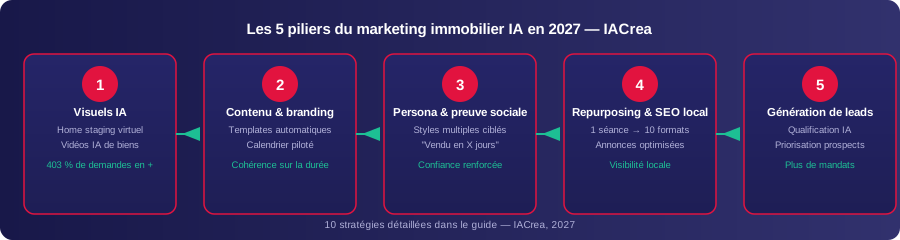 The 10 strategies from this guide grouped into 5 action pillars
1. Systematic virtual home staging
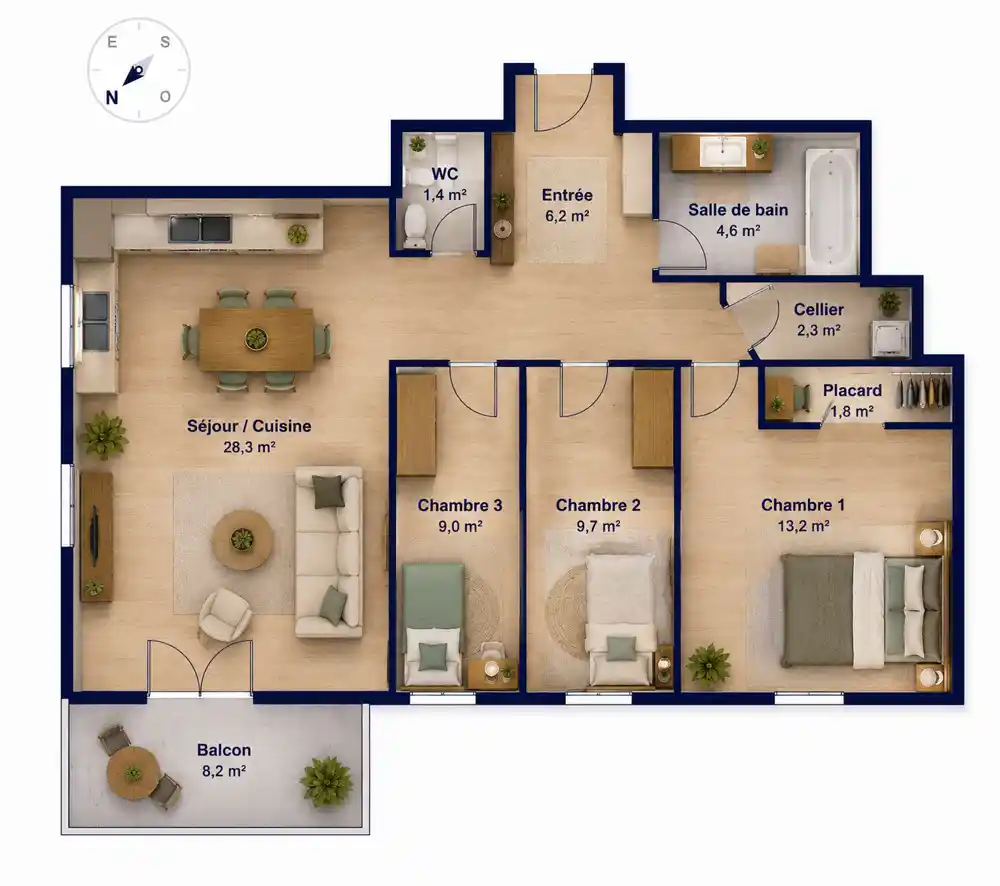
Every empty or poorly furnished property posted without staging is a missed opportunity. Virtual home staging turns a raw photo into a bright, furnished interior in seconds, for €15 to €50 per room compared to €1,500 to €5,000 for physical staging. This is the most cost-effective impact strategy in this guide — to be applied to 100% of vacant properties.
2. AI-generated videos for every property, without exception
With 403% more inquiries for listings with videos, not producing videos means missing out on the most effective format on the market. AI-driven real estate videos create animated sequences from a simple still photo — no filming or video equipment needed, for every mandate.
3. Automatic branded templates
A consistent feed, matching your agency’s colors, on every post and platform, builds brand recognition over time. AI template engines automatically apply your graphic charter (logo, colors, contact info) to each generated visual, saving you manual design work for each property.
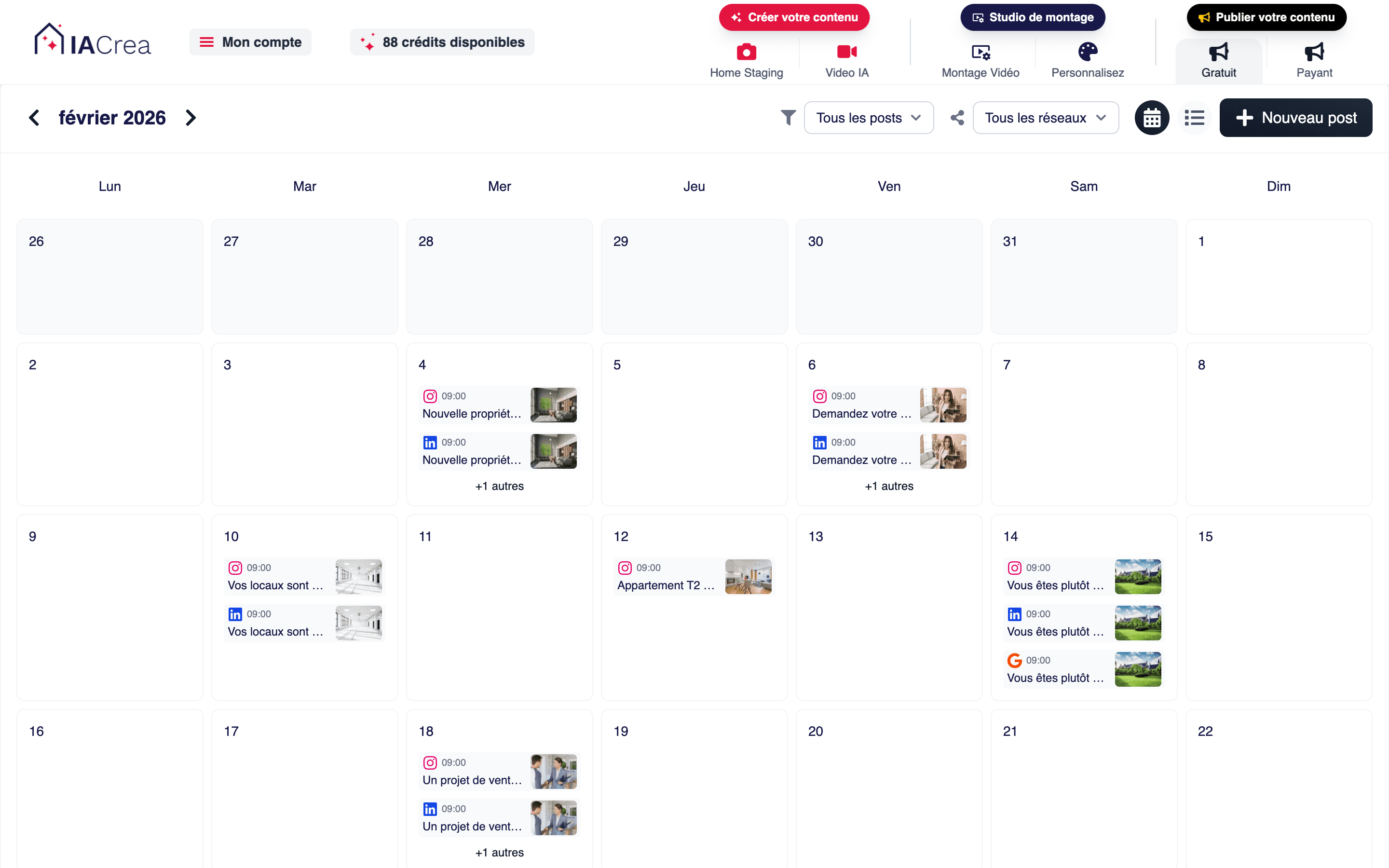
4. Data-driven publishing calendar
Posting at the right time is just as important as sharing quality content. AI content planning allows you to prepare a week’s worth of posts in a single session and publish during peak engagement hours — regularity always outperforms burst postings followed by silence.
5. Buyer persona personalization
The same staged room can appeal to different buyer profiles: Scandinavian, industrial, contemporary styles. Generating multiple staging variants for a single property helps test which style converts best depending on neighborhood and target buyer type — an A/B test previously costly in physical staging becomes free with AI.
6. Automated social proof: "Sold in X days"
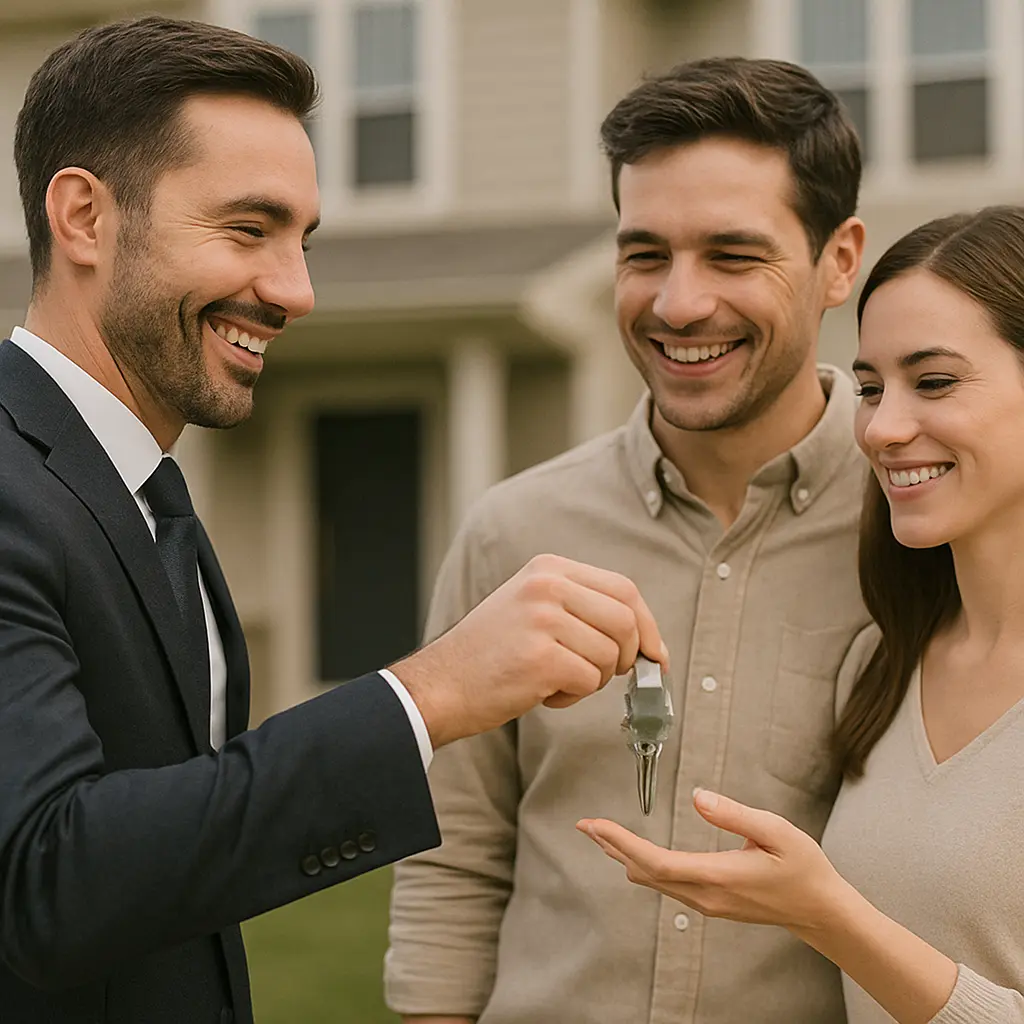 Posts showing "Sold in X days" with staged photos consistently outperform traditional listing posts
Posts announcing a property "Sold in 12 days at 98% of asking price," with a staged photo, generate more incoming contacts than a simple listing ad. This social proof reassures future vendors of your ability to close quickly and at the right price — a content piece to automate after each transaction.
7. Multi-format repurposing from a single photo session
One 10-minute photo shoot should produce content for a month: Instagram carousel, vertical Reel, Facebook post, LinkedIn visual, portal banner. AI tools generate all formats from one export, removing the need to reshoot for each platform.
8. Local SEO optimization for listings and agency profiles
Descriptions and Google Business profiles generated or reformulated by AI, naturally integrating neighborhood, city, and local landmarks, improve local searchability — increasingly crucial as 67% of buyers start their search with an AI tool.
9. Staging as a negotiation tool
Beyond the listing, a staged version of an empty property helps justify a sale price to buyers who struggle to visualize. Showing real potential during viewings or before negotiations strengthens your sales pitch without physical staging costs.
10. Automated lead generation
Real estate lead generation powered by AI identifies and qualifies seller prospects via behavioral signals (searches, social interactions, page visits), prioritizing contacts with a higher likelihood of mandate, rather than dispersing effort inefficiently.
Traditional marketing vs AI real estate marketing
| Criterion | Traditional marketing | AI-powered real estate marketing |
|---|---|---|
| Visual production cost | €1,500 – €5,000 per property (staging, photographer, videographer) | €15 – €100 per property |
| Production timeline | Several days (staging, shooting, editing) | Minutes to hours |
| Content volume per property | 1 to 2 formats (photo, sometimes video) | 5 to 10 formats (photo, video, carousel, templates) |
| Publication regularity | Dependent on agent’s time | Pre-plannable, sustainable long-term |
| Personalization per target | Rare (costly) | Multiple variants at no extra cost |
Traditional marketing remains relevant for very high-end properties, where professional shoots and physical staging are expected signals of prestige. For the remaining 90% of the market, cost-efficiency favors AI significantly.
Roadmap: where to start in 2027
Week 1 — Visual foundations. Apply virtual staging and generate an AI video for all your active mandates. These are strategies #1 and #2 from this guide, offering immediate visible impact.
Week 2 — Consistency and rhythm. Set up branded templates and your publishing calendar. The goal: never publish reactively again, but prepare a week’s content in one session.
Week 3 — Differentiation. Test personalization by persona on a high-potential property, and launch your first social proof post on a recent sale.
Week 4 — Scale. Extend multi-format repurposing to each new mandate and evaluate a lead generation tool to prioritize your prospecting.
Find concrete examples of staging and video transformation on our examples page, and compare packages tailored to your volume of mandates on our pricing page. To deepen your social media content strategy, our guide on AI content for real estate social media details the full production workflow.
FAQ
What is the most ROI-friendly AI real estate marketing strategy in 2027?
Virtual staging remains the most cost-effective: €15 to €50 per photo versus €1,500 to €5,000 for physical staging, with measurable impact on click-through rates. Combining this with an AI property video captures attention on portals and social channels at minimal cost.
Do I need a big marketing budget to apply these strategies in 2027?
No. Most of these 10 strategies rely on AI tools accessible for just a few dozen euros per month, without needing an agency or graphic designer. The real cost is the learning time — about one to two weeks to integrate into your routines, versus hundreds of euros monthly in traditional marketing.
Does AI real estate marketing replace human contact?
No, it frees up time. AI automates visual production and repetitive tasks (retouching, formatting, scheduling), giving agents more time for what matters: visits, negotiations, and client relationships. Top-performing agents combine AI-driven production with personalized human follow-up.
How to measure the effectiveness of an AI real estate marketing strategy?
Track three KPIs: click-through rates on listing portals, engagement rates (saves, DMs) on social media, and the number of mandate leads generated monthly. Vanity metrics like views and likes don’t reflect actual results — DMs and inquiry requests are the real signals.
Which AI strategies should an inexperienced agent prioritize first?
Start with virtual staging and AI videos on your current listings — two quick-impact, low-cost levers. Then add content planning and branded templates to maintain regular posting, before moving to advanced strategies like persona personalization or automated lead generation.
Conclusion
AI real estate marketing in 2027 is not just another tool — it’s a paradigm shift: more formats, faster production, more frequent publishing, at a much lower budget than traditional marketing. The 10 strategies in this guide, implemented gradually over four weeks, cover the entire journey from visual staging to lead generation.
Begin with virtual staging and AI videos on your most promising active mandate this week, then try IACrea for free to build the entire workflow described here from a single platform.
About the author

Co-founder & CEO of IACrea
Pauline Clavelloux is co-founder and CEO of IACrea. In daily contact with real estate agencies and agents, she understands their challenges around visibility, marketing and lead generation. On the blog, she shares actionable strategies on real estate marketing, social media and prospecting in the age of AI.
Related articles

Ready to turn your photos into content that sells?
Join thousands of real estate agents using IACrea to create professional content in seconds.
Try for free →