

Knowing how to write a real estate listing comes down to three things: a headline that gives the key facts at a glance, a description built in 3 blocks (hook, features, neighborhood) and photos edited to look bright and inviting. Apply the method to every listing and you'll see the difference in your inquiries.
Buyers look at photos first, then read: in NAR's 2025 Profile of Home Buyers and Sellers, 81% of buyers rated listing photos very useful and 77% said the same about detailed property information. On Zillow or Realtor.com, your listing has a few seconds to stop the scroll. The words you write, and the photos that go with them, make the difference.
Hardly anyone measures the quality of their listings, yet it drives the number of inquiries you get, the quality of your showings and how fast the home sells. This guide gives you a step-by-step method to write listings that actually convert.
What you'll learn in this guide:
- The 3-block structure of a real estate listing description that brings in inquiries
- The 7 mistakes most agents still make in their listings
- How AI photo editing gets your listing more clicks
- A before-and-after table comparing a weak listing with an optimized one
- How to get the most out of the MLS, the big portals and social media
Why your listing is your first sales pitch
A listing isn't just a tool to sell a home. It's how the seller judges your professionalism. A seller who sees their home in great photos and described accurately will list with you again and refer you to friends. A seller who sees a sloppy listing will call another agent for the next sale.
What buyers actually look for when they scan a listing
Buyers don't read a listing, they scan it. In a few seconds, they answer four questions without even thinking about it:
- Does this home meet my must-haves? (square footage, price, location)
- Do the photos make me want to see it in person?
- Does the description tell me something the photos don't?
- Who is selling it, and do they look serious?
Your listing has to answer all four at a glance. If one is missing, the buyer moves on to the next home.
The direct impact on your next listings
Buyers' agents see it too: in NAR's 2025 Profile of Home Staging, 73% of buyers' agents said listing photos are important to their buyers. A listing that looks professional brings in more qualified showings, and a home that sells smoothly is your best argument at the next listing appointment. For an agent handling 30 to 50 listings a year, that adds up fast.
How to write a real estate listing that converts
The headline: 10 words to earn the click
On many portals, the first line of your description is the only text buyers see before they tap “more,” right under the main photo. Treat it as a headline. It should include:
- The home type (condo, single-family home, townhouse, loft…)
- The square footage
- The number of bedrooms and bathrooms
- The exact location (neighborhood, subdivision, town)
- A standout feature (terrace, view, quiet street, fully renovated, hardwood floors…)
Weak headline: "Beautiful condo for sale in Chicago" Strong headline: "2-bed condo, 730 sq ft — terrace, sun-filled, Logan Square"
The second headline packs the key facts into fewer than 60 characters and puts the home in context right away.
The description: 3 paragraphs, 3 decisions
Build every listing description in three distinct blocks:
Block 1 — The hook (2-3 sentences): Say what makes this home unique. Lead with the emotional details: morning light, the view over the rooftops, the quiet of the backyard. Save the technical details for later. This is where you make buyers want to see it.
Block 2 — The features: List the rooms, appliances and systems, HOA fees, property taxes and other practical details. Be thorough: buyers should be able to decide whether to book a showing without calling you for the basics.
Block 3 — The neighborhood: Commute options, shopping, parks, what makes the area appealing. These details weigh heavily on the decision, especially for families and commuters. Describe the area, not the people who live there (more on that in mistake #5).
The key facts table: reassure before you persuade
| Item | What to include |
|---|---|
| Square footage | Exact living area, and where the number comes from (county records, builder plans, a measurement) |
| HOA | Monthly fee and what it covers |
| Property taxes | Annual amount |
| Updates | Roof, HVAC, kitchen, windows, with the year of each |
| Layout | Orientation, floor (for a condo), views |
| Parking | Garage, driveway, assigned space, street parking |
| HOA projects | Upcoming special assessments or building work |
A complete table cuts down on questions during showings and helps you weed out buyers who aren't a fit.
Photos: the first conversion lever in your listing
Photos come first: 81% of buyers rate listing photos very useful (NAR, 2025 Profile of Home Buyers and Sellers). Before reading a single line of your description, a buyer has already decided whether the home deserves a closer look.
Two features improve the look of your listings right away:
1. Virtual staging: for an empty home, or one with dated furniture, virtual staging creates furnished, decorated photos in seconds, ready to post. Buyers can picture themselves living there, and you get more clicks. See our before-and-after examples to judge the difference for yourself.
2. The AI HDR effect: the IACrea real estate photo app corrects exposure, color and contrast for you and applies an HDR effect, so you get bright, professional-looking photos even from a phone.
Label your virtually staged photos (“Virtually staged”). The NAR Code of Ethics (Article 12) asks REALTORS® to present a true picture in their advertising, many MLSs have their own rules on staged photos, and since January 1, 2026, California (AB 723) requires a disclosure and access to the original image for digitally altered listing photos.
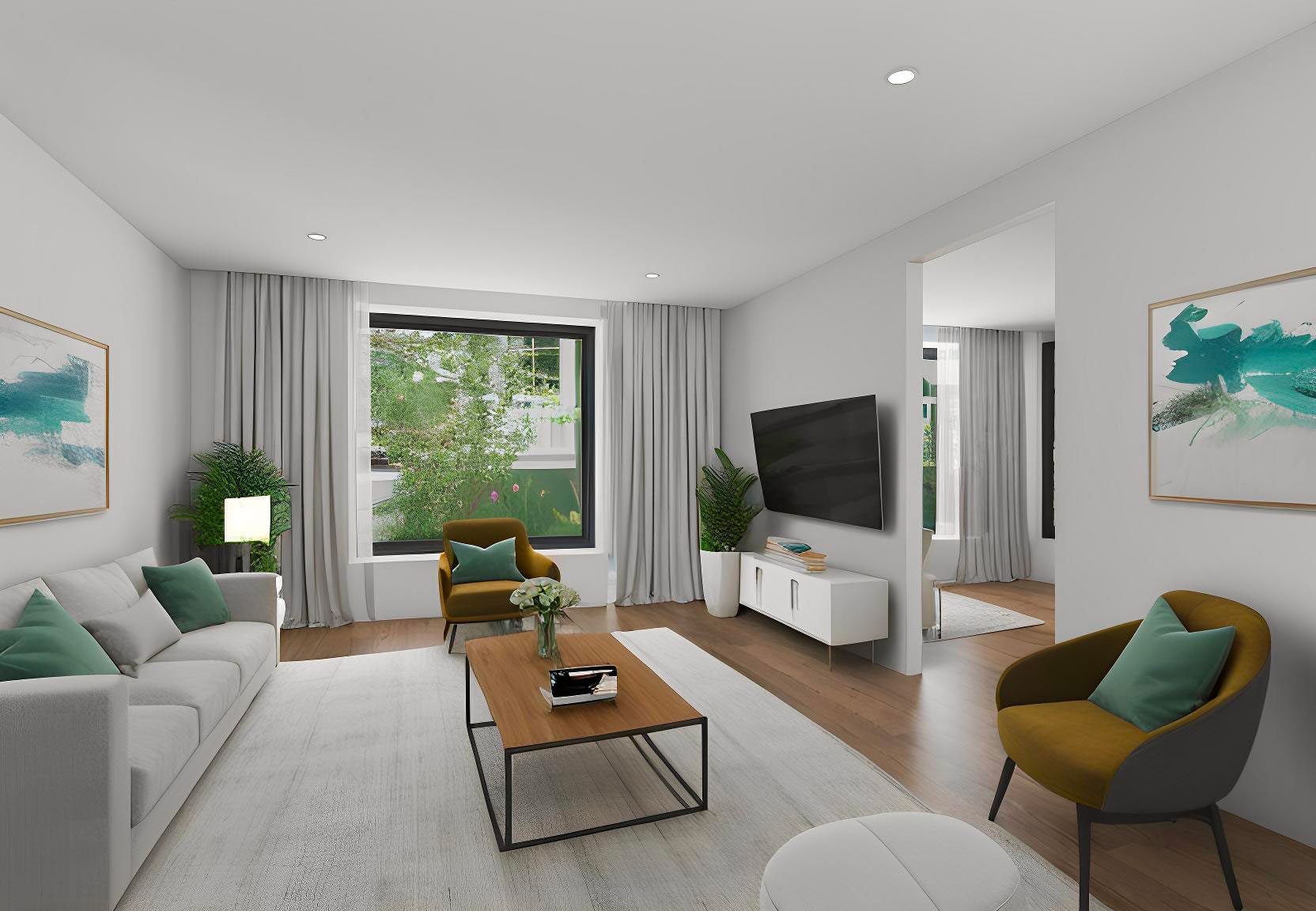 A virtually staged living room helps buyers picture the space far better than an empty room
Writing a listing description with AI: fast, but not enough on its own
AI tools can write a first draft of your description from the home's features (square footage, bedrooms, upgrades, neighborhood) in seconds. That's real time saved for an agent who writes 30 to 50 listings a year. But auto-generated copy stays generic: it misses the charm of an open view, the history of the neighborhood or the feel of a room filled with late-afternoon light. Use it as a working draft, never as the finished listing. Your personal touch is what turns a correct description into one that makes buyers want to visit.
Where AI really changes things is how long it takes to improve your listing photos. A dim room or a dull gray sky, edited in seconds with the IACrea real estate photo app, goes from an ordinary snapshot to a bright, professional photo without a reshoot. For an empty home, virtually furnishing an empty room takes about as long as a regular edit, and you don't have to wait for a home stager's next opening.
In practice, to get a listing live within the hour: shoot the home on your phone, edit the photos and generate a first draft of the description, then rewrite that draft by hand to add what only your knowledge of the home can bring.
7 mistakes that sink a real estate listing
1. A generic headline: "Charming home, must see!" says nothing. Always add square footage, location and a standout feature.
2. A description that's too short: A few lines signal a lack of care, and buyers skip listings that leave them guessing. Aim for 800 characters or more, within your MLS's limit.
3. Cryptic abbreviations: "Upd kit w/ SS appl, W/D hkup, 2BR/1BA." Write in plain English so buyers understand it and the words they search for actually appear in your listing.
4. Portrait (vertical) photos: Portals display photos in landscape. A vertical photo wastes much of the frame, especially on mobile.
5. Language that describes the buyer instead of the home: "Perfect for a young couple," "ideal for singles," "exclusive neighborhood." The Fair Housing Act (42 U.S.C. § 3604(c)) prohibits housing ads that indicate a preference, limitation or discrimination based on race, color, religion, sex, disability, familial status or national origin, and many states and cities protect additional groups. Describe the home and its features, never who should live there.
6. No call to action: Always end with a concrete invitation: "Call or text to schedule a showing this week, we reply within 24 hours."
7. Untouched photos of an empty home: An empty condo photographed as is looks cold and smaller than it is. Even a quick pass with virtual staging completely changes how buyers see the space.
Before and after: one listing rewritten with the method
Here's how a typical listing changes when you apply the method above (an illustrative example):
| Criterion | Original listing | Optimized listing |
|---|---|---|
| Headline | "Condo for sale Chicago" | "3-bed condo, 1,150 sq ft — terrace, quiet, Lincoln Park" |
| Number of photos | 4 unedited photos, empty rooms | 10 photos with the AI HDR effect + virtual staging in 3 rooms |
| Description | 3 lines, missing information | 3 blocks: hook + features + neighborhood |
| Key facts | Missing | HOA fee, property taxes, year built, recent updates |
| Inquiries in 7 days | 2 | 11 |
| Time to first showing | 12 days | 3 days |
Reworking this listing took 2 hours, including 45 minutes of photo editing with IACrea. Find the plan that fits your listing volume on our pricing page.
Syndication and optimization across portals
Posting the same listing and hoping for the best isn't enough anymore. Each channel works differently:
- The MLS: it's the source most portals pull from. Fill in every field, double-check square footage, beds and baths, and stay within your MLS's limits for the remarks field and photos. An error here gets copied everywhere.
- Zillow, Realtor.com and Redfin: they display your MLS data, so their search filters depend on how complete your fields are. Your first photo and the opening line of your description do the work in the search results.
- Your website: a dedicated page for the listing, with every photo and the full description, gives you a link to share that you control.
- Social media: a short version of the listing (hook + 2-3 staged photos) posted on Instagram or Facebook brings in inquiries on top of the ones from the portals.
On the technical side, each MLS and portal sets its own limits on photo file size and format, and some reject iPhone HEIC files: our free real estate photo compressor gets a whole batch to the right size and format in one go, no sign-up required.
To go further with a multichannel content strategy, read our guide to real estate social media content made with AI and our best practices for sharing your listing photos on social media.
FAQ
How long should a real estate listing description be? An effective listing description runs about 800 to 1,500 characters, roughly 130 to 250 words. Any shorter and you don't have room to sell the home; any longer and buyers stop reading. Your MLS also caps the public remarks field, and the limit varies from one MLS to another, so check yours before you write.
What words should you use in a real estate listing to attract buyers? Pick concrete, vivid words: sun-filled, quiet, fully renovated, hardwood floors, open floor plan, unobstructed view, walk to shops. Skip vague ones (nice, charming, great location) and cryptic abbreviations (W/D hkup, upd kit). Describe the home, never the ideal buyer: a phrase like “perfect for a young couple” can run afoul of fair housing rules.
How do I make my listing more visible on Zillow and other portals? Portals like Zillow, Realtor.com and Redfin get most of their listings from MLS data feeds, so fix your listing at the source: a clear opening line (home type, square footage, neighborhood), a full photo set covering every room and the exterior, every MLS field filled in, and a description that uses the words buyers actually search for. A mistake entered in the MLS shows up everywhere the listing is syndicated.
Photos or text: which gets more clicks on a listing? Photos come first: in NAR's 2025 Profile of Home Buyers and Sellers, 81% of buyers rated listing photos very useful, ahead of detailed property information (77%). The text then turns that click into an inquiry. You need both: great photos with a thin description bring unqualified showings, and a good description with weak photos gets few clicks.
Can you use AI to write a real estate listing? Yes. AI tools can write a first draft from the home's features. You still need to make it yours: AI doesn't know the charm of a particular view, what makes the neighborhood special or the story of the home. Treat it as a working draft, not a finished listing, and check it for accuracy and fair housing language before you publish.
Conclusion
A listing that converts isn't luck. It's the result of a repeatable method: a precise headline with the key facts, a description in 3 blocks, photos improved with AI, and a listing tuned for each channel. Agents who apply it to every listing sell faster and earn more trust from sellers. That's how to write a real estate listing that works.
IACrea takes care of the photo side: from shooting with the real estate photo app to virtual staging and AI real estate video, so every listing becomes a sales pitch in its own right.
Try IACrea for free and publish your next listing with photos that make the difference.
About the author

Co-founder & CTO of IACrea
Constance Laborie is co-founder and CTO of IACrea, the AI platform that helps real estate professionals create their visuals — photos, virtual home staging and videos — in seconds. She leads the product and technical development of the platform and writes practical guides on real estate photography, virtual home staging and the use of AI in real estate.
Related articles


Ready to turn your photos into content that sells?
Join thousands of real estate agents using IACrea to create professional content in seconds.
Try for free →