

Before you dial a homeowner you've never spoken to, there's a list to check. The National Association of REALTORS® is blunt about it: real estate professionals must comply with the Do Not Call Registry for any cold calling, and the TCPA adds a consent requirement for autodialed calls and texts. Cold calling isn't banned in the US, but the list of people you can legally call is shorter than most scripts assume.
Real estate prospecting doesn't stop there. It shifts toward the techniques that stay wide open (door-to-door, direct mail, social media, referrals) and toward the ones that bring the homeowner to you, like geo-targeted ads and real estate lead generation. This guide walks through eight techniques, with the effort each one takes, the rule to follow and how to track the contact all the way to the listing appointment.
What you'll learn in this guide:
- Eight real estate prospecting techniques compared in one table: target, effort and the rule to know
- What's allowed on the phone, at the door and in the mailbox under US rules
- How to define and qualify a real estate lead before you spend time on it
- The lead tracker to keep, with its six columns and five statuses
- A sample one-week prospecting plan to adapt to your farm area
Real estate prospecting: definition and goals
Real estate prospecting covers everything an agent does to go find future clients instead of waiting for them to call. On the seller side, it's how you get listing appointments, and therefore listings. On the buyer side, it builds the pool of buyers you can match with the homes you list.
The two feed each other. An agent who knows active buyers in a neighborhood has something concrete to tell that neighborhood's homeowners, and an agent who wins listings attracts new buyers.
There are two ways to prospect. Outbound prospecting means going to people: farming, door knocking, calls, direct mail. Inbound prospecting means being visible enough that they contact you: social media, referrals, ads. Because the phone rules are tight, inbound carries more weight than it used to: a homeowner who reaches out first has also given you a reason to call back.
What is a real estate lead?
A real estate lead is a specific person who plans, or might plan, to sell, buy or rent, and who hasn't signed anything with you yet. Not every name in your database carries the same weight. Three levels are enough to sort them:
- The contact: a name or an address, with no known plans. Think of a homeowner on a street where you left door hangers.
- The lead: someone with stated or likely plans. They asked for a home valuation, listed their home for sale by owner or replied to one of your messages.
- The qualified lead: you know the home, the timeline and the reason for the move, they aren't working with another agent and they've agreed to hear from you again.
Five questions move someone from one level to the next: which home, what timeline, why, which other agents they've already talked to, and how they're willing to be contacted. That last one isn't just a courtesy. It's what lets you pick up the phone.
Seller prospecting and buyer prospecting
The techniques are the same; the messages differ. To a seller, you offer a well-supported CMA and a marketing plan for the home. To a buyer, you offer a heads-up as soon as a home matching their search is listed. Keep two separate lists in your tracker: the follow-ups don't run on the same cadence or carry the same content.
The 8 real estate prospecting techniques at a glance
No single technique is enough on its own. Use the table below to pick two or three, based on your area and the time you have.
| Technique | Main target | Effort to plan for | Rule to know |
|---|---|---|---|
| Farming: mailers and door hangers | Homeowners in one neighborhood | Printing and distribution, repeated | Nothing goes in a mailbox without postage |
| Door knocking | Homeowners on one street, neighbors of a home you sold | Time in the field, in blocks | “No Soliciting” signs, city permits and hours |
| FSBO and expired listings | Owners selling on their own, or whose listing expired | A quick daily check | The Do Not Call Registry applies |
| Phone: cold calls, circle prospecting | Numbers scrubbed against the Registry, people who asked for a call | Fixed weekday blocks | Registry check every 31 days, calls from 8 a.m. to 9 p.m. |
| Social media | Local residents, past clients | Regular posting | The seller's OK before you show their home |
| Referrals | Your clients' networks, local partners | Ask at every closing | Federal and state limits on paid referrals |
| Geo-targeted ads | Sellers or buyers in a defined area | Ad budget, little time | A form where people ask to be contacted |
| Database follow-up | CMAs that went nowhere, past clients | One session a week | Honor every opt-out and do-not-call request |
Prospecting in the field: real estate farming and door knocking
Fieldwork is still the foundation of a well-worked farm area. It's the only kind of prospecting that reaches homeowners without a screen, and none of the phone rules apply to it.
Real estate farming with mailers and door hangers
Real estate farming means working the same neighborhood over and over until yours is the name homeowners remember. In print, it runs on repetition: one farm area, covered several times, with a message that changes each time. Three pieces cover most needs: the free home valuation offer, the “just sold” notice for a home on the street and the neighborhood market update.
 A free home valuation flyer: one image, one offer, one call to action.
One rule is easy to miss: the mailbox is off-limits. The USPS Domestic Mail Manual says mailboxes may be used only for matter bearing postage, and that covers anything placed on, attached to, hung from or inserted into one. So a flyer goes on the doorknob as a door hanger, or it goes through the mail. If you go the mail route, the USPS Every Door Direct Mail service delivers a postcard or flyer to every address on the carrier routes you pick, with no mailing list and, in its retail version, no mailing permit.
Taglines, required disclaimers and how to measure the response to a drop are covered in our article on real estate flyers.
Door knocking
Door knocking gives you what no other channel does: a thirty-second conversation, in person, with someone who lives on the street. It works best when it's tied to something local, such as a home you just sold or listed a few doors down.
An opener that works has two parts: who you are, then a question people can answer without committing to anything.
“Hi, I'm [first name] with [brokerage]. We just sold the house at [address], a few doors down. I'll only take a minute. Do you know anyone on the street who's thinking about selling?”
There's no single national rule for door knocking. The rules are local, so read your city code before you start. Two points come up again and again:
- A “No Soliciting” sign means no. Skip the house, and leave as soon as someone says “no thanks.” Gated communities and HOAs often add their own restrictions.
- Permits and hours are set by the city. Champaign, Illinois, for example, requires a city-issued permit, allows soliciting from 9 a.m. to 9 p.m. and tells solicitors to avoid properties with a “No Soliciting/No Trespass” sign. The next town over may require nothing at all, or cut you off earlier in the evening.
In condo buildings, never follow a resident through a secured door without being invited. Log every door in your tracker that same evening: address, response, date. You can't follow up on a door you never logged.
FSBO and expired listings: spotting sellers already on the market
Working FSBOs and expired listings means tracking owners who are selling on their own (for sale by owner) or whose listing expired without a sale, and offering them your services. For years, that meant a phone call. Today, that call comes with a condition. According to the guidance on NAR's telemarketing page, you may not call a FSBO seller or the owner of an expired listing whose number is on the National Do Not Call Registry when the purpose of the call is to offer to list the home.
The method doesn't go away; its role changes. It starts as a watch list:
- New FSBO listings in your area, checked every morning: type of home, asking price, street when you can identify it.
- Listings that linger. A home still for sale after several weeks, or one with a price cut, signals a seller who is starting to second-guess their approach.
- Expired listings in your MLS. Confirm the status before any contact: NAR's Code of Ethics (Standard of Practice 16-4) bars REALTORS® from soliciting a listing that is currently listed exclusively with another broker.
- Actual sold prices. MLS comps and county public records show what the homes around an address really sold for. Those numbers, not a slogan, are what belong in your letter to the owner.
Three moves are still open to you once you've spotted the home. A personally addressed letter with something useful in it: the last two sales on the street and their days on market. A “just sold” door hanger or postcard on that street. And visibility: an owner who sees your name in three places in a month may well call you on their own.
There are two lines not to cross. Honor “no agents, please” notices and the terms of use of FSBO sites and listing portals, which often restrict solicitation through their messaging tools. And never pose as a buyer to get in the door: the seller always finds out, and the listing goes elsewhere. If you really do have a buyer for that type of home, say so, with their price range and timeline.
Cold calling and circle prospecting: who you can still call
The phone is still the fastest way to turn a contact into an appointment. What matters is the list of people you're allowed to call.
The federal rules live in two places. The FTC's Do Not Call provisions bar sales calls to numbers on the National Do Not Call Registry, and your call list has to be scrubbed against an updated version of the Registry at least every 31 days. NAR adds that some states keep their own lists on top of the federal one. Under the FTC's Telemarketing Sales Rule, calls to a home are allowed only between 8 a.m. and 9 p.m. local time at the location called, and you may not call anyone who has asked not to be called again. The FTC's guidance cites fines of up to $53,088, and each call can count as a separate violation.
Then there's the TCPA. As NAR summarizes it, the law requires prior express consent before you use an automated dialing system for telemarketing calls or texts, and that consent has to be in writing for autodialed or prerecorded telemarketing calls to cell phones. If a dialer or a texting tool does the work for you, get that consent first.
The people you can still call
- A number that isn't on the Registry or on a state list, checked within the last 31 days. This is what circle prospecting relies on: calling the neighbors around a home you just listed or sold, from a list you've scrubbed first.
- A homeowner who gave you written permission to call. The FTC requires an agreement in writing that includes the number to be called and the person's signature.
- Someone who came to you with a question or a request, for three months from the date of that inquiry.
- Your clients, during the listing and for up to 18 months after your last transaction with them.
- Businesses (lenders, contractors, property managers, HOA management companies): most business-to-business sales calls are exempt from the Do Not Call provisions.
None of these exceptions survives a “please don't call me again.”
Getting permission on every channel
Every touchpoint should offer a way to say yes. On a form, use a checkbox that is never pre-checked, with specific wording: “I agree to be called or texted by [agent] of [brokerage] at this number about my home valuation.” At an open house or on a doorstep, use a sign-in sheet with the same sentence and the person's signature. In your tracker, record three things per contact: the channel they agreed to, the date and where the permission came from.
Email works differently. The CAN-SPAM Act doesn't make you ask before you send, but every commercial email needs accurate header information, a subject line that reflects the content, a clear statement that it's an advertisement, your valid physical postal address and a clear way to opt out. You have 10 business days to honor an opt-out, and the FTC puts the penalty at up to $53,088 per email. Texts fall under the TCPA rules above: get consent first, and make opting out as easy as replying “STOP.”
Calling back after a home valuation request
A good callback is short. Restate the context (“You asked for a home valuation on [street]”), ask your qualifying questions and offer two appointment times. Save the pitch for the appointment: on the phone, the goal is a time on the calendar.
Social media and referrals: prospecting that comes to you
These two channels have one thing in common: the homeowner makes the first move, which makes the permission question much simpler.
Social media
Your account is there to prove, week after week, that you work the neighborhood and that you market your listings well. Four kinds of posts do that:
- The just-sold home, with the street and days on market, once the seller has agreed in writing.
- The before-and-after of a room, labeled “Virtually staged.”
- The listing video, which walks viewers through the home where photos only show individual rooms. A real estate video can be generated from the listing photos.
- The local market: recent sales in your farm area, with three lines of commentary, within your MLS's rules on sharing sold data.
Consistency beats volume. One post a week for a year does more than ten in a month. To keep that pace, batch your content and use a tool to schedule your posts. Formats and posting times are covered in our guide to listing photos on social media.
Every profile should point to a single action: a link to a home valuation request form, with the permission checkbox.
Referrals
A referred seller walks into the appointment with a level of trust other channels take months to build. You still have to ask. Three moments work well: the day the home goes under contract, closing day and the anniversary of the sale.
Ask for something specific rather than a vague favor: “If a neighbor or a coworker mentions selling, could you pass along my card?” If your client gives you a name and a number, ask them to check with the person first, so your call is expected.
Local partners do the same job on a larger scale: loan officers, contractors, property managers, HOA managers, local business owners. Be careful before you pay anyone for a referral. RESPA Section 8 prohibits giving or accepting a fee, kickback or other thing of value for referring settlement service business tied to a federally related mortgage loan, and its exemption for cooperative brokerage and referral arrangements applies only between real estate agents and brokers. Your state's license law may add its own limits, so check it and ask your broker before any money changes hands.
Geo-targeted ads: reaching homeowners in your farm area
Geo-targeted advertising means showing a sponsored post to people in a defined geographic area, with a form that collects their contact information. It's the digital version of the door hanger. The message lands on the phones of people in and around your farm area, and those who respond leave their number and ask to hear from you.
It takes three things: an image that stops the scroll, a single offer (a home valuation, alerts on new listings in the neighborhood) and speed. A form filled out on Tuesday and not called back until Friday has lost most of its value. Choose your area for its homes and price range, never for who lives there, and keep the copy about the home: the Fair Housing Act prohibits discrimination based on race or color, religion, sex, national origin, familial status and disability.
Plan around one limit. On Facebook and Instagram, housing ads shown in the US run under a Special Ad Category. Meta's audience rules for housing campaigns don't allow targeting by ZIP code, and an audience built around a city, an address or a pin drop also includes people within a 15-mile radius. Your ad will reach well beyond your farm area, so let the creative do the narrowing: name the neighborhood in the headline and show a street people recognize.
Setup is where most agents give up: targeting, budget, form, handling the replies. IACrea takes care of it. The platform designs, sets up and optimizes campaigns for the areas you choose, aimed at either sellers or buyers. You enter an address and a prospecting radius, within the limits the ad platform sets for housing ads. The tool estimates how many leads to expect and you set the budget. Each lead's contact information reaches you as soon as it comes in, so you don't have to wait for the campaign to end.
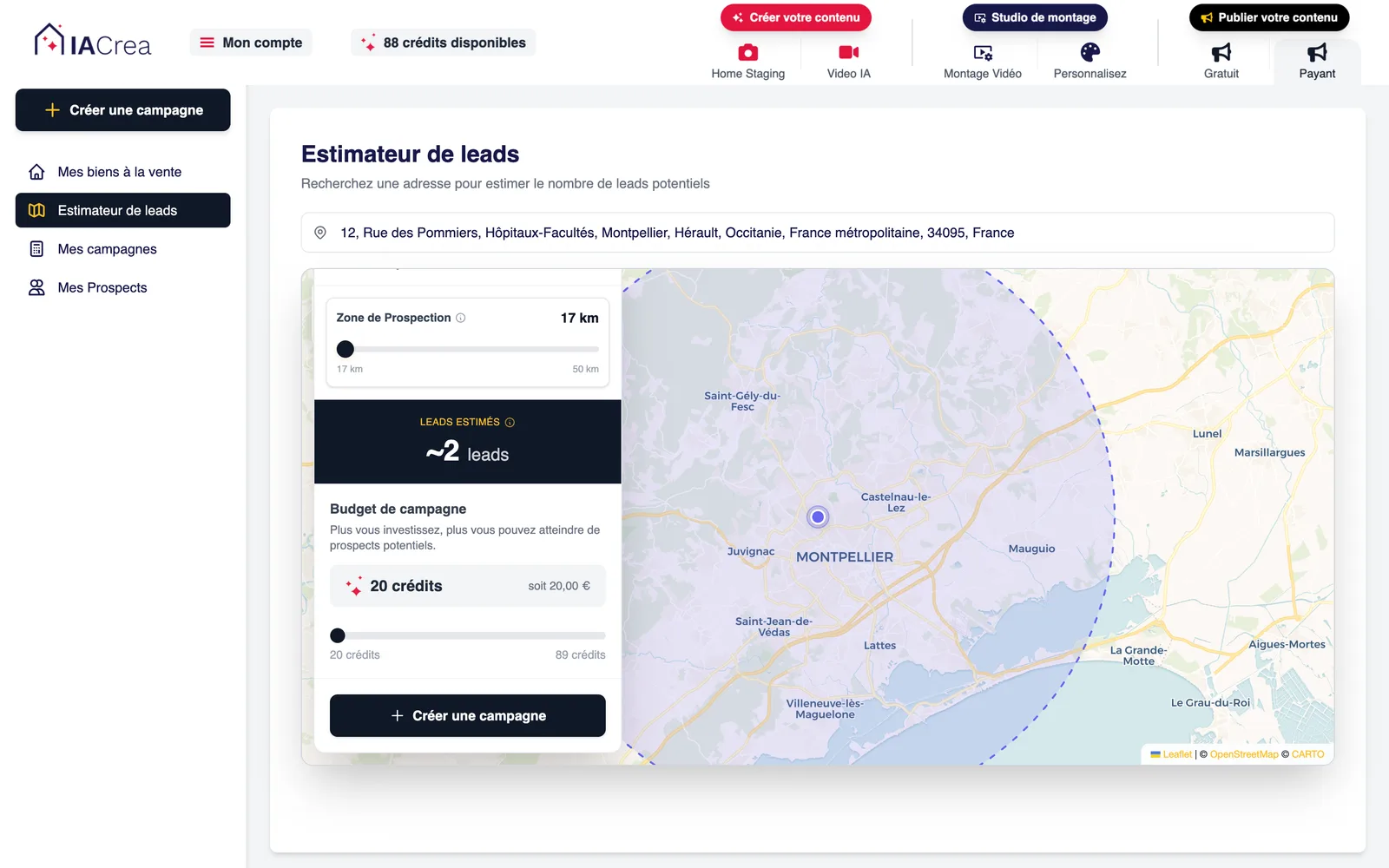 A prospecting area defined around an address, with estimated leads and the campaign budget.
Our page on area-targeted lead generation campaigns explains how it works and the two audiences you can target. A good habit is to run the campaign around the area you just covered with door hangers, so the homeowner sees your name on the doorknob, then on their phone.
Following up on every real estate lead: one tracker, a cadence, the numbers
A contact scribbled on the corner of a flyer and never followed up on is a lost contact, no matter which technique brought it in. Follow-up is the eighth technique, and the one that makes the other seven pay off.
One tracker, six columns
A spreadsheet is enough to start, as long as there's only one. It needs six columns:
| Column | What goes in it |
|---|---|
| Source | March 12 door hanger drop, door knocking on [street], north-side ad campaign, referral from [client] |
| First contact | Date and a one-line summary |
| Plans | The home, the stated timeline, the reason for selling or buying |
| Permission to contact | Channel they agreed to (phone, text, email, mail), date, where permission was given |
| Next action | One action and one date, never blank |
| Status | To qualify, to follow up, appointment set, listing signed, inactive |
On the buyer side, a touring agreement comes before the first showing. That goes in your tracker too: buyers sometimes have a home to sell before they buy.
The follow-up cadence
A follow-up isn't a “just checking in” call. It brings something new: a sale that closed on the street, a shift in neighborhood prices, a buyer looking for that type of home. Set the next action at the end of every conversation, and match the spacing to the timeline: frequent for a sale planned this quarter, further apart for a move that's a year away.
When someone asks not to be contacted anymore, mark them “inactive” that same day and stop, on every channel.
Measure by channel
Three numbers per technique per month are enough: contacts made, listing appointments, listings signed. Ask every new contact the same question (“How did you hear about me?”) and write the answer in the Source column. After a quarter, you'll know which technique really feeds your pipeline in your area, something no national average will tell you. It's also the most reliable answer to the question of how to get listings: follow the channel your own numbers point to. To tie these channels together, our guide to attracting, qualifying and nurturing seller and buyer leads with AI walks through the sequence from campaign to follow-up.
From first contact to the listing appointment
Prospecting isn't judged by the number of contacts but by the number of listings. And the listing is won or lost at the appointment, on two questions the seller has but rarely says out loud: Is this price realistic, and what will you do with my home?
You answer the first with a well-supported CMA, built on comparable sales in the area. You answer the second by showing, not telling. One photo of the main living area, taken with the IACrea photo app when you arrive, is enough to show the seller their own living room furnished with virtual staging.
 Before: the room as the seller knows it.
 After: the same room, as buyers will see it in the listing.
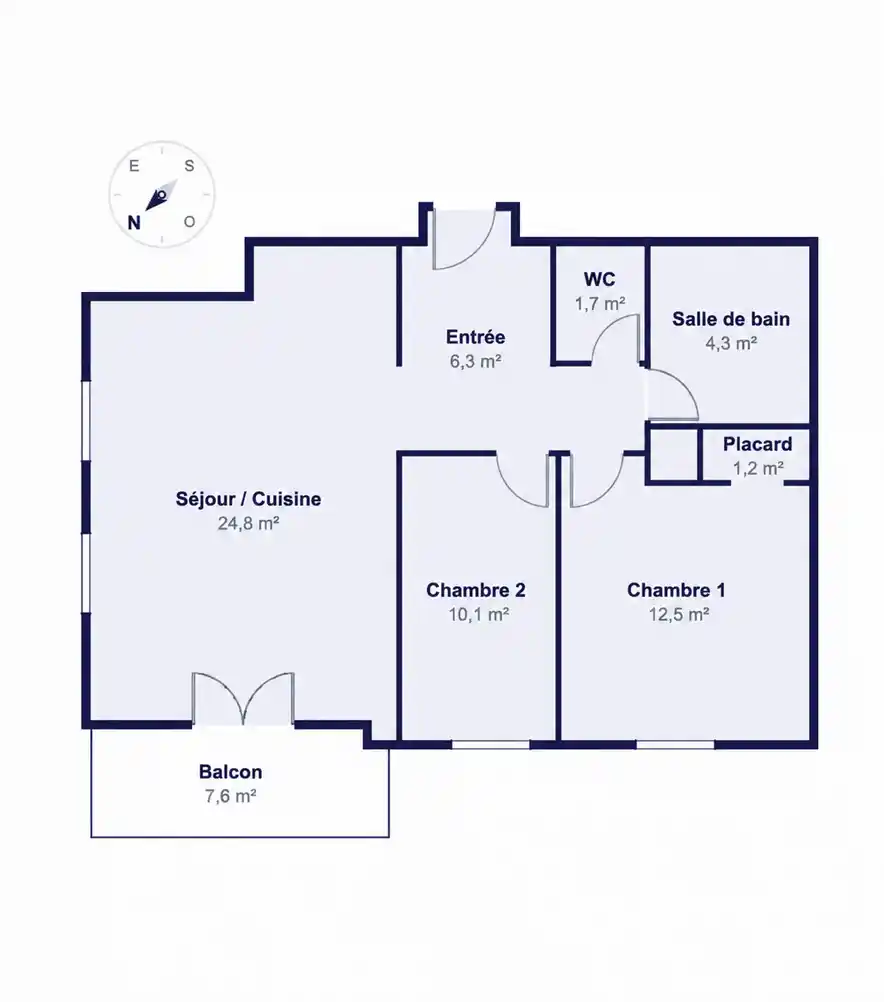
Add the 2D floor plan scanned on site and the listing video, and the seller sees your marketing plan instead of hearing it described. Our page on how to win more listings at the listing appointment walks through this appointment toolkit.
A one-week real estate prospecting plan
Here's an example for a solo agent working one farm area. The times are rough estimates: what matters is that each block is on the calendar and devoted to a single technique.
| Day | Action | Approx. time | What you log |
|---|---|---|---|
| Monday | Database follow-up: contacts who agreed to be called | 1.5 hours | Appointments set, next actions |
| Tuesday | In the field: door hangers or door knocking in part of the farm | 2 hours | Streets covered, responses |
| Wednesday | FSBO and expired listing check, personally addressed letters | 1 hour | Homes spotted, letters sent |
| Thursday | Social media content: a just-sold post, a video | 1 hour | Posts scheduled |
| Friday | Partners and referrals, then the weekly review | 1.5 hours | Contacts, appointments, listings by channel |
A geo-targeted campaign runs in parallel around that week's area. The leads it generates get a call the same day, before anything else.
Three rules keep this plan going. Work the same farm for several months before you switch, because repetition builds name recognition. Don't move a prospecting block for paperwork. And review your three numbers per channel at the end of each month before you change the mix.
FAQ
What are the main real estate prospecting techniques? There are eight: farming with mailers and door hangers, door knocking, FSBO and expired listings, phone calls, social media, referrals, geo-targeted ads and working your own database. No single one is enough on its own: combine two or three in the same farm area and track each month how many listing appointments each one brings in.
Can real estate agents still make cold calls? Yes, within limits. NAR states that real estate professionals must comply with the National Do Not Call Registry for any cold calling, and FTC rules allow calls to a home only between 8 a.m. and 9 p.m. local time. You can call a number on the Registry only in specific cases, such as when you have written permission or the person made an inquiry in the last three months. Autodialed calls and texts need prior consent under the TCPA.
Is door knocking legal for real estate agents? Generally yes, but the rules are local. A city can set permitted hours and require a solicitor's permit, and a posted “No Soliciting” sign means you skip the house. Read your city code and any HOA rules before you start, and leave as soon as someone says no.
What is a qualified real estate lead? It's a homeowner or a buyer whose plans, home and timeline you know, who isn't working with another agent and who has agreed to hear from you again. If any one of those pieces is missing, the contact still needs qualifying and isn't worth an appointment yet.
How much time should you spend on real estate prospecting each week? There's no magic number. What counts is consistency: fixed time blocks, scheduled like appointments, in the same farm area. For each block, log the contacts made and the appointments set, then adjust the mix after a quarter.
Conclusion
Real estate prospecting today is won less on the phone and more on whatever leads a homeowner to raise their hand: a well-targeted door hanger, a steady presence in your farm area, a referral asked for at the right moment, a geo-targeted campaign. Pick two or three techniques, stick with them for several months in the same area and log every contact in a single tracker.
The rest is decided at the appointment. To walk in with images of the seller's own home rather than a brochure, try IACrea for free, then check our pricing to pick the plan that fits your listing volume.
About the author

Co-founder & CEO of IACrea
Pauline Clavelloux is co-founder and CEO of IACrea. In daily contact with real estate agencies and agents, she understands their challenges around visibility, marketing and lead generation. On the blog, she shares actionable strategies on real estate marketing, social media and prospecting in the age of AI.
Related articles

Ready to turn your photos into content that sells?
Join thousands of real estate agents using IACrea to create professional content in seconds.
Try for free →