

In a February 2026 survey of NAR members by Realtors Property Resource (RPR), 82% of real estate agents said they had already brought AI tools into their business. But in NAR's 2026 Realtors Technology Report, generative AI tops the list of tools agents use or plan to use (54%), while marketing automation lags at 34%. The agents who put AI to work across their whole marketing, from photos to lead generation, are pulling ahead, and it already shows in the listings they win.
In 2027, AI real estate marketing is no longer a way to stand out: it's the foundation of an agent's visibility, whether you run a brokerage or work solo. This guide walks through 10 concrete real estate marketing strategies, ranked by impact and ease, to change how you produce marketing without blowing your budget.
What you'll learn in this guide:
- Why real estate marketing is moving to AI in 2027, with the numbers behind it
- 10 concrete strategies, from the simplest to the most advanced
- Traditional marketing vs AI marketing, side by side
- A roadmap to get started this week
Why real estate marketing is shifting to AI in 2027
Competition for each listing is tighter. US existing-home sales fell to 4.06 million in 2024, the lowest annual total since 1995 (NAR), so more agents are chasing fewer transactions. Service quality alone no longer sets you apart: how you present a home and how consistently you show up online have become real selection criteria for sellers.
On the buyer side, the listing itself does the first round of selling. In NAR's 2025 Profile of Home Buyers and Sellers, 81% of recent buyers found listing photos very useful, 77% said the same of detailed property information, and 57% of floor plans. Buyers' agents see it too: 73% rate photos as important to their buyers, and 48% say the same of video (NAR, 2025 Profile of Home Staging).
The equation is simple. Traditional channels (unedited photos, generic posts, door knocking) are losing ground to formats that AI produces and distributes faster, for an audience that already uses AI every day.
The 10 AI real estate marketing strategies to put in place in 2027
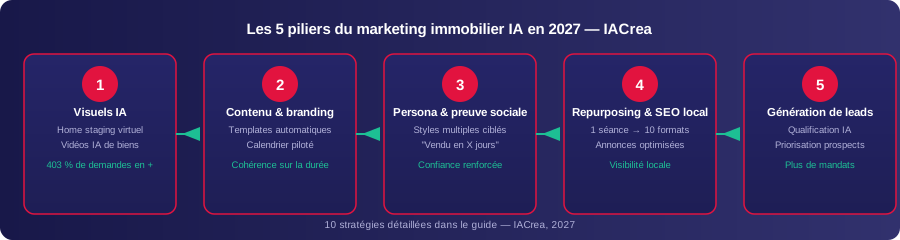 The 10 strategies in this guide, grouped into 5 action pillars
1. Virtual staging on every vacant listing
Every empty or poorly furnished home you list without staging is a missed opportunity: 83% of buyers' agents say staging makes it easier for buyers to picture the property as their future home (NAR, 2025 Profile of Home Staging). Virtual staging turns an empty-room photo into a bright, furnished interior in seconds, for a fraction of the median $1,500 sellers spend on a physical staging service. It's the best impact-to-cost ratio in this guide: use it on 100% of your vacant listings, and label the photos as virtually staged. NAR's Code of Ethics (Article 12) requires a true picture in advertising, and since January 1, 2026, California's AB 723 requires a disclosure and access to the original photo for digitally altered listing photos.
2. AI videos for every listing, no exceptions
Nearly half of buyers' agents (48%) say video matters to their buyers, yet most listings still go live without one. Skipping video means giving up one of the easiest ways to stand out. AI listing video creates an animated clip from a single still photo, so you can give every listing a video without a shoot or any video gear.
3. Automatic branded templates
A consistent feed in your brand colors, on every post and every platform, builds recognition over time. AI template engines apply your brand kit (logo, colors, contact details) to every image they generate, so you never redo the same design work for each home.
4. A data-driven posting calendar
When you post matters as much as what you post. AI content scheduling lets you prepare a week of posts in one session and publish them when your audience is most active. A steady rhythm beats bursts of posts followed by weeks of silence every time.
5. Personalization by buyer persona
The same room staged in Scandinavian, industrial or contemporary style speaks to different buyers. Generating several staging variations for one listing lets you test which style performs best for a given neighborhood and target buyer. An A/B test that would cost a fortune with physical staging becomes free with AI.
6. Automated social proof: “sold in X days”
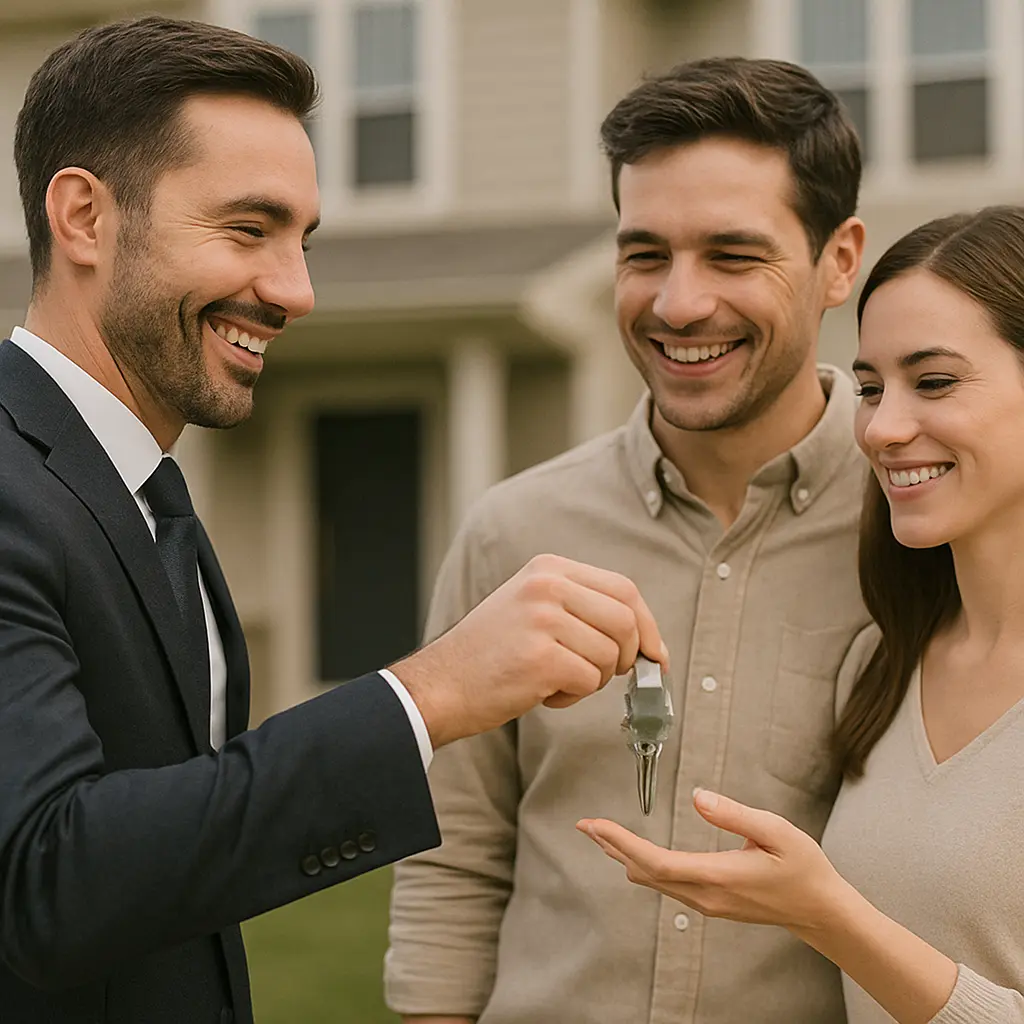 “Sold in X days” posts with a staged photo consistently outperform standard listing posts
A post showing a home “Sold in 12 days at 98% of list price” with a staged photo brings in more inbound contacts than a plain listing post. This kind of social proof reassures future sellers that you close fast and at the right price. Automate it after every closing.
7. Multi-format repurposing from one photo session
A single 10-minute photo session should feed a month of content: Instagram carousel, vertical Reel, Facebook post, LinkedIn image, listing portal banner. AI tools produce every format from one export, so you never reshoot for each platform.
8. Local SEO for your listings and Google Business Profile
Listing descriptions and Google Business Profile content written or rewritten with AI, naturally working in the neighborhood, the city and local landmarks, improve your local search visibility. That matters more and more as buyers start their search in AI assistants and search results that pull in exactly those local details.
9. Virtual staging as a negotiation tool
Beyond the listing, a staged version of an empty home helps you justify the asking price to buyers who struggle to picture the space. Showing a room's real potential during a showing or ahead of negotiations strengthens your pitch, with no physical staging costs.
10. Automated lead generation
AI-powered real estate lead generation identifies and qualifies seller leads from behavioral signals (searches, social interactions, page visits), so you can focus on the contacts most likely to list instead of spreading your prospecting thin.
Traditional marketing vs AI real estate marketing
| Criteria | Traditional marketing | AI real estate marketing |
|---|---|---|
| Image production cost | A median $1,500 for a staging service alone (NAR), plus photographer and videographer | A fraction of that per home |
| Turnaround | Several days (staging, shoot, editing) | Minutes to hours |
| Content per listing | 1 to 2 formats (photos, sometimes video) | 5 to 10 formats (photos, video, carousel, templates) |
| Posting consistency | Depends on how much time the agent has | Scheduled ahead, sustainable over time |
| Personalization by audience | Rare (too expensive) | Multiple variations at no extra cost |
Traditional marketing still has its place for luxury homes, where a professional shoot and physical staging are expected signs of prestige. For the rest of the market, the cost-to-performance ratio leans clearly toward AI.
Roadmap: where to start in 2027
Week 1 — Visual foundations. Apply virtual staging and generate an AI video for all your active listings. These are strategies #1 and #2 in this guide, the ones with the most visible immediate impact.
Week 2 — Consistency and rhythm. Set up your branded templates and your posting calendar. The goal: never post reactively again, and prepare a week of content in a single session.
Week 3 — Differentiation. Test buyer persona personalization on a high-potential listing, and publish your first social proof post about a recent sale.
Week 4 — Scale. Extend multi-format repurposing to every new listing, and evaluate a lead generation tool to prioritize your prospecting.
See real staging and video transformations on our examples page, and compare plans for your listing volume on our pricing page. To go deeper on social media, our guide to AI content for real estate social media covers the full production workflow. And to see where each piece of software fits in the life of a listing, our roundup of the best AI tools for real estate explains what each category of tool does, and what it doesn't.
FAQ
Which AI real estate marketing strategy has the best ROI in 2027? Virtual staging. Sellers who stage physically spend a median $1,500 on a staging service (NAR, 2025 Profile of Home Staging), while virtually staging a photo costs a fraction of that, so you can apply it to every vacant listing. Pair it with an AI listing video and you get attention on listing portals and social media for very little money.
Do you need a big marketing budget to use these strategies in 2027? No. Most of these 10 strategies run on AI tools with affordable monthly plans, with no marketing agency or graphic designer. The real cost is the time it takes to learn the workflow: plan on one to two weeks to build it into your routine, instead of paying for a traditional marketing budget month after month.
Does AI real estate marketing replace human contact with clients? No, it frees up time for it. AI handles image production and repetitive tasks (editing, formatting, scheduling) so you can spend your time on what matters: showings, negotiation and client relationships. The agents who get the best results pair AI production with personal, human follow-up.
How do you measure whether an AI real estate marketing strategy works? Track three numbers: click-through rate on listing portals, engagement on social media (saves and direct messages), and the number of listing leads you generate each month. Raw views and likes are vanity metrics. Direct messages and showing requests are the signals that actually count.
Which AI strategies should a new agent start with? Start with virtual staging and AI videos on your current listings: two levers with immediate impact at almost no cost. Then add content scheduling and branded templates to keep a steady posting rhythm, before moving on to advanced strategies like buyer persona personalization or automated lead generation.
Conclusion
AI real estate marketing in 2027 isn't just one more tool in your kit. It changes the pace and the scale: more formats, produced faster, posted more consistently, for far less than traditional marketing. Rolled out over four weeks, the 10 strategies in this guide cover the whole journey, from staged photos to lead generation.
Start this week with virtual staging and an AI video on your most promising active listing, then try IACrea for free to build the entire workflow described here from a single platform.
About the author

Co-founder & CEO of IACrea
Pauline Clavelloux is co-founder and CEO of IACrea. In daily contact with real estate agencies and agents, she understands their challenges around visibility, marketing and lead generation. On the blog, she shares actionable strategies on real estate marketing, social media and prospecting in the age of AI.
Related articles


Ready to turn your photos into content that sells?
Join thousands of real estate agents using IACrea to create professional content in seconds.
Try for free →