

In 2026, which AI tools are recommended in real estate?
Tools evolve every year, so we’ve compiled the best AI tools for real estate.
The summary table
| # | Tool | Mandate stage | What it really does | Pricing model |
|---|---|---|---|---|
| 1 | IACrea | Marketing | Photos, virtual home staging, 2D plans, videos, social media | Subscription with no commitment |
| 2 | Keyzia | Valuation / documentation | Property data copilote (DPE, DVF, PLU, urban planning) | On quotation |
| 3 | PriceHubble | Valuation | Market assessment and analysis, estimation widget | On quotation (B2B) |
| 4 | RealAdvisor | Prospecting | Public valuation and seller connection | Subscription / lead |
| 5 | SIANA | Follow-up | Administrative copilote for advisors, exchange capture | Subscription, free trial |
| 6 | Noota | Follow-up | Automatic meeting reports, CRM export | Freemium (300 min/month) |
1. IACrea: Visual marketing of the property
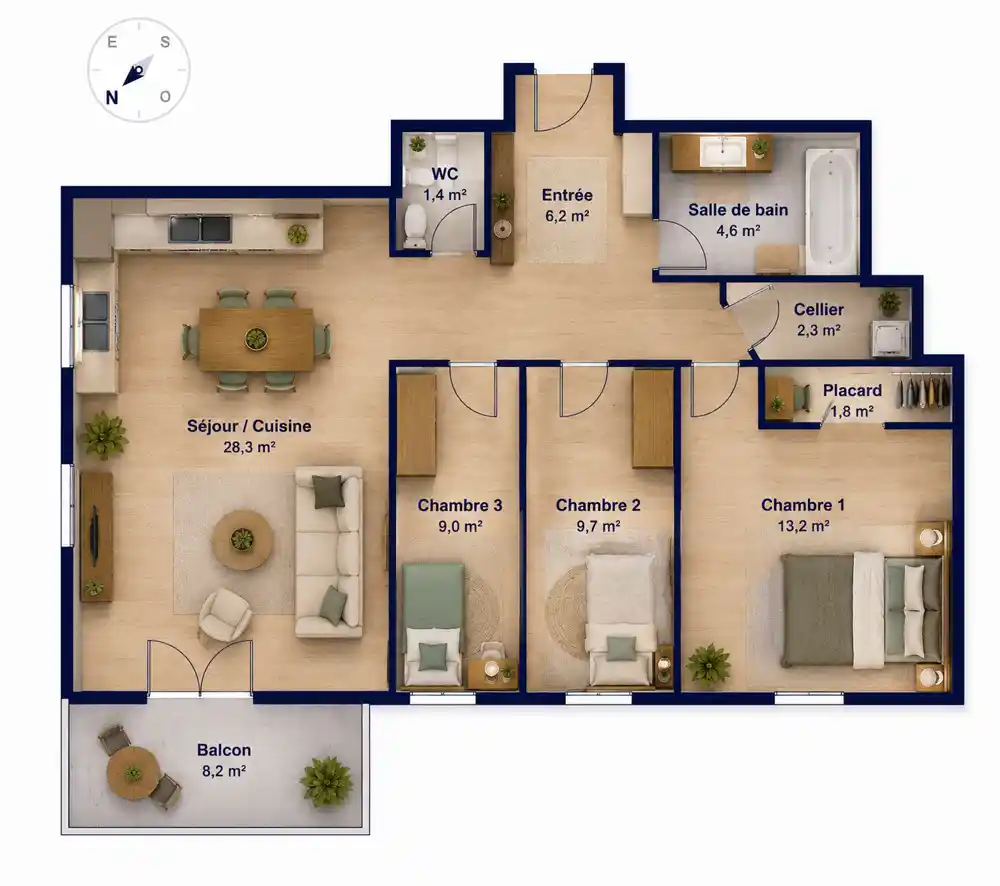
IACrea has become essential for property marketing because it covers the entire chain from visit to publication: photo capture with an app, virtual home staging, decluttering, property video from still photos, then scheduling on social media.

Before: unfinished living room

After virtual renovation
What IACrea does
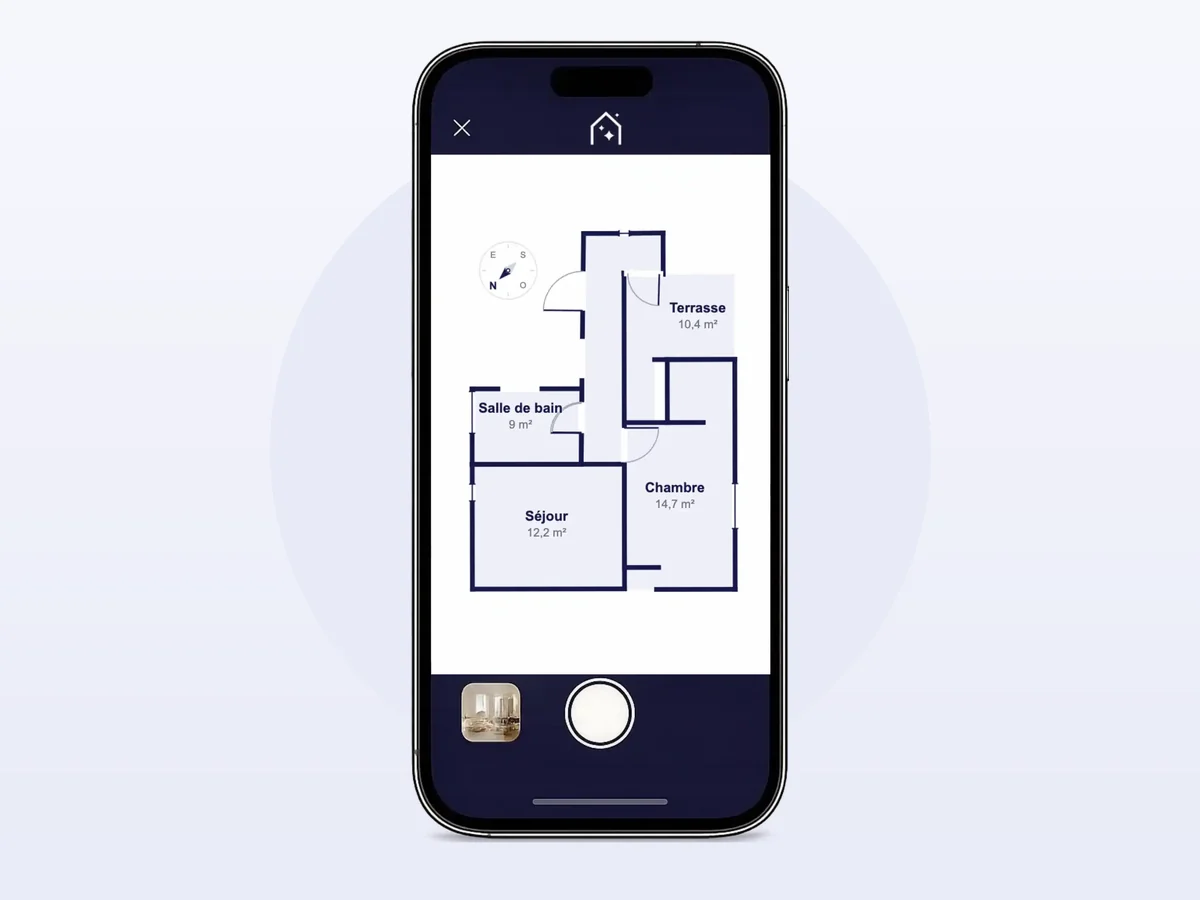
The mobile app enables taking professional-quality photos with automated light and blue sky enhancements.
You can then scan rooms for 2D plans, edit photos with home staging or AI videos.
All photos are synchronized online.
The web platform allows editing plans, retouching photos, creating images, editing videos, AI videos, posting on social media, etc.
IACrea thus enables a seamless and simple flow from photo capture to social media dissemination.
What IACrea does not do
IACrea does not appraise a property, does not read a PLU, and does not fill your CRM. It is a production and visual distribution tool.
2. Keyzia, centralised property data
Keyzia is a French platform aggregating property data into a single conversational interface: energy performance diagnostics, past transactions, cadastral data, local urban plan, green value. The approach claims to be a sovereign multi-agent AI connected to dozens of public sources updated daily.
The benefit for an advisor is tangible. Preparing a seller meeting now involves opening five or six separate services: DVF, Urban Planning Geoportal, DPE observatory, cadastral map, then manually matching results. Asking a natural language question to simplify the research saves most of the prep time.
When it becomes cost-effective
For simple mandates and areas you know well, the added value is marginal. It becomes significant when working on constrained properties: deteriorated co-ownerships, zones with evolving urban plans, thermal sieves subject to Climate Law schedules, or when expanding into new sectors.
What it does not do
It’s not a commercial production tool: it documents the property, it doesn’t stage it. Nor does it replace the contradictory appraisal by the agent; it provides data to support it.
3. PriceHubble: market valuation and analysis
PriceHubble is a B2B benchmark for algorithmic real estate valuation in Europe. The Swiss platform combines statistical modeling, comparable transactions, and neighborhood socio-economic data to produce an estimate and, importantly, insight into the market dynamics of a zone.
Its most used feature in agencies isn't the estimate itself but the estimation widget embedded on agency websites: visitors get an instant range, and the agency collects qualified seller contacts.
Note
Pricing details are not public and are negotiated based on volume, which rules out independent agents just starting out. At this stage, a consumer-oriented estimation tool will provide similar value at no cost.
4. RealAdvisor: capturing sellers upstream
RealAdvisor approaches from the opposite angle: targeting individuals first, offering a free online estimate, then connecting those interested with local agents. Created in Geneva in 2017 and present in France since 2021, it claimed over one million estimates in 2025 and around 2,500 partner agents in France (Journal de l'Agence).
The advantage is an acquisition channel: sellers arrive with a project already formulated, shifting the conversation away from cold prospecting.
What it does not do
You don't own the lead: you purchase it, either financially or in visibility, sharing the sector with other partners. It’s a lead-generation supplement, not a sole acquisition strategy, which is why it pairs well with a AI-assisted real estate prospecting strategy you control end-to-end.
5. SIANA: the administrative copilote for advisors
Launched at the end of 2024, SIANA addresses the less visible part of the profession: data re-entry. The assistant connects to channels an agent actually uses: emails, SMS, messengers, calendar, automatically extracting useful info, cross-referencing public data like DVF or energy diagnostics. After a beta phase with about 300 advisors, it went into production and was deployed across several networks of brokers.
Its promise: cut administrative low-value tasks in half. Verify this on your own organization, but the direction is correct: it's re-entry, not production, that caps the number of mandates an advisor can handle.
What it does not do
The tool captures and structures data; it does not make decisions or produce visuals. It also requires accepting a connection to your personal communication channels: a serious GDPR concern before broader deployment.
6. Noota: automatic meeting report
Noota records an appointment, whether video call, phone, or in person, transcribes it, identifies the speakers, and produces a structured report with action points. The result is directly sent to the CRM or agency collaboration tools. Hosting is French, and the service claims over 95% accuracy in French, with a free plan of 300 minutes per month.
For an advisor, a clear use case is an estimation appointment: what the seller says about their property, schedule, and target price often get lost between the visit and the office back. Getting it as a usable report improves follow-up quality and secures dossier handover to colleagues.
What it does not do
It’s a horizontal tool, not an exclusive real estate solution: it doesn't understand mandate vocabulary or mandatory disclosures. It faithfully transcribes, and you draw conclusions.
A sensible reminder—often overlooked: recording conversations requires informing participants and obtaining their consent. Automatic reports do not exempt from this step.
In what order should you adopt these tools
The common mistake is activating everything at once, on an annual budget. Three months later, two out of five subscriptions are no longer active. The following order minimizes waste.
Step 1: Visuals. This is the component whose effects are visible from the first published listing, and whose adoption doesn't rely on any technical integration. Our before/after examples illustrate the gap between rough photos and polished ones.
Step 2: Reports. Zero or low cost, no change in routine other than pressing a button at the start of an appointment. This component makes the next two usable because it finally feeds your CRM with your own data.
Step 3: Property data. Once you have volume, preparing for appointments becomes a bottleneck. Now is the time to invest in a data copilote or a professional valuation platform.
Step 4: Acquisition. Paid lead channels can only be assessed with rigorous tracking of cost per signed mandate. Without steps 2 and 3, you lack the data to make informed decisions.
The 4 mistakes that cause AI failure in agencies
Confusing tool and method. A virtual home staging tool doesn't sell faster by itself; it's the consistent decision to retouch visuals for each mandate that does. The tool makes the decision feasible; it doesn't replace it.
Stacking subscriptions without a usage plan. Each component should answer a specific question: what task will I eliminate from my schedule this week? If unclear, the tool will be abandoned.
Omitting legal mention of generated visuals. A virtual staging image must be labeled as such. The exact rule and wording are detailed in our guide on legal mentions for virtual home staging. It’s about compliance, not style.
Believing unchecked figures. Including those produced by AI tools. The same discipline applies as with appraisals: track back to the data.
FAQ
What is the best AI tool for a beginner real estate agent?
Choose the one that tackles the most visible bottleneck, which is almost always the quality of listing visuals. A visual marketing tool like IACrea delivers measurable results from the first mandate, with no technical setup or training. Data and copiloting tools come next, when the mandate volume justifies their cost.
Are AI-generated photos allowed in a property listing?
Yes, provided it’s explicitly mentioned. Consumer protection laws prohibit misleading buyers about the property's real state: including a label like "virtually staged photo" on the visual or in the description clears ambiguity.
Does AI replace real estate agents?
No, it shifts value. Automatable tasks such as re-entry, formatting, document research, visual production make up an increasing portion of work time, but contradictory appraisals, negotiation, and seller relations remain human acts. Agents gaining ground are those reinvesting freed time into the field.
Conclusion
There’s no single best AI real estate tool in absolute terms; each tool is relevant for different needs.
To go further on marketing, our guide on AI-assisted real estate marketing strategies details how to sequence visuals, dissemination, and follow-up without wasting your evenings.
About the author

Co-founder & CTO of IACrea
Constance Laborie is co-founder and CTO of IACrea, the AI platform that helps real estate professionals create their visuals — photos, virtual home staging and videos — in seconds. She leads the product and technical development of the platform and writes practical guides on real estate photography, virtual home staging and the use of AI in real estate.
Related articles

Ready to turn your photos into content that sells?
Join thousands of real estate agents using IACrea to create professional content in seconds.
Try for free →